below is the entire graph of function f. graph ( f^{-1} ), the inverse of f.
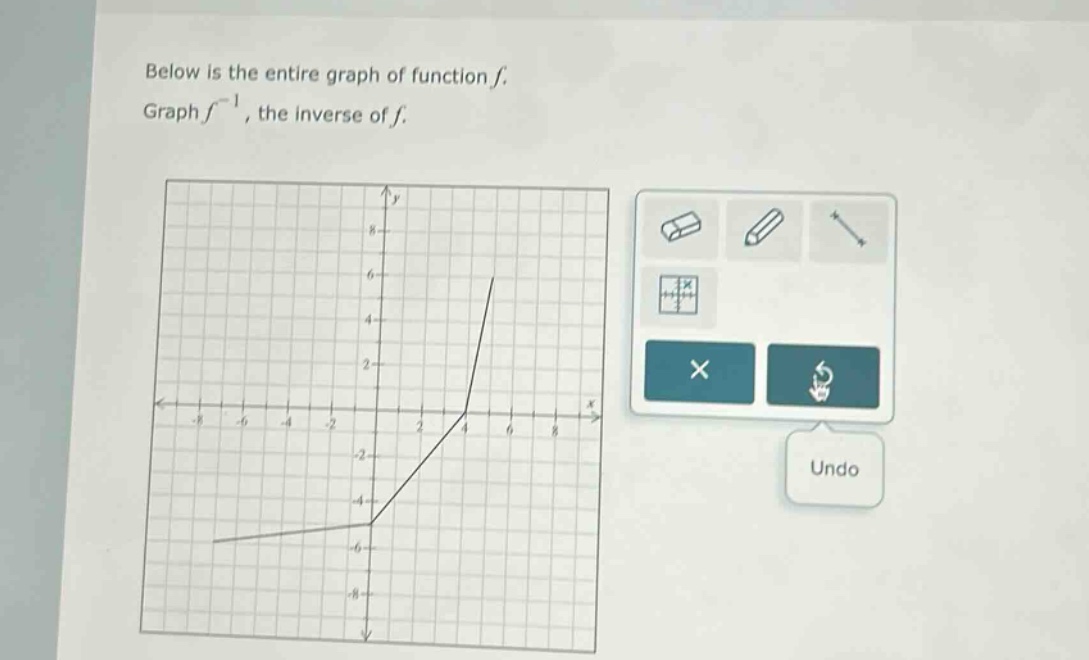
below is the entire graph of function f. graph ( f^{-1} ), the inverse of f.
Answer
Explanation:
Step1: Recall the property of inverse functions
The graph of (y = f^{-1}(x)) is the reflection of the graph of (y = f(x)) about the line (y=x). This means that if ((a,b)) is a point on the graph of (y = f(x)), then ((b,a)) is a point on the graph of (y = f^{-1}(x)).
Step2: Identify key points on (y = f(x))
Let's assume some key points on (y = f(x)). For example, if we can find points like ((x_1,y_1)) from the given graph of (y = f(x)). Suppose we have a point ((x,y)) on (f(x)). After reflection about (y = x), the new point will be ((y,x)).
Step3: Plot the reflected points
Take each point ((x,y)) from the graph of (f(x)), swap its (x) and (y) coordinates to get ((y,x)), and then plot these new points. Connect the plotted points in the same order (based on the original function's behavior) to get the graph of (y = f^{-1}(x)).
Answer:
To graph (f^{-1}), reflect the graph of (f) about the line (y = x) by swapping the (x) and (y) - coordinates of all points on the graph of (f) and then connecting the new points.