on equal intervals, the y - values of a quadratic function have a common second difference. complete…
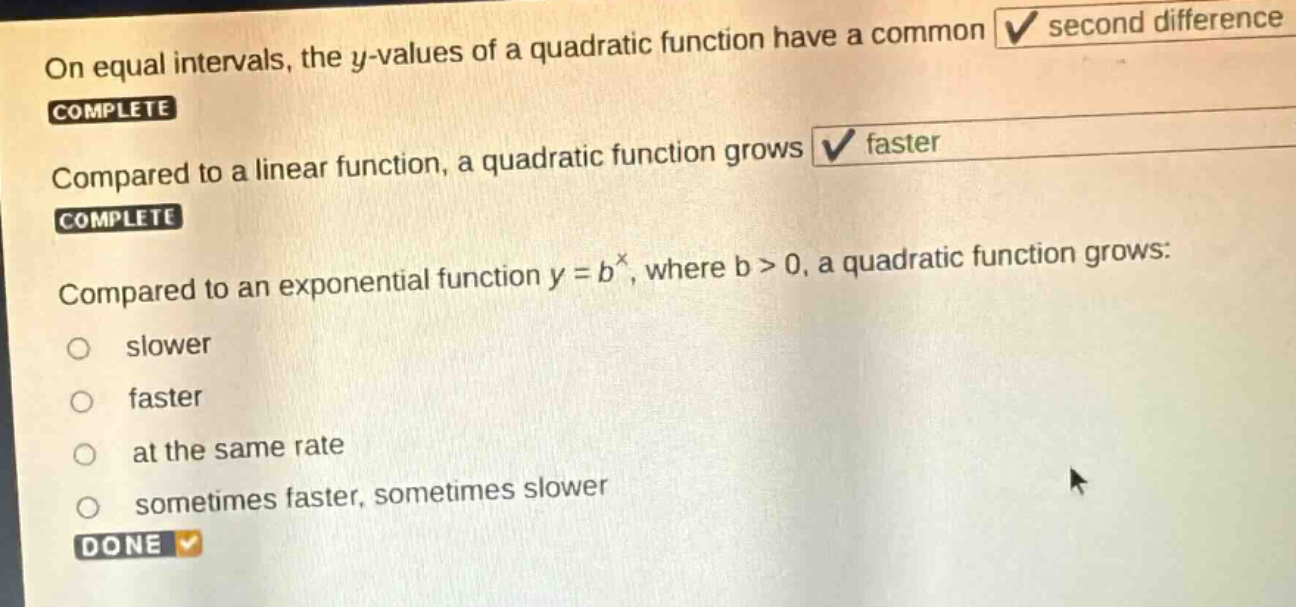
on equal intervals, the y - values of a quadratic function have a common second difference. complete compared to a linear function, a quadratic function grows faster. complete compared to an exponential function y = b^x, where b > 0, a quadratic function grows: slower faster at the same rate sometimes faster, sometimes slower done
Answer
Answer:
A. slower
Explanation:
Step1: Comprender el crecimiento de funciones
Las funciones exponenciales $y = b^{x}$ ($b>0, b\neq1$) crecen más rápidamente que las funciones cuadráticas $y = ax^{2}+bx + c$ ($a\neq0$) a largo plazo. Esto se debe a que en una función exponencial, el factor de crecimiento es proporcional al valor actual de la función, mientras que en una función cuadrática, el crecimiento es de orden polinómico.