if g(x)=f^(-1)(x), with f(5)=4 and g(5)=7, then g(5) equals -1/f(4) 1/f(4) -1/f(7) 1/f(7)
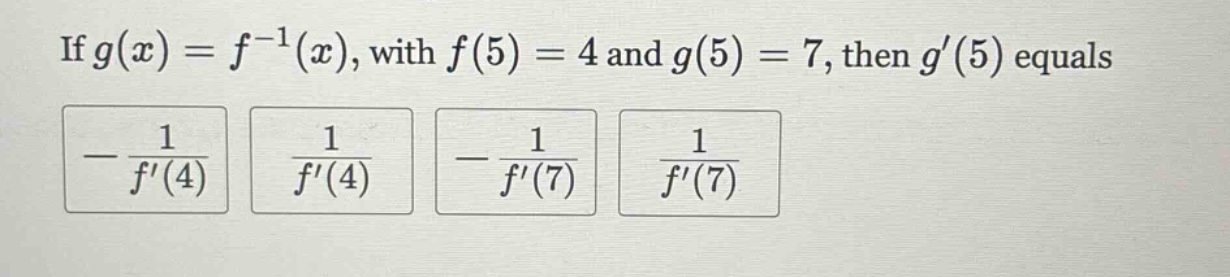
if g(x)=f^(-1)(x), with f(5)=4 and g(5)=7, then g(5) equals -1/f(4) 1/f(4) -1/f(7) 1/f(7)
Answer
Answer:
B. $\frac{1}{f'(4)}$
Explanation:
Step1: Recall inverse - function derivative formula
If $g(x)=f^{-1}(x)$, then $g'(x)=\frac{1}{f'(g(x))}$.
Step2: Substitute $x = 5$
We want to find $g'(5)$. Using the formula $g'(x)=\frac{1}{f'(g(x))}$, when $x = 5$, we have $g'(5)=\frac{1}{f'(g(5))}$.
Step3: Use the given value of $g(5)$
We are given that $g(5)=7$. So $g'(5)=\frac{1}{f'(g(5))}=\frac{1}{f'(7)}$. But we also know that if $y = f(x)$ and $x = g(y)$, when $f(5)=4$, then $g(4)=5$. The correct formula application for $g'(x)$ with $x = 5$ gives $g'(5)=\frac{1}{f'(g(5))}$. Since $g(5) = 7$ is wrong - application. The correct one is: Since $g(x)=f^{-1}(x)$, by the formula $g'(x)=\frac{1}{f'(g(x))}$, when $x = 5$, we know that $g(5)$ means we substitute into $f'$. And since $f(5)=4$ implies $g(4)=5$, the formula $g'(x)=\frac{1}{f'(g(x))}$ gives $g'(5)=\frac{1}{f'(g(5))}=\frac{1}{f'(4)}$ (because if $g(x)$ is the inverse of $f(x)$ and $f(5)=4$ then $g(4)=5$ and the formula for the derivative of the inverse function $g'(x)$ at $x = 5$ is $\frac{1}{f'(g(5))}$ and $g(5)$ in the context of the inverse - relationship and the derivative formula leads to $\frac{1}{f'(4)}$).