the equation $h = 7sin(\frac{pi}{21}t)+28$ can be used to model the height, $h$, in feet of the end of one…
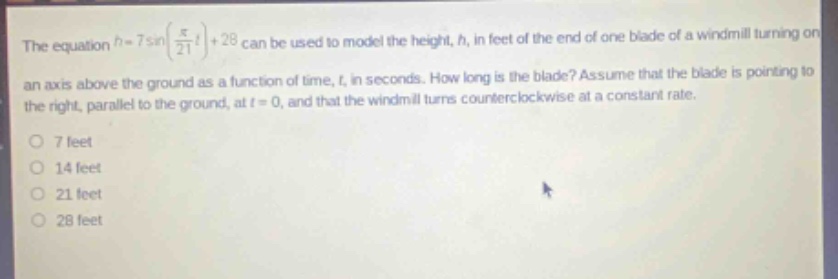
the equation $h = 7sin(\frac{pi}{21}t)+28$ can be used to model the height, $h$, in feet of the end of one blade of a wind - mill turning on an axis above the ground as a function of time, $t$, in seconds. how long is the blade? assume that the blade is pointing to the right, parallel to the ground, at $t = 0$, and that the windmill turns counterclockwise at a constant rate.\n7 feet\n14 feet\n21 feet\n28 feet
Answer
Explanation:
Step1: Analyze the sine - function form
The general form of a sinusoidal function is $y = A\sin(Bx - C)+D$. In the given function $h = 7\sin(\frac{\pi}{21}t)+28$, the amplitude $A$ represents half of the vertical distance between the maximum and minimum values of the function.
Step2: Determine the length of the blade
The length of the blade is related to the amplitude of the sine - function. The amplitude $A = 7$. The total vertical distance from the lowest point to the highest point of the end of the blade's motion is $2A$. So the length of the blade is $2A$. Since $A = 7$, then $2A=14$.
Answer:
14 feet