the equation $h = 7sinleft(\frac{pi}{21}t\right)+28$ can be used to model the height, $h$, in feet of the…
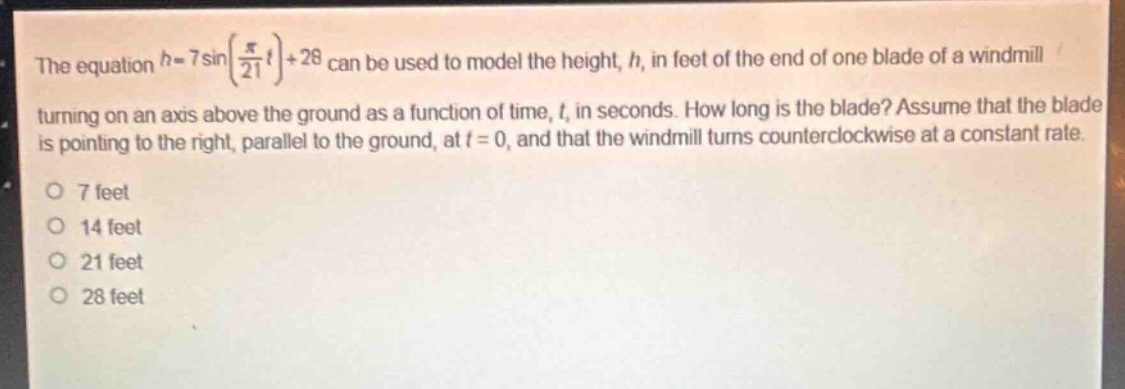
the equation $h = 7sinleft(\frac{pi}{21}t\right)+28$ can be used to model the height, $h$, in feet of the end of one blade of a windmill turning on an axis above the ground as a function of time, $t$, in seconds. how long is the blade? assume that the blade is pointing to the right, parallel to the ground, at $t = 0$, and that the windmill turns counterclockwise at a constant rate.\n7 feet\n14 feet\n21 feet\n28 feet
Answer
Answer:
A. 7 feet
Explanation:
Step1: Recall sine - function properties
The general form of a sine - function is (y = A\sin(Bx - C)+D). In the given equation (h = 7\sin(\frac{\pi}{21}t)+28), the amplitude (A) represents the maximum displacement from the mid - line. The height of the end of the windmill blade is modeled by a sine function. The mid - height of the blade's motion is (h = 28) (the vertical shift (D)). The amplitude (A = 7).
Step2: Relate amplitude to blade length
When the blade is rotating, the amplitude of the sine function that models the height of the end of the blade represents the length of the blade. This is because the maximum deviation of the end of the blade from its mid - height position (when it is horizontal) is equal to the length of the blade. So the length of the blade is 7 feet.