which equation describes a rational function with x - intercepts at - 4 and 2, a vertical asymptote at x = 1…
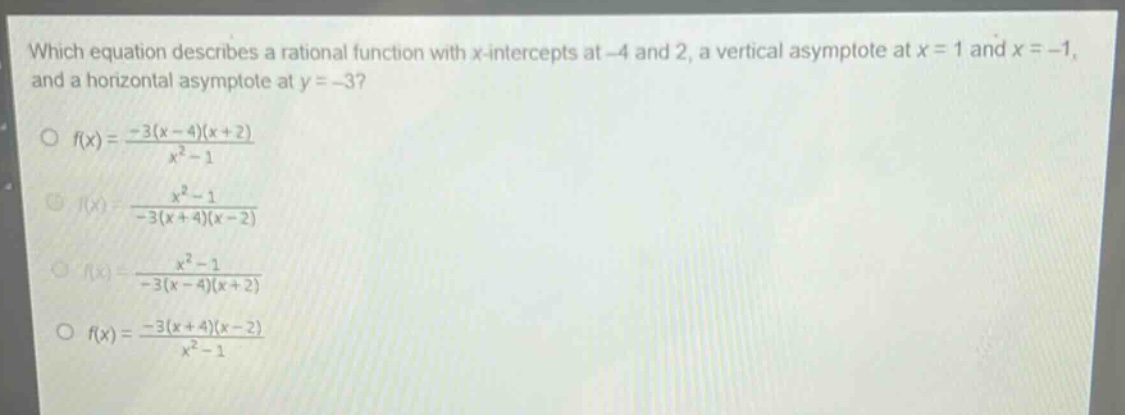
which equation describes a rational function with x - intercepts at - 4 and 2, a vertical asymptote at x = 1 and x=-1, and a horizontal asymptote at y = - 3?\n f(x)=\frac{-3(x - 4)(x + 2)}{x^{2}-1}\n f(x)=\frac{x^{2}-1}{-3(x + 4)(x - 2)}\n f(x)=\frac{x^{2}-1}{-3(x - 4)(x + 2)}\n f(x)=\frac{-3(x + 4)(x - 2)}{x^{2}-1}
Answer
Answer:
D. $f(x)=\frac{-3(x + 4)(x - 2)}{x^{2}-1}$
Explanation:
Step1: Recall x - intercept rule
The x - intercepts of a rational function $y=\frac{N(x)}{D(x)}$ occur when $N(x)=0$. If the x - intercepts are at $x = - 4$ and $x = 2$, then the numerator $N(x)$ must have factors of $(x + 4)$ and $(x - 2)$.
Step2: Recall vertical - asymptote rule
Vertical asymptotes of a rational function $y=\frac{N(x)}{D(x)}$ occur when $D(x)=0$. If the vertical asymptotes are at $x = 1$ and $x=-1$, then $D(x)=(x - 1)(x + 1)=x^{2}-1$.
Step3: Recall horizontal - asymptote rule
For a rational function $y=\frac{a_nx^n+\cdots}{b_mx^m+\cdots}$, if $n = m$, the horizontal asymptote is $y=\frac{a_n}{b_m}$. Here, we want a horizontal asymptote at $y=-3$. A rational function of the form $y=\frac{-3(x + 4)(x - 2)}{x^{2}-1}$ satisfies all the given conditions.