which equation is represented by the graph below?\no y = ln x - 3\no y = ln x - 4\no y = e^x - 3\no y = e^x…
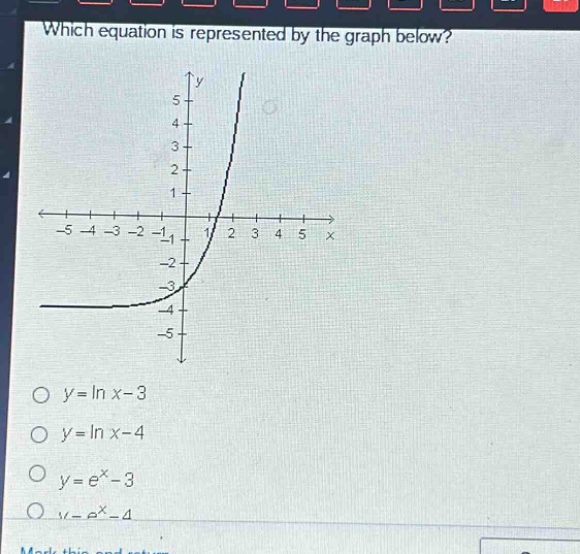
which equation is represented by the graph below?\no y = ln x - 3\no y = ln x - 4\no y = e^x - 3\no y = e^x - 4
Answer
Explanation:
Step1: Recall key - points of exponential and logarithmic functions
The natural logarithm function (y = \ln x) has a vertical asymptote at (x = 0) and passes through the point ((1,0)). The exponential function (y=e^{x}) has a (y) - intercept at ((0,1)).
Step2: Analyze the (y) - intercept of the given graph
The graph has a (y) - intercept at ((0, - 3)). For (y=\ln x-3), when (x = 1), (y=\ln(1)-3=0 - 3=-3), but (\ln x) is not defined for (x\leqslant0) and the graph seems to be defined for (x = 0). For (y=\ln x - 4), when (x = 1), (y=\ln(1)-4=-4). For (y = e^{x}-3), when (x = 0), (y=e^{0}-3=1 - 3=-2). For (y=e^{x}-4), when (x = 0), (y=e^{0}-4=1 - 4=-3). Also, the general shape of the graph is similar to the exponential function (y = e^{x}) which is an increasing function for all real (x).
Answer:
(y = e^{x}-4)