7. which equation represents the graph shown? (a) y = cos 1/2(x - 45°) - 2 (b) y = cos 1/2(x - 135°) - 2 (c)…
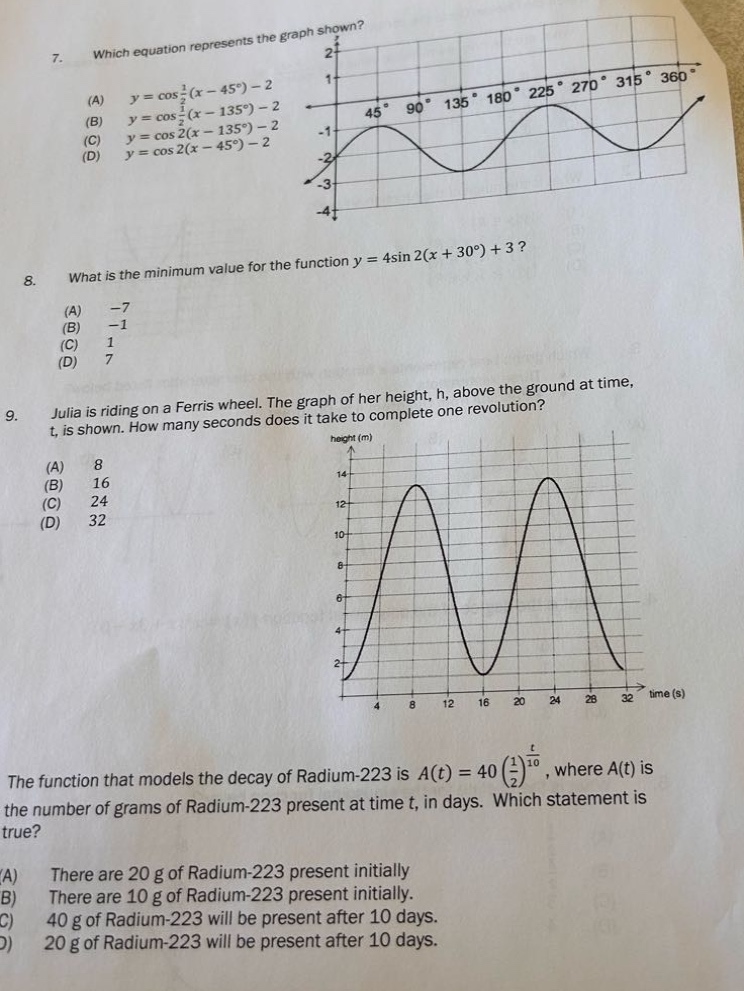
7. which equation represents the graph shown? (a) y = cos 1/2(x - 45°) - 2 (b) y = cos 1/2(x - 135°) - 2 (c) y = cos 2(x - 135°) - 2 (d) y = cos 2(x - 45°) - 2 8. what is the minimum value for the function y = 4sin 2(x + 30°) + 3? (a) -7 (b) -1 (c) 1 (d) 7 9. julia is riding on a ferris wheel. the graph of her height, h, above the ground at time, t, is shown. how many seconds does it take to complete one revolution? (a) 8 (b) 16 (c) 24 (d) 32 the function that models the decay of radium - 223 is a(t)=40(1/2)^(t/10), where a(t) is the number of grams of radium - 223 present at time t, in days. which statement is true? (a) there are 20 g of radium - 223 present initially. (b) there are 10 g of radium - 223 present initially. (c) 40 g of radium - 223 will be present after 10 days. (d) 20 g of radium - 223 will be present after 10 days.
Answer
Question 7
Explanation:
Step1: Recall general cosine - function form
The general form of a cosine function is $y = A\cos(B(x - C))+D$, where $A$ is the amplitude, $B$ affects the period ($T=\frac{360^{\circ}}{|B|}$), $C$ is the phase - shift, and $D$ is the vertical shift.
Step2: Analyze the period of the given graph
The period of the given graph is $180^{\circ}$. Using the period formula $T = \frac{360^{\circ}}{|B|}$, if $T = 180^{\circ}$, then $180^{\circ}=\frac{360^{\circ}}{|B|}$, so $|B| = 2$.
Step3: Analyze the phase - shift
The graph is shifted to the right. Looking at the key points, the phase - shift $C = 45^{\circ}$. The vertical shift $D=-2$. The function is $y=\cos(2(x - 45^{\circ}))-2$.
Answer:
D. $y=\cos(2(x - 45^{\circ}))-2$
Question 8
Explanation:
Step1: Recall the range of the sine function
The range of the sine function $y = \sin(u)$ is $[- 1,1]$. For the function $y = 4\sin(2(x + 30^{\circ}))+3$, let $u = 2(x + 30^{\circ})$.
Step2: Find the minimum value of the sine part
The minimum value of $\sin(2(x + 30^{\circ}))$ is $-1$.
Step3: Calculate the minimum value of the whole function
Substitute $\sin(2(x + 30^{\circ}))=-1$ into $y = 4\sin(2(x + 30^{\circ}))+3$. Then $y=4\times(-1)+3=-4 + 3=-1$.
Answer:
B. $-1$
Question 9
Explanation:
Step1: Identify the period of the Ferris - wheel height graph
The period of a periodic function is the time it takes to complete one full cycle. Looking at the graph of the height of Julia on the Ferris - wheel as a function of time, we can see that one full revolution (one complete cycle of the graph) occurs from $t = 0$ to $t = 32$ seconds.
Answer:
D. $32$
Question 10
Explanation:
Step1: Find the initial amount of Radium - 223
To find the initial amount, substitute $t = 0$ into the function $A(t)=40(\frac{1}{2})^{\frac{t}{10}}$. When $t = 0$, $A(0)=40(\frac{1}{2})^0=40\times1 = 40$ g.
Step2: Find the amount after 10 days
Substitute $t = 10$ into the function $A(t)=40(\frac{1}{2})^{\frac{t}{10}}$. Then $A(10)=40(\frac{1}{2})^{\frac{10}{10}}=40\times\frac{1}{2}=20$ g.
Answer:
D. 20 g of Radium - 223 will be present after 10 days.