essential question what are the characteristics of the graphs of the sine and cosine functions?\n1…
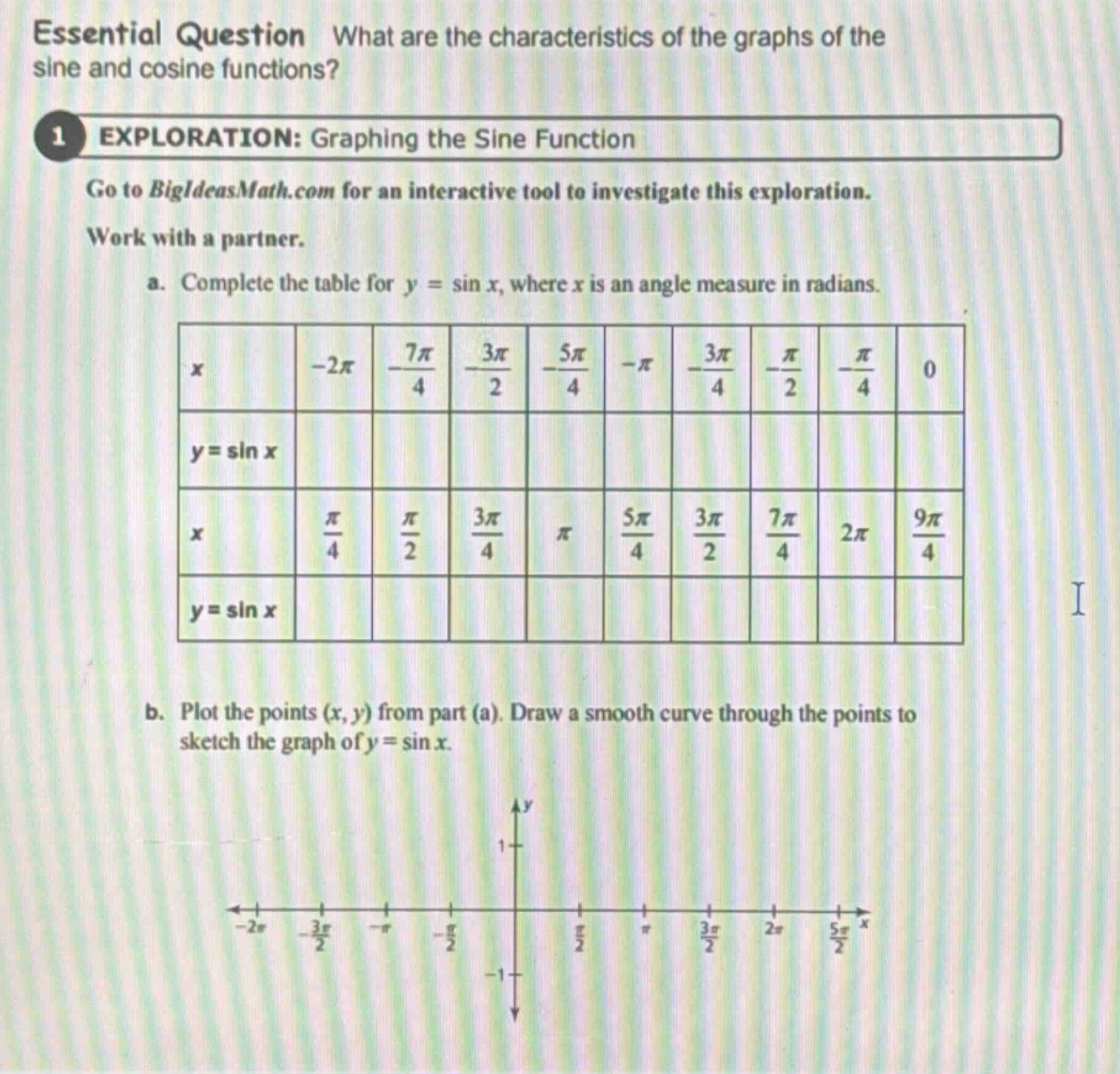
essential question what are the characteristics of the graphs of the sine and cosine functions?\n1 exploration: graphing the sine function\ngo to bigideasmath.com for an interactive tool to investigate this exploration.\nwork with a partner.\na. complete the table for (y = sin x), where (x) is an angle measure in radians.\n| (x) | (-2pi) | (\frac{7pi}{4}) | (\frac{3pi}{2}) | (-\frac{5pi}{4}) | (-pi) | (-\frac{3pi}{4}) | (-\frac{pi}{2}) | (-\frac{pi}{4}) | (0) |\n| (y = sin x) | | | | | | | | | |\n| (x) | (\frac{pi}{4}) | (\frac{pi}{2}) | (\frac{3pi}{4}) | (pi) | (\frac{5pi}{4}) | (\frac{3pi}{2}) | (\frac{7pi}{4}) | (2pi) | (\frac{9pi}{4}) |\n| (y = sin x) | | | | | | | | | |\nb. plot the points ((x,y)) from part (a). draw a smooth curve through the points to sketch the graph of (y=sin x).
Answer
Explanation:
Step1: Recall sine - function values
Use the unit - circle definition of the sine function $\sin x = y$ - coordinate of the point on the unit circle corresponding to the angle $x$.
Step2: Calculate values for $x=-2\pi$
Since $\sin(-2\pi)=0$ (because the angle $- 2\pi$ corresponds to the point $(1,0)$ on the unit circle).
Step3: Calculate values for $x =-\frac{7\pi}{4}$
$\sin(-\frac{7\pi}{4})=\frac{\sqrt{2}}{2}$, as the angle $-\frac{7\pi}{4}$ is equivalent to $\frac{\pi}{4}$ in the positive direction and $\sin\frac{\pi}{4}=\frac{\sqrt{2}}{2}$.
Step4: Calculate values for $x =-\frac{3\pi}{2}$
$\sin(-\frac{3\pi}{2}) = 1$, because the angle $-\frac{3\pi}{2}$ corresponds to the point $(0,1)$ on the unit circle.
Step5: Calculate values for $x =-\frac{5\pi}{4}$
$\sin(-\frac{5\pi}{4})=\frac{\sqrt{2}}{2}$, since $-\frac{5\pi}{4}$ is equivalent to $\frac{3\pi}{4}$ in the positive direction and $\sin\frac{3\pi}{4}=\frac{\sqrt{2}}{2}$.
Step6: Calculate values for $x =-\pi$
$\sin(-\pi)=0$, as the angle $-\pi$ corresponds to the point $(-1,0)$ on the unit circle.
Step7: Calculate values for $x =-\frac{3\pi}{4}$
$\sin(-\frac{3\pi}{4})=-\frac{\sqrt{2}}{2}$, because $-\frac{3\pi}{4}$ is equivalent to $\frac{5\pi}{4}$ in the positive direction and $\sin\frac{5\pi}{4}=-\frac{\sqrt{2}}{2}$.
Step8: Calculate values for $x =-\frac{\pi}{2}$
$\sin(-\frac{\pi}{2})=-1$, since the angle $-\frac{\pi}{2}$ corresponds to the point $(0, - 1)$ on the unit circle.
Step9: Calculate values for $x =-\frac{\pi}{4}$
$\sin(-\frac{\pi}{4})=-\frac{\sqrt{2}}{2}$, as $-\frac{\pi}{4}$ is equivalent to $\frac{7\pi}{4}$ in the positive direction and $\sin\frac{7\pi}{4}=-\frac{\sqrt{2}}{2}$.
Step10: Calculate values for $x = 0$
$\sin(0)=0$, corresponding to the point $(1,0)$ on the unit circle.
Step11: Calculate values for $x=\frac{\pi}{4}$
$\sin\frac{\pi}{4}=\frac{\sqrt{2}}{2}$.
Step12: Calculate values for $x=\frac{\pi}{2}$
$\sin\frac{\pi}{2}=1$.
Step13: Calculate values for $x=\frac{3\pi}{4}$
$\sin\frac{3\pi}{4}=\frac{\sqrt{2}}{2}$.
Step14: Calculate values for $x=\pi$
$\sin(\pi)=0$.
Step15: Calculate values for $x=\frac{5\pi}{4}$
$\sin\frac{5\pi}{4}=-\frac{\sqrt{2}}{2}$.
Step16: Calculate values for $x=\frac{3\pi}{2}$
$\sin\frac{3\pi}{2}=-1$.
Step17: Calculate values for $x=\frac{7\pi}{4}$
$\sin\frac{7\pi}{4}=-\frac{\sqrt{2}}{2}$.
Step18: Calculate values for $x = 2\pi$
$\sin(2\pi)=0$.
Step19: Calculate values for $x=\frac{9\pi}{4}$
$\sin\frac{9\pi}{4}=\frac{\sqrt{2}}{2}$, since $\frac{9\pi}{4}=2\pi+\frac{\pi}{4}$ and $\sin(2\pi +\alpha)=\sin\alpha$.
The completed table:
| $x$ | $-2\pi$ | $-\frac{7\pi}{4}$ | $-\frac{3\pi}{2}$ | $-\frac{5\pi}{4}$ | $-\pi$ | $-\frac{3\pi}{4}$ | $-\frac{\pi}{2}$ | $-\frac{\pi}{4}$ | $0$ | $\frac{\pi}{4}$ | $\frac{\pi}{2}$ | $\frac{3\pi}{4}$ | $\pi$ | $\frac{5\pi}{4}$ | $\frac{3\pi}{2}$ | $\frac{7\pi}{4}$ | $2\pi$ | $\frac{9\pi}{4}$ |
|---|---|---|---|---|---|---|---|---|---|---|---|---|---|---|---|---|---|---|
| $y = \sin x$ | $0$ | $\frac{\sqrt{2}}{2}$ | $1$ | $\frac{\sqrt{2}}{2}$ | $0$ | $-\frac{\sqrt{2}}{2}$ | $-1$ | $-\frac{\sqrt{2}}{2}$ | $0$ | $\frac{\sqrt{2}}{2}$ | $1$ | $\frac{\sqrt{2}}{2}$ | $0$ | $-\frac{\sqrt{2}}{2}$ | $-1$ | $-\frac{\sqrt{2}}{2}$ | $0$ | $\frac{\sqrt{2}}{2}$ |
For part (b), after plotting the points $(x,y)$ from the table on the $x - y$ coordinate plane, we can draw a smooth curve that oscillates between $y=-1$ and $y = 1$, has a period of $2\pi$, and passes through the origin. The curve is symmetric about the origin (since $y = \sin x$ is an odd function, $\sin(-x)=-\sin x$).
Answer:
The completed table is shown above and the graph of $y = \sin x$ is a smooth - oscillating curve between $y=-1$ and $y = 1$ with period $2\pi$ passing through the origin.