estimate the area under the graph of f(x)=3x³ between x = 0 and x = 4 using each finite approximation below…
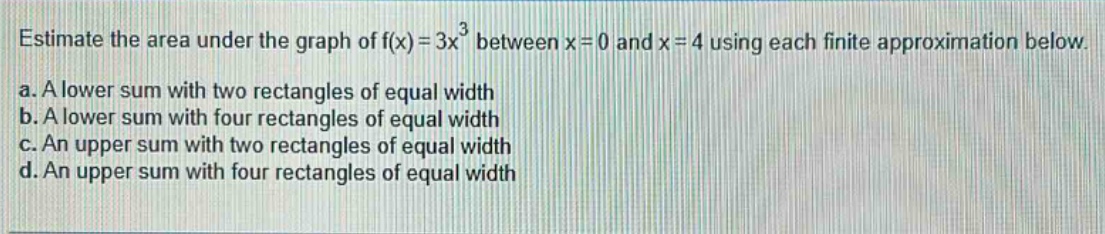
estimate the area under the graph of f(x)=3x³ between x = 0 and x = 4 using each finite approximation below. a. a lower sum with two rectangles of equal width b. a lower sum with four rectangles of equal width c. an upper sum with two rectangles of equal width d. an upper sum with four rectangles of equal width
Answer
Explanation:
Step1: Calculate the width of rectangles
The interval is $[0,4]$. For $n$ rectangles, the width $\Delta x=\frac{b - a}{n}$, where $a = 0$, $b = 4$.
Step2: For lower - sum with 2 rectangles ($n = 2$)
$\Delta x=\frac{4-0}{2}=2$. The sub - intervals are $[0,2]$ and $[2,4]$. For a lower sum of $y = 3x^{3}$, we evaluate the function at the left - hand endpoints. $f(0)=3\times0^{3}=0$, $f(2)=3\times2^{3}=3\times8 = 24$. The lower sum $L_2=\sum_{i = 0}^{1}f(x_i)\Delta x=f(0)\times2+f(2)\times2=(0 + 24)\times2=48$.
Step3: For lower - sum with 4 rectangles ($n = 4$)
$\Delta x=\frac{4-0}{4}=1$. The sub - intervals are $[0,1]$, $[1,2]$, $[2,3]$, $[3,4]$. We evaluate the function at the left - hand endpoints. $f(0)=0$, $f(1)=3\times1^{3}=3$, $f(2)=24$, $f(3)=3\times3^{3}=81$. The lower sum $L_4=\sum_{i = 0}^{3}f(x_i)\Delta x=(0 + 3+24 + 81)\times1=108$.
Step4: For upper - sum with 2 rectangles ($n = 2$)
$\Delta x = 2$. The sub - intervals are $[0,2]$ and $[2,4]$. For an upper sum of $y = 3x^{3}$, we evaluate the function at the right - hand endpoints. $f(2)=24$, $f(4)=3\times4^{3}=3\times64 = 192$. The upper sum $U_2=\sum_{i = 1}^{2}f(x_i)\Delta x=f(2)\times2+f(4)\times2=(24 + 192)\times2=432$.
Step5: For upper - sum with 4 rectangles ($n = 4$)
$\Delta x=1$. The sub - intervals are $[0,1]$, $[1,2]$, $[2,3]$, $[3,4]$. We evaluate the function at the right - hand endpoints. $f(1)=3$, $f(2)=24$, $f(3)=81$, $f(4)=192$. The upper sum $U_4=\sum_{i = 1}^{4}f(x_i)\Delta x=(3 + 24+81 + 192)\times1=300$.
Answer:
a. 48 b. 108 c. 432 d. 300