estimate the value of the definite integral \n\n int_{2}^{8} \frac{1}{x} dx \n\nby computing left - hand and…
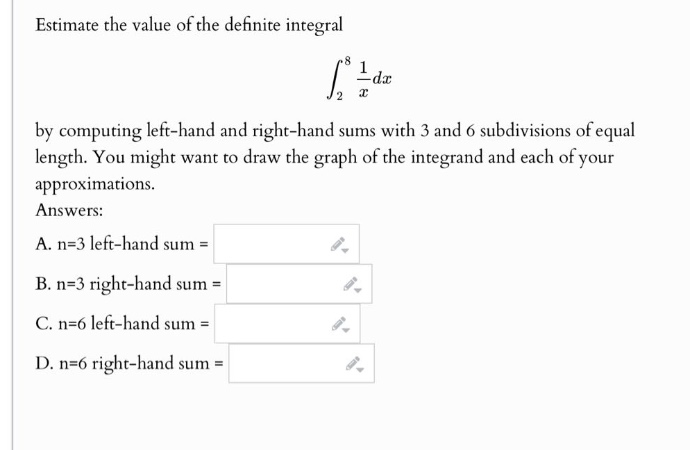
estimate the value of the definite integral \n\n int_{2}^{8} \frac{1}{x} dx \n\nby computing left - hand and right - hand sums with 3 and 6 subdivisions of equal length. you might want to draw the graph of the integrand and each of your approximations.\nanswers:\na. n = 3 left - hand sum =\nb. n = 3 right - hand sum =\nc. n = 6 left - hand sum =\nd. n = 6 right - hand sum =
Answer
Explanation:
Step1: Calculate the width of sub - intervals
The interval is $[a,b]=[2,8]$. The width of a sub - interval $\Delta x=\frac{b - a}{n}$. For $n = 3$, $\Delta x=\frac{8 - 2}{3}=2$. The sub - intervals are $[2,4]$, $[4,6]$, $[6,8]$. For $n = 6$, $\Delta x=\frac{8 - 2}{6}=1$. The sub - intervals are $[2,3]$, $[3,4]$, $[4,5]$, $[5,6]$, $[6,7]$, $[7,8]$.
Step2: Calculate left - hand sum for $n = 3$
The left - hand sum $L_3=\sum_{i = 0}^{2}f(x_i)\Delta x$, where $x_i=a + i\Delta x$. $x_0 = 2$, $x_1 = 4$, $x_2 = 6$, $f(x)=\frac{1}{x}$. $L_3=f(2)\times2+f(4)\times2+f(6)\times2=\left(\frac{1}{2}+\frac{1}{4}+\frac{1}{6}\right)\times2=\left(\frac{6 + 3+2}{12}\right)\times2=\frac{11}{6}\times2=\frac{11}{3}\approx3.67$.
Step3: Calculate right - hand sum for $n = 3$
The right - hand sum $R_3=\sum_{i = 1}^{3}f(x_i)\Delta x$, where $x_i=a + i\Delta x$. $x_1 = 4$, $x_2 = 6$, $x_3 = 8$. $R_3=f(4)\times2+f(6)\times2+f(8)\times2=\left(\frac{1}{4}+\frac{1}{6}+\frac{1}{8}\right)\times2=\left(\frac{6 + 4+3}{24}\right)\times2=\frac{13}{24}\times2=\frac{13}{12}\approx1.08$.
Step4: Calculate left - hand sum for $n = 6$
The left - hand sum $L_6=\sum_{i = 0}^{5}f(x_i)\Delta x$, where $x_i=a + i\Delta x$. $x_0 = 2$, $x_1 = 3$, $x_2 = 4$, $x_3 = 5$, $x_4 = 6$, $x_5 = 7$. $L_6=f(2)\times1+f(3)\times1+f(4)\times1+f(5)\times1+f(6)\times1+f(7)\times1=\frac{1}{2}+\frac{1}{3}+\frac{1}{4}+\frac{1}{5}+\frac{1}{6}+\frac{1}{7}=\frac{210 + 140+105 + 84+70 + 60}{420}=\frac{669}{420}\approx1.59$.
Step5: Calculate right - hand sum for $n = 6$
The right - hand sum $R_6=\sum_{i = 1}^{6}f(x_i)\Delta x$, where $x_i=a + i\Delta x$. $x_1 = 3$, $x_2 = 4$, $x_3 = 5$, $x_4 = 6$, $x_5 = 7$, $x_6 = 8$. $R_6=f(3)\times1+f(4)\times1+f(5)\times1+f(6)\times1+f(7)\times1+f(8)\times1=\frac{1}{3}+\frac{1}{4}+\frac{1}{5}+\frac{1}{6}+\frac{1}{7}+\frac{1}{8}=\frac{280+210 + 168+140+120+105}{840}=\frac{1023}{840}\approx1.22$.
Answer:
A. $\frac{11}{3}$ B. $\frac{13}{12}$ C. $\frac{669}{420}$ D. $\frac{1023}{840}$