estimate the volume of the solid that lies above the square r = 0, 2 × 0, 2 and below the elliptical…
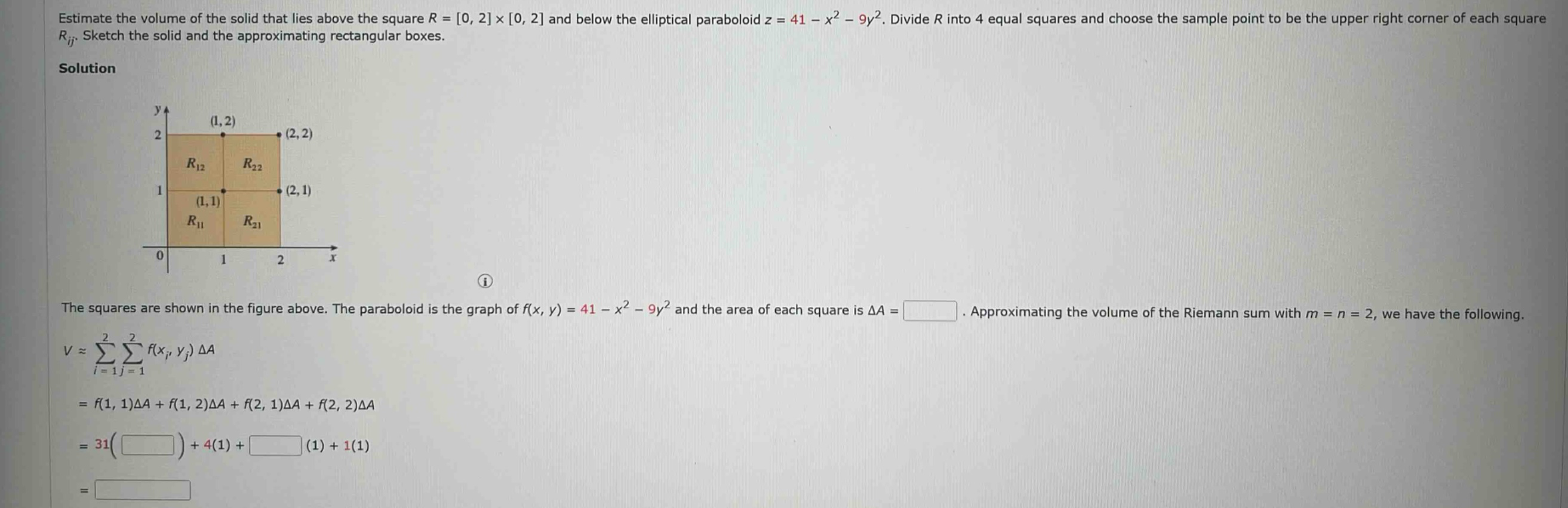
estimate the volume of the solid that lies above the square r = 0, 2 × 0, 2 and below the elliptical paraboloid z = 41 - x² - 9y². divide r into 4 equal squares and choose the sample point to be the upper right corner of each square rij. sketch the solid and the approximating rectangular boxes. the squares are shown in the figure above. the paraboloid is the graph of f(x, y) = 41 - x² - 9y² and the area of each square is δa =. approximating the volume of the riemann sum with m = n = 2, we have the following. v ≈ ∑²ᵢ₌₁∑²ⱼ₌₁f(xᵢ, yⱼ)δa = f(1, 1)δa + f(1, 2)δa + f(2, 1)δa + f(2, 2)δa = 31( ) + 4(1) + (1) + 1(1) =
Answer
Explanation:
Step1: Calculate the area of each sub - square
The square $R=[0,2]\times[0,2]$ is divided into $4$ equal squares. The side - length of each sub - square is $1$ (since $2\div2 = 1$). So, $\Delta A=1\times1 = 1$.
Step2: Calculate $f(x,y)$ at the sample points
- For $(x_1,y_1)=(1,1)$: $f(1,1)=41-1^{2}-9\times1^{2}=41 - 1-9=31$.
- For $(x_1,y_2)=(1,2)$: $f(1,2)=41-1^{2}-9\times2^{2}=41 - 1-36 = 4$.
- For $(x_2,y_1)=(2,1)$: $f(2,1)=41-2^{2}-9\times1^{2}=41 - 4 - 9=28$.
- For $(x_2,y_2)=(2,2)$: $f(2,2)=41-2^{2}-9\times2^{2}=41 - 4-36 = 1$.
Step3: Calculate the Riemann sum for the volume
$V\approx\sum_{i = 1}^{2}\sum_{j = 1}^{2}f(x_i,y_j)\Delta A=f(1,1)\Delta A+f(1,2)\Delta A+f(2,1)\Delta A+f(2,2)\Delta A$. Substitute $\Delta A = 1$ and the values of $f(x_i,y_j)$: $V\approx31\times1+4\times1+28\times1+1\times1=31 + 4+28+1=64$.
Answer:
$64$