evaluate ∮c 4y² dx + 10xy dy, where c is the boundary of the semiannular region d in the upper half - plane…
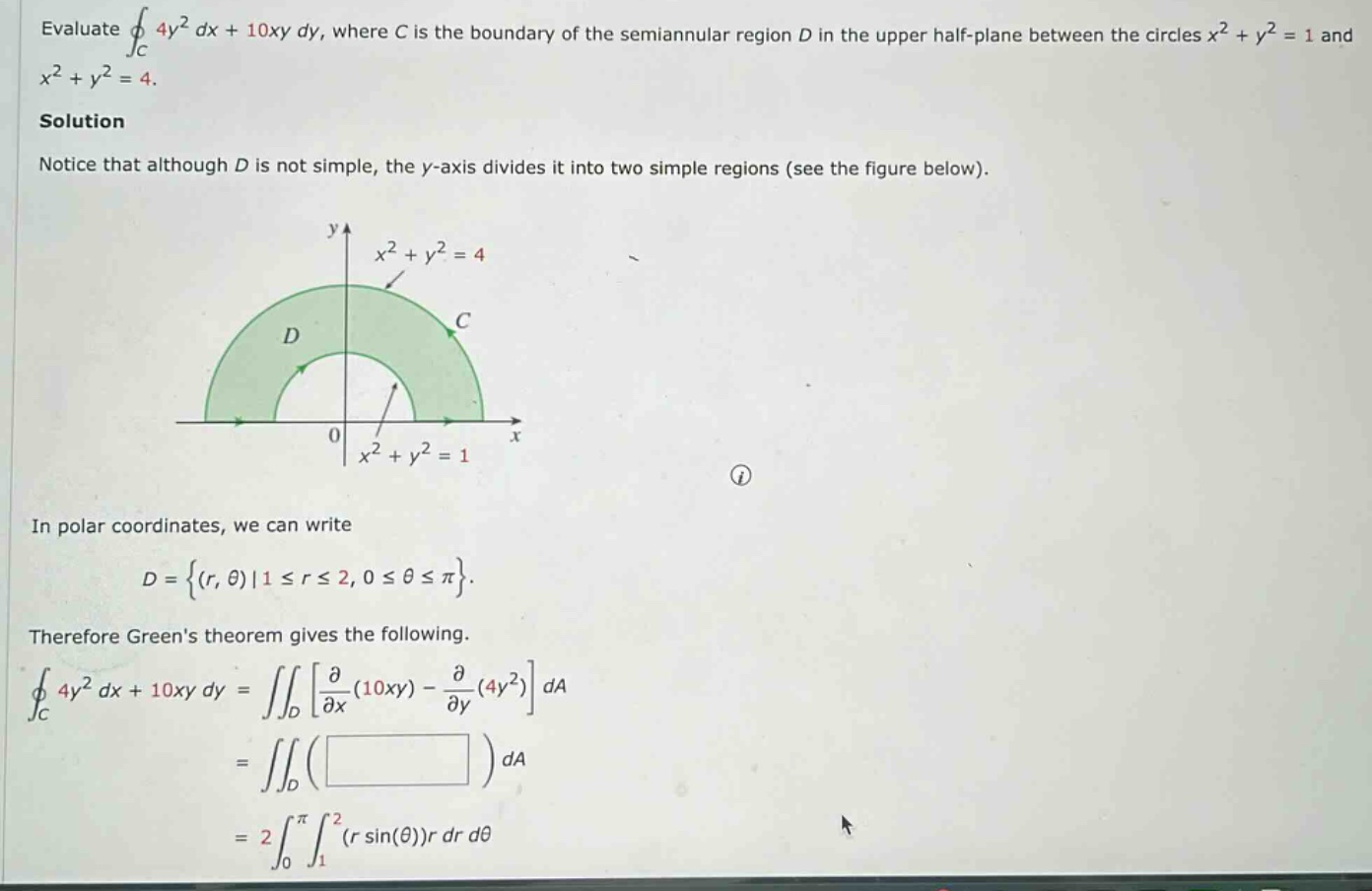
evaluate ∮c 4y² dx + 10xy dy, where c is the boundary of the semiannular region d in the upper half - plane between the circles x² + y² = 1 and x² + y² = 4. solution notice that although d is not simple, the y - axis divides it into two simple regions (see the figure below). in polar coordinates, we can write d={(r,θ)|1≤r≤2,0≤θ≤π}. therefore greens theorem gives the following. ∮c 4y² dx + 10xy dy=∬d∂/∂x(10xy) - ∂/∂y(4y²)da =∬d( )da =2∫0π∫1²(r sin(θ))r dr dθ
Answer
Explanation:
Step1: Aplicar la regla de diferenciación
Calculamos $\frac{\partial}{\partial x}(10xy)=10y$ y $\frac{\partial}{\partial y}(4y^{2}) = 8y$. Entonces $\frac{\partial}{\partial x}(10xy)-\frac{\partial}{\partial y}(4y^{2})=10y - 8y=2y$.
Step2: Convertir a coordenadas polares
Sabemos que $y = r\sin(\theta)$ y $dA = r\ dr\ d\theta$. El dominio $D$ en coordenadas polares es $1\leq r\leq2$, $0\leq\theta\leq\pi$. Sustituyendo en la integral doble $\iint_{D}2y\ dA$, obtenemos $2\int_{0}^{\pi}\int_{1}^{2}(r\sin(\theta))r\ dr\ d\theta$.
Step3: Resolver la integral doble
Primero integramos con respecto a $r$: $\int_{1}^{2}r^{2}\ dr=\left[\frac{1}{3}r^{3}\right]{1}^{2}=\frac{8}{3}-\frac{1}{3}=\frac{7}{3}$. Luego integramos con respecto a $\theta$: $\int{0}^{\pi}\sin(\theta)\ d\theta=[-\cos(\theta)]_{0}^{\pi}=-( \cos(\pi)-\cos(0))=-(- 1 - 1)=2$. Multiplicando los resultados de las integrales parciales: $2\times\frac{7}{3}\times2=\frac{28}{3}$.
Answer:
$\frac{28}{3}$