evaluate ∫₀⁸ dx / √(4 + x²).
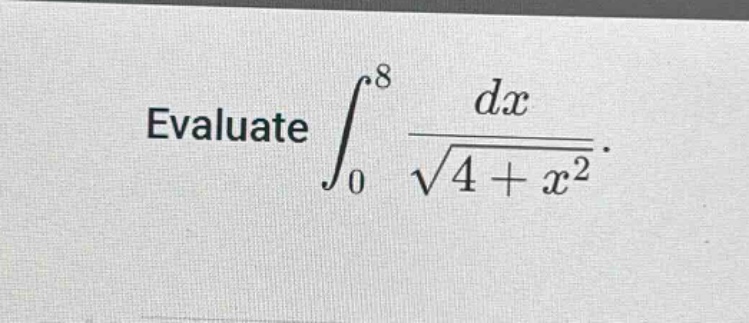
evaluate ∫₀⁸ dx / √(4 + x²).
Answer
Explanation:
Step1: Use trig - substitution
Let $x = 2\tan\theta$, then $dx=2\sec^{2}\theta d\theta$. When $x = 0$, $\theta=0$; when $x = 8$, $\tan\theta = 4$, so $\theta=\arctan(4)$. Also, $\sqrt{4 + x^{2}}=\sqrt{4+4\tan^{2}\theta}=2\sec\theta$.
Step2: Rewrite the integral
The integral $\int_{0}^{8}\frac{dx}{\sqrt{4 + x^{2}}}$ becomes $\int_{0}^{\arctan(4)}\frac{2\sec^{2}\theta d\theta}{2\sec\theta}=\int_{0}^{\arctan(4)}\sec\theta d\theta$.
Step3: Integrate $\sec\theta$
The antiderivative of $\sec\theta$ is $\ln|\sec\theta+\tan\theta|$. So, $\int_{0}^{\arctan(4)}\sec\theta d\theta=\left[\ln|\sec\theta+\tan\theta|\right]_{0}^{\arctan(4)}$.
Step4: Use right - triangle relationships
If $\tan\theta = 4$, then by the Pythagorean theorem, $\sec\theta=\sqrt{1 + \tan^{2}\theta}=\sqrt{1 + 16}=\sqrt{17}$.
Step5: Evaluate the definite integral
$\left[\ln|\sec\theta+\tan\theta|\right]_{0}^{\arctan(4)}=\ln(\sqrt{17}+4)-\ln(1 + 0)=\ln(4+\sqrt{17})$.
Answer:
$\ln(4 + \sqrt{17})$