evaluate ∫₀¹ 1/(1 + x²) dx exactly and show that the result is π/4. then, find the approximate value of the…
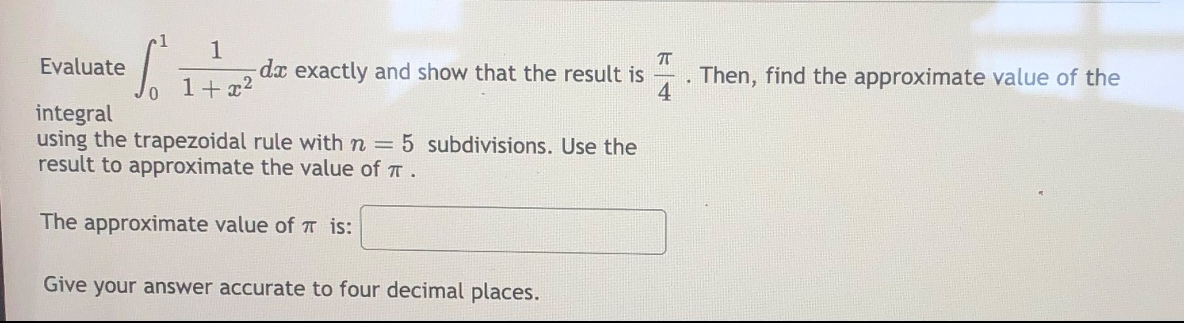
evaluate ∫₀¹ 1/(1 + x²) dx exactly and show that the result is π/4. then, find the approximate value of the integral using the trapezoidal rule with n = 5 subdivisions. use the result to approximate the value of π. the approximate value of π is: give your answer accurate to four decimal places.
Answer
Explanation:
Step1: Find the exact integral
The antiderivative of $\frac{1}{1 + x^{2}}$ is $\arctan(x)$. Using the fundamental - theorem of calculus, $\int_{0}^{1}\frac{1}{1 + x^{2}}dx=\left[\arctan(x)\right]_{0}^{1}=\arctan(1)-\arctan(0)=\frac{\pi}{4}-0 = \frac{\pi}{4}$.
Step2: Apply the trapezoidal rule
The trapezoidal rule is given by $T_n=\frac{\Delta x}{2}\left[f(x_0)+2\sum_{i = 1}^{n - 1}f(x_i)+f(x_n)\right]$, where $\Delta x=\frac{b - a}{n}$, $a = 0$, $b = 1$, and $n = 5$. So, $\Delta x=\frac{1-0}{5}=0.2$. The $x$-values are $x_0 = 0,x_1=0.2,x_2 = 0.4,x_3=0.6,x_4 = 0.8,x_5 = 1$. $f(x)=\frac{1}{1 + x^{2}}$. $f(x_0)=\frac{1}{1+0^{2}} = 1$; $f(x_1)=\frac{1}{1+(0.2)^{2}}=\frac{1}{1.04}\approx0.9615$; $f(x_2)=\frac{1}{1+(0.4)^{2}}=\frac{1}{1.16}\approx0.8621$; $f(x_3)=\frac{1}{1+(0.6)^{2}}=\frac{1}{1.36}\approx0.7353$; $f(x_4)=\frac{1}{1+(0.8)^{2}}=\frac{1}{1.64}\approx0.6098$; $f(x_5)=\frac{1}{1+1^{2}}=\frac{1}{2}=0.5$. $T_5=\frac{0.2}{2}\left[1 + 2(0.9615+0.8621+0.7353+0.6098)+0.5\right]$ $=0.1\left[1+2(3.1687)+0.5\right]$ $=0.1\left[1 + 6.3374+0.5\right]$ $=0.1\times7.8374 = 0.78374$.
Step3: Approximate $\pi$
Since $\int_{0}^{1}\frac{1}{1 + x^{2}}dx\approx T_5$ and $\int_{0}^{1}\frac{1}{1 + x^{2}}dx=\frac{\pi}{4}$, then $\frac{\pi}{4}\approx0.78374$. So, $\pi\approx4\times0.78374 = 3.13496\approx3.1350$.
Answer:
$3.1350$