evaluate the following limit: lim x→∞ e^(4x)/x^2. enter -1 if your answer is -∞, enter 1 if your answer is…
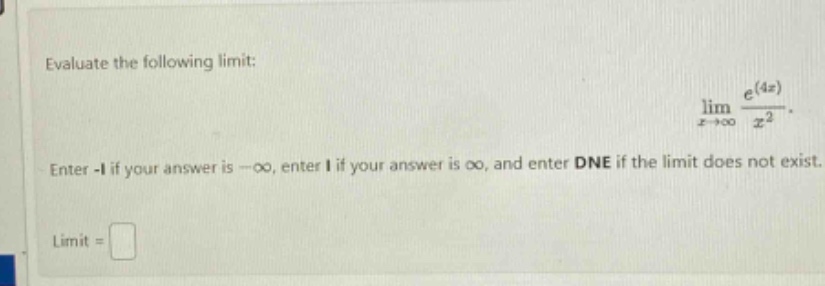
evaluate the following limit: lim x→∞ e^(4x)/x^2. enter -1 if your answer is -∞, enter 1 if your answer is ∞, and enter dne if the limit does not exist. limit =
Answer
Explanation:
Step1: Apply L'Hopital's rule
As $x\to\infty$, we have the indeterminate form $\frac{\infty}{\infty}$ for $\lim_{x\to\infty}\frac{e^{4x}}{x^{2}}$. By L'Hopital's rule, if $\lim_{x\to a}\frac{f(x)}{g(x)}$ is in the form $\frac{\infty}{\infty}$ or $\frac{0}{0}$, then $\lim_{x\to a}\frac{f(x)}{g(x)}=\lim_{x\to a}\frac{f'(x)}{g'(x)}$. Let $f(x) = e^{4x}$ and $g(x)=x^{2}$. Then $f'(x)=4e^{4x}$ and $g'(x) = 2x$. So, $\lim_{x\to\infty}\frac{e^{4x}}{x^{2}}=\lim_{x\to\infty}\frac{4e^{4x}}{2x}$.
Step2: Apply L'Hopital's rule again
The new - limit $\lim_{x\to\infty}\frac{4e^{4x}}{2x}$ is still in the $\frac{\infty}{\infty}$ form. Applying L'Hopital's rule again, $f_1(x)=4e^{4x}$, $g_1(x) = 2x$, $f_1'(x)=16e^{4x}$, $g_1'(x)=2$. So, $\lim_{x\to\infty}\frac{4e^{4x}}{2x}=\lim_{x\to\infty}\frac{16e^{4x}}{2}$.
Step3: Evaluate the limit
We know that $\lim_{x\to\infty}e^{4x}=\infty$. Then $\lim_{x\to\infty}\frac{16e^{4x}}{2}= \infty$.
Answer:
1