evaluate the following limit. use lhôpitals rule when it is convenient and applicable. lim (e^ax + x)^(1/x)…
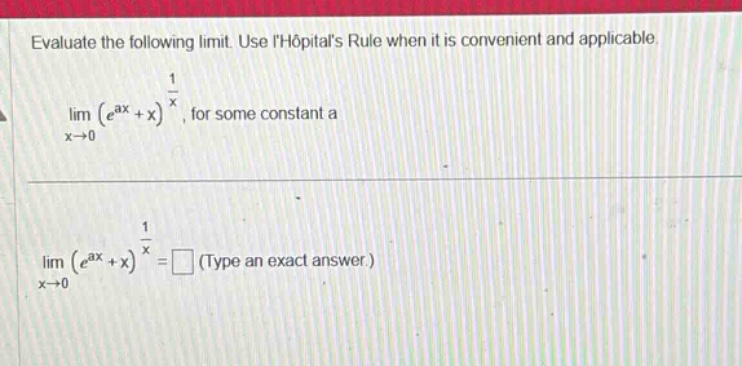
evaluate the following limit. use lhôpitals rule when it is convenient and applicable. lim (e^ax + x)^(1/x), for some constant a x→0 lim (e^ax + x)^(1/x)=□ (type an exact answer.) x→0
Answer
Explanation:
Step1: Let (y=(e^{ax}+x)^{\frac{1}{x}})
Take the natural - logarithm of both sides: (\ln y=\frac{1}{x}\ln(e^{ax}+x))
Step2: Find the limit of (\ln y) as (x\to0)
(\lim_{x\to0}\ln y=\lim_{x\to0}\frac{\ln(e^{ax}+x)}{x}), which is in the (\frac{0}{0}) form.
Step3: Apply L'Hopital's Rule
Differentiate the numerator and denominator. The derivative of (\ln(e^{ax}+x)) is (\frac{ae^{ax} + 1}{e^{ax}+x}), and the derivative of (x) is (1). So (\lim_{x\to0}\frac{\ln(e^{ax}+x)}{x}=\lim_{x\to0}\frac{ae^{ax}+1}{e^{ax}+x})
Step4: Evaluate the limit
Substitute (x = 0) into (\frac{ae^{ax}+1}{e^{ax}+x}), we get (\frac{a\cdot e^{0}+1}{e^{0}+0}=\frac{a + 1}{1}=a + 1)
Step5: Find the limit of (y)
Since (\lim_{x\to0}\ln y=a + 1), then (\lim_{x\to0}y = e^{\lim_{x\to0}\ln y}). So (\lim_{x\to0}(e^{ax}+x)^{\frac{1}{x}}=e^{a + 1})
Answer:
(e^{a + 1})