evaluate the following limit. use lhopitals rule when it is convenient and applicable. lim x→0 (e^4x…
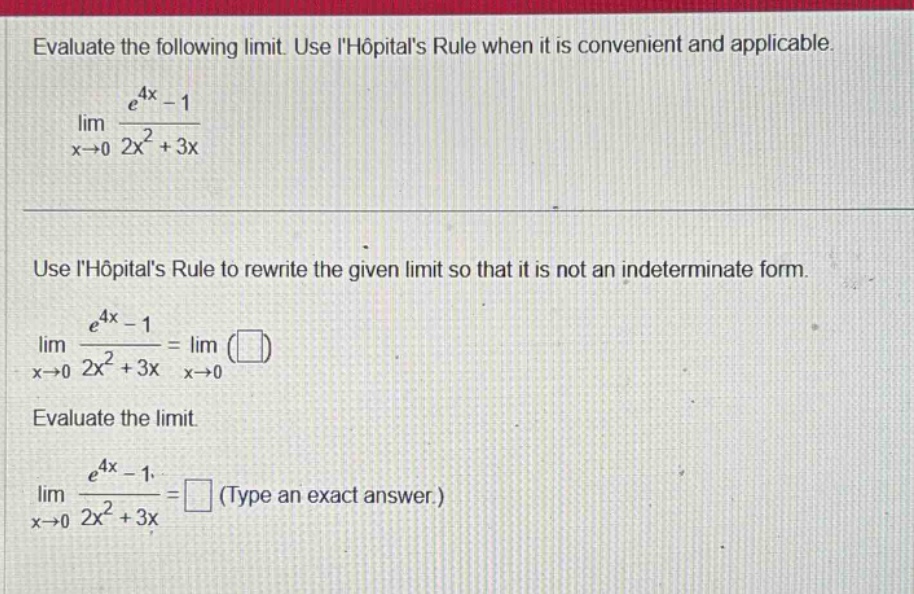
evaluate the following limit. use lhopitals rule when it is convenient and applicable. lim x→0 (e^4x - 1)/(2x^2 + 3x) use lhopitals rule to rewrite the given limit so that it is not an indeterminate form. lim x→0 (e^4x - 1)/(2x^2 + 3x)=lim x→0 ( ) evaluate the limit. lim x→0 (e^4x - 1)/(2x^2 + 3x)= (type an exact answer.)
Answer
Explanation:
Step1: Check indeterminate - form
When (x\rightarrow0), (\lim_{x\rightarrow0}(e^{4x}-1)=e^{0}-1 = 0) and (\lim_{x\rightarrow0}(2x^{2}+3x)=0). So, it is in the (\frac{0}{0}) indeterminate - form.
Step2: Apply L'Hopital's Rule
Differentiate the numerator and the denominator. The derivative of (y = e^{4x}-1) with respect to (x) is (y^\prime=4e^{4x}), and the derivative of (y = 2x^{2}+3x) with respect to (x) is (y^\prime = 4x + 3). So, (\lim_{x\rightarrow0}\frac{e^{4x}-1}{2x^{2}+3x}=\lim_{x\rightarrow0}\frac{4e^{4x}}{4x + 3}).
Step3: Evaluate the new limit
Substitute (x = 0) into (\frac{4e^{4x}}{4x + 3}). We get (\frac{4e^{0}}{4\times0+3}=\frac{4\times1}{3}=\frac{4}{3}).
Answer:
(\frac{4}{3})