evaluate the following limit. use lhopitals rule when it is convenient and applicable. lim(x→5+)(1/(x…
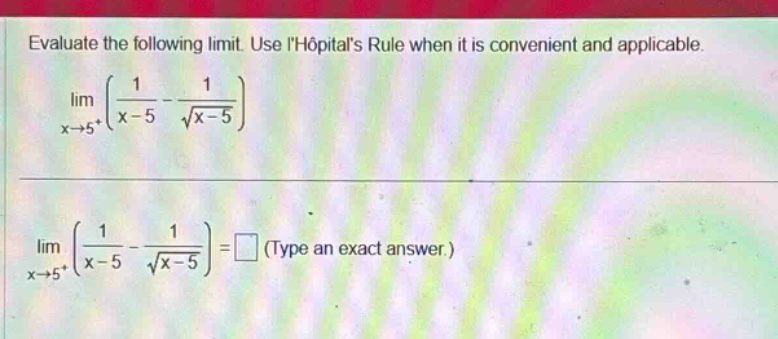
evaluate the following limit. use lhopitals rule when it is convenient and applicable. lim(x→5+)(1/(x - 5)-1/√(x - 5)) lim(x→5+)(1/(x - 5)-1/√(x - 5))=□ (type an exact answer.)
Answer
Explanation:
Step1: Combine the fractions
First, find a common - denominator. The common denominator of (x - 5) and (\sqrt{x - 5}) is ((x - 5)\sqrt{x - 5}). [ \begin{align*} \frac{1}{x - 5}-\frac{1}{\sqrt{x - 5}}&=\frac{1-\sqrt{x - 5}}{(x - 5)\sqrt{x - 5}} \end{align*} ] Let (t=\sqrt{x - 5}), then (x=t^{2}+5). As (x\rightarrow5^{+}), (t\rightarrow0^{+}). Substituting (x=t^{2}+5) into the fraction, we get (\frac{1 - t}{t^{2}\cdot t}=\frac{1 - t}{t^{3}}).
Step2: Check the form
As (t\rightarrow0^{+}), the fraction (\frac{1 - t}{t^{3}}) is in the (\frac{1}{0}) form. We can rewrite the original limit (\lim_{x\rightarrow5^{+}}\left(\frac{1}{x - 5}-\frac{1}{\sqrt{x - 5}}\right)) as (\lim_{t\rightarrow0^{+}}\frac{1 - t}{t^{3}}) and rewrite it in a form suitable for L'Hopital's Rule. First, rewrite the original expression as (\lim_{x\rightarrow5^{+}}\frac{\sqrt{x - 5}-(x - 5)}{(x - 5)\sqrt{x - 5}}), which is in the (\frac{0}{0}) form as (x\rightarrow5^{+}). Apply L'Hopital's Rule. The derivative of the numerator (y_1=\sqrt{x - 5}-(x - 5)=(x - 5)^{\frac{1}{2}}-(x - 5)) is (y_1^\prime=\frac{1}{2\sqrt{x - 5}}-1). The derivative of the denominator (y_2=(x - 5)\sqrt{x - 5}=(x - 5)^{\frac{3}{2}}) is (y_2^\prime=\frac{3}{2}(x - 5)^{\frac{1}{2}}). So, (\lim_{x\rightarrow5^{+}}\frac{\frac{1}{2\sqrt{x - 5}}-1}{\frac{3}{2}\sqrt{x - 5}}=\lim_{x\rightarrow5^{+}}\frac{\frac{1 - 2\sqrt{x - 5}}{2\sqrt{x - 5}}}{\frac{3}{2}\sqrt{x - 5}}=\lim_{x\rightarrow5^{+}}\frac{1 - 2\sqrt{x - 5}}{3(x - 5)}). This is still in the (\frac{0}{0}) form. Apply L'Hopital's Rule again. The derivative of the numerator (u = 1-2\sqrt{x - 5}=1 - 2(x - 5)^{\frac{1}{2}}) is (u^\prime=-\frac{1}{\sqrt{x - 5}}), and the derivative of the denominator (v = 3(x - 5)) is (v^\prime=3).
Step3: Evaluate the limit
(\lim_{x\rightarrow5^{+}}\frac{-\frac{1}{\sqrt{x - 5}}}{3}=-\infty)
Answer:
(-\infty)