evaluate the following limit using lhospitals rule. enter an exact answer. provide your answer below: lim…
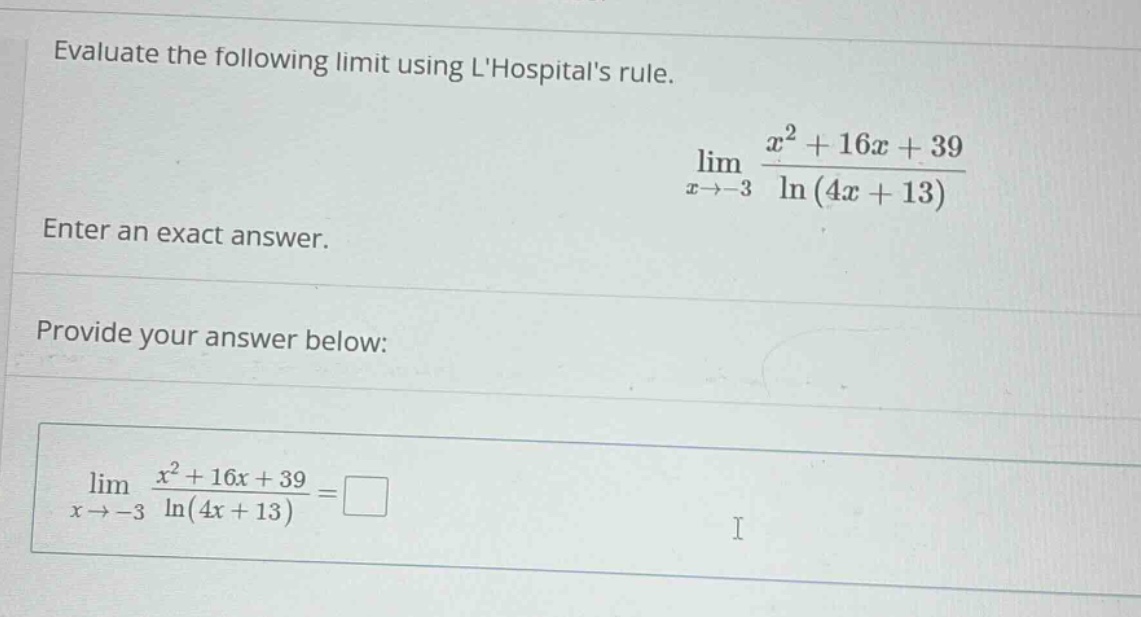
evaluate the following limit using lhospitals rule. enter an exact answer. provide your answer below: lim x→−3 (x² + 16x + 39) / ln(4x + 13) =
Answer
Explanation:
Step1: Check indeterminate form
When (x = - 3), (x^{2}+16x + 39=(-3)^{2}+16\times(-3)+39=9 - 48 + 39 = 0) and (\ln(4x + 13)=\ln(4\times(-3)+13)=\ln(1)=0). So, it is in the (\frac{0}{0}) indeterminate - form and L'Hopital's rule can be applied.
Step2: Differentiate numerator and denominator
The derivative of the numerator (y_1=x^{2}+16x + 39) using the power - rule ((x^n)^\prime=nx^{n - 1}) is (y_1^\prime = 2x+16). The derivative of the denominator (y_2=\ln(4x + 13)) using the chain - rule ((\ln(u))^\prime=\frac{u^\prime}{u}) where (u = 4x+13) and (u^\prime = 4) is (y_2^\prime=\frac{4}{4x + 13}).
Step3: Find the new limit
By L'Hopital's rule, (\lim_{x\rightarrow - 3}\frac{x^{2}+16x + 39}{\ln(4x + 13)}=\lim_{x\rightarrow - 3}\frac{2x + 16}{\frac{4}{4x + 13}}). Simplify the right - hand side to (\lim_{x\rightarrow - 3}\frac{(2x + 16)(4x + 13)}{4}).
Step4: Substitute (x=-3)
Substitute (x=-3) into (\frac{(2x + 16)(4x + 13)}{4}). We have (\frac{(2\times(-3)+16)(4\times(-3)+13)}{4}=\frac{(-6 + 16)(-12 + 13)}{4}=\frac{10\times1}{4}=\frac{5}{2}).
Answer:
(\frac{5}{2})