evaluate the following limits. if needed, enter inf for ∞ and -inf for - (a) lim(x→∞) (4x + 4)/(2x² - 6x +…
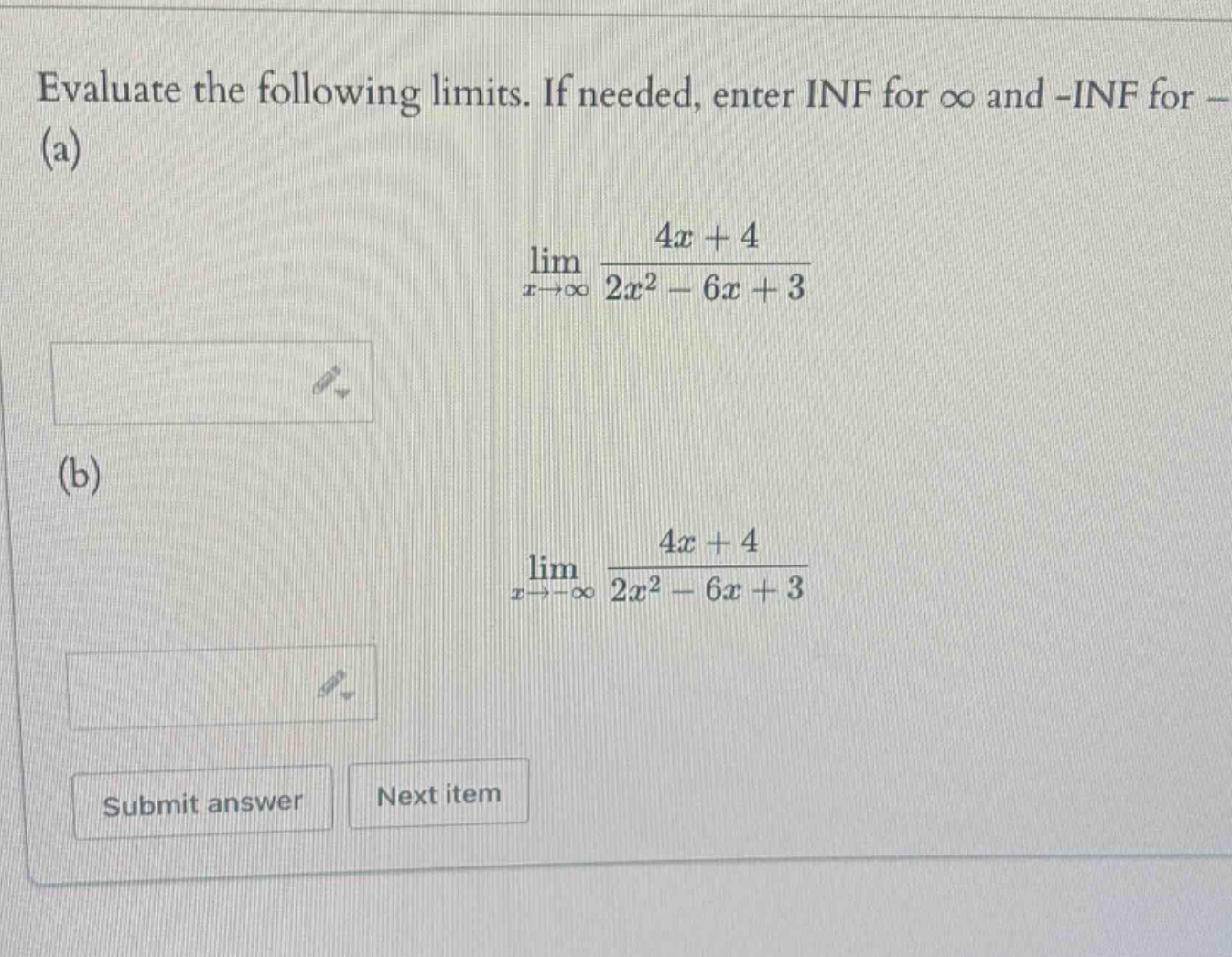
evaluate the following limits. if needed, enter inf for ∞ and -inf for - (a) lim(x→∞) (4x + 4)/(2x² - 6x + 3) (b) lim(x→-∞) (4x + 4)/(2x² - 6x + 3) submit answer next item
Answer
Explanation:
Step1: Divide by highest - power of x in denominator
Divide both the numerator and denominator of $\frac{4x + 4}{2x^{2}-6x + 3}$ by $x^{2}$. We get $\lim_{x\rightarrow\pm\infty}\frac{\frac{4x}{x^{2}}+\frac{4}{x^{2}}}{\frac{2x^{2}}{x^{2}}-\frac{6x}{x^{2}}+\frac{3}{x^{2}}}=\lim_{x\rightarrow\pm\infty}\frac{\frac{4}{x}+\frac{4}{x^{2}}}{2-\frac{6}{x}+\frac{3}{x^{2}}}$.
Step2: Use limit rules for infinity
We know that $\lim_{x\rightarrow\pm\infty}\frac{c}{x^{n}} = 0$ for $n>0$ and $c$ is a constant. So, $\lim_{x\rightarrow\pm\infty}\frac{4}{x}=0$, $\lim_{x\rightarrow\pm\infty}\frac{4}{x^{2}} = 0$, $\lim_{x\rightarrow\pm\infty}\frac{6}{x}=0$ and $\lim_{x\rightarrow\pm\infty}\frac{3}{x^{2}}=0$.
Step3: Evaluate the limit
Substitute the values of the limits of the individual terms into the expression. $\lim_{x\rightarrow\pm\infty}\frac{\frac{4}{x}+\frac{4}{x^{2}}}{2-\frac{6}{x}+\frac{3}{x^{2}}}=\frac{0 + 0}{2-0 + 0}=0$.
Answer:
(a) 0 (b) 0