evaluate $y = e^{x}+1$ for the following values of $x$. round to the nearest thousandth.\n$x =…
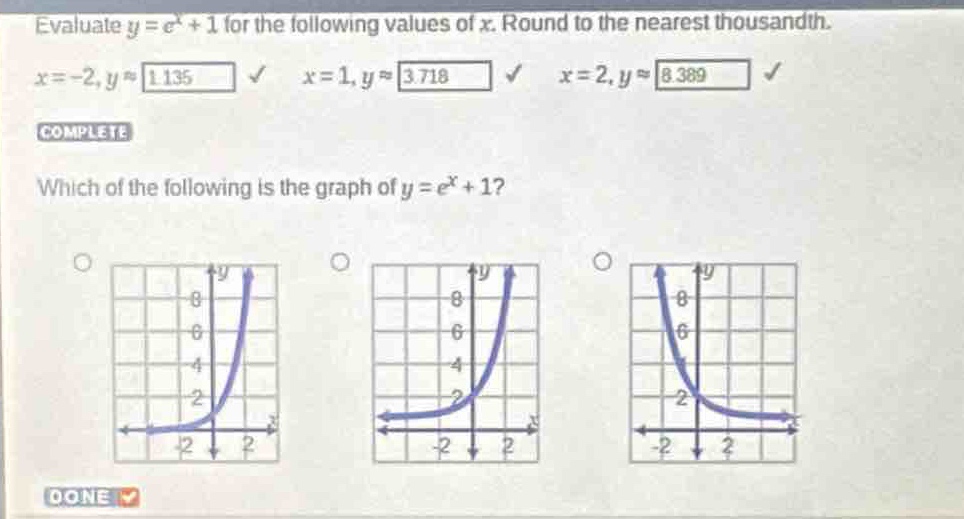
evaluate $y = e^{x}+1$ for the following values of $x$. round to the nearest thousandth.\n$x = - 2,y\\approx1.135$ $x = 1,y\\approx3.718$ $x = 2,y\\approx8.389$\ncomplete\nwhich of the following is the graph of $y = e^{x}+1$?
Answer
Explanation:
Step1: Analyze the function properties
The function $y = e^{x}+1$ is an exponential - type function. The parent function of $y = e^{x}+1$ is $y = e^{x}$, and the graph of $y = e^{x}+1$ is the graph of $y = e^{x}$ shifted up 1 unit. The function $y = e^{x}$ has a $y$ - intercept at $(0, 1)$ (since when $x = 0$, $y=e^{0}=1$), so the function $y = e^{x}+1$ has a $y$ - intercept at $(0,2)$ (when $x = 0$, $y=e^{0}+1=2$). Also, as $x\to-\infty$, $e^{x}\to0$, so $y = e^{x}+1\to1$; as $x\to+\infty$, $e^{x}\to+\infty$, so $y = e^{x}+1\to+\infty$.
Step2: Examine the graphs
The first graph has a $y$ - intercept below 2. The second graph has a $y$ - intercept at 2, and as $x\to-\infty$, $y$ approaches 1, and as $x\to+\infty$, $y$ approaches $+\infty$. The third graph is a decreasing function, while $y = e^{x}+1$ is an increasing function.
Answer:
The second graph.