evaluate the function graphically. find $f(0)$
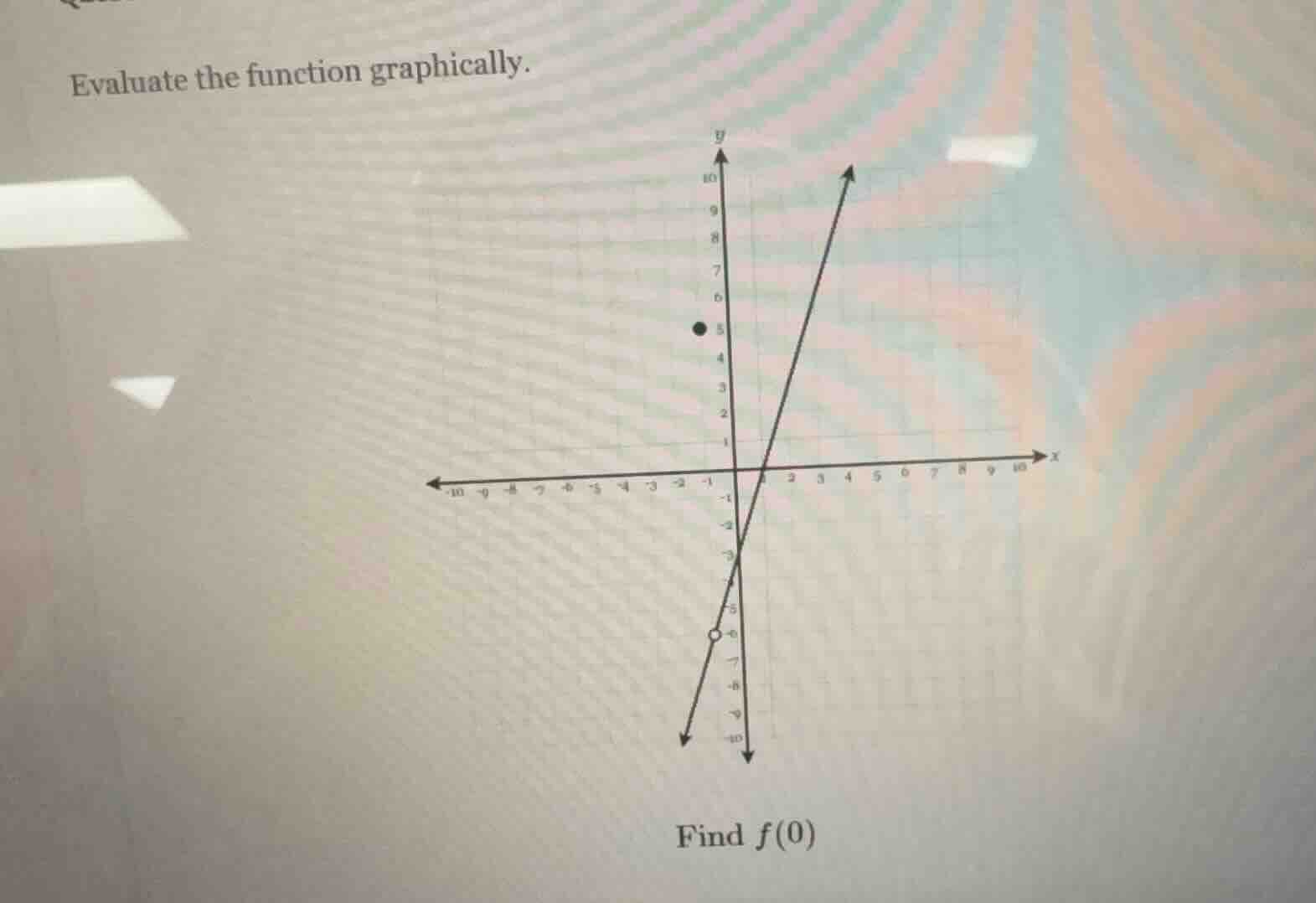
evaluate the function graphically. find $f(0)$
Answer
Explanation:
Step1: Understand the task
We need to find ( f(0) ) from the graph, which means finding the ( y )-value when ( x = 0 ) (the ( y )-intercept of the function's graph, considering the correct point at ( x = 0 )).
Step2: Analyze the graph at ( x = 0 )
Looking at the graph, when ( x = 0 ), we check the point on the function's graph. The graph has a line, and at ( x = 0 ), the ( y )-coordinate of the point on the line (the solid or relevant part for the function's value at ( x = 0 )) is -3? Wait, no, wait. Wait, the graph: let's see, the line passes through ( x = 0 ). Wait, the ( y )-axis is ( x = 0 ). Looking at the graph, the line (the main line) at ( x = 0 ) has a ( y )-value? Wait, no, maybe I misread. Wait, the graph: there's a line, and at ( x = 0 ), the point on the line (the functional value) – wait, the graph shows that at ( x = 0 ), the line crosses the ( y )-axis at ( y=-3 )? Wait, no, let's check again. Wait, the problem is to find ( f(0) ), so we look for the ( y )-coordinate when ( x = 0 ). The graph: the line (the one with the arrow going up) – wait, no, there are two lines? Wait, no, the graph has a line that passes through the origin? Wait, no, the ( y )-axis is ( x = 0 ). Let's see the coordinates: when ( x = 0 ), the point on the function (the line) – wait, the graph shows that at ( x = 0 ), the ( y )-value is -3? Wait, no, maybe I made a mistake. Wait, the graph: the line (the one with the arrow) – let's see, when ( x = 0 ), the ( y )-coordinate of the point on the line is -3? Wait, no, looking at the graph, the line (the main line) at ( x = 0 ) (the ( y )-axis) has a ( y )-value of -3? Wait, no, maybe the correct point: when ( x = 0 ), the function's value is the ( y )-coordinate at ( x = 0 ). Looking at the graph, the line (the one that's a straight line) at ( x = 0 ) is at ( y = -3 )? Wait, no, maybe I misread. Wait, the graph: the ( y )-axis is ( x = 0 ). The line (the one with the arrow going up) – when ( x = 0 ), what's the ( y )-value? Wait, the graph has a point at ( x = -1 ), ( y = 5 ) (a black dot), and a hollow circle at ( x = -1 ), ( y = -6 ). But for ( x = 0 ), we look at the line (the main line) – the one that passes through the origin? Wait, no, the line (the one with the arrow) – let's see, when ( x = 0 ), the ( y )-coordinate is -3? Wait, no, maybe the correct answer is -3? Wait, no, let's check again. Wait, the problem is to find ( f(0) ), so we find the ( y )-value when ( x = 0 ). The graph: the line (the function's graph) at ( x = 0 ) (the ( y )-axis) – looking at the graph, the line (the one with the arrow going up) – when ( x = 0 ), the ( y )-value is -3? Wait, no, maybe I made a mistake. Wait, the graph: the ( y )-axis is ( x = 0 ). The line (the main line) – let's see, the line passes through ( x = 1 ), ( y = 0 )? No, wait, the origin is (0,0), but the line crosses the ( y )-axis at (0, -3)? Wait, maybe. So when ( x = 0 ), ( f(0) = -3 )? Wait, no, maybe I misread. Wait, the graph: the line (the one with the arrow) – at ( x = 0 ), the ( y )-coordinate is -3. So ( f(0) = -3 ).
Wait, maybe I should re-express: to find ( f(0) ), we locate ( x = 0 ) on the ( x )-axis (the ( y )-axis), then find the corresponding ( y )-value on the function's graph. The graph shows that at ( x = 0 ), the point on the function (the line) has a ( y )-value of -3. So ( f(0) = -3 ).
Answer:
( \boldsymbol{-3} )