4. evaluate the given function at x = 1 and x = 3 to determine if the intermediate value theorem guarantees…
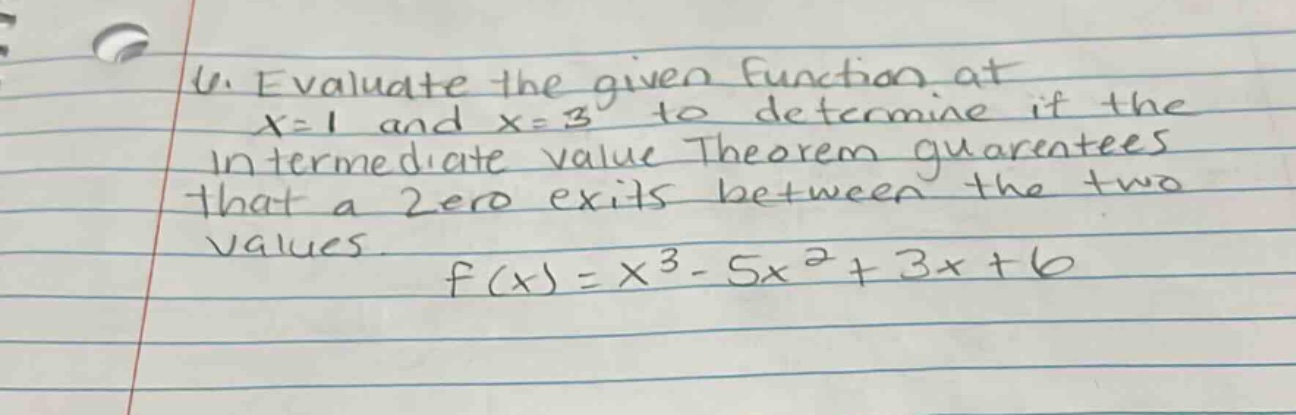
4. evaluate the given function at x = 1 and x = 3 to determine if the intermediate value theorem guarantees that a zero exits between the two values. f(x)=x^3 - 5x^2+3x + 6
Answer
Answer:
We first evaluate (f(1)) and (f(3)) to check the Intermediate - Value Theorem conditions.
- Evaluate (f(1)):
- Substitute (x = 1) into (f(x)=x^{3}-5x^{2}+3x + 6).
- (f(1)=1^{3}-5\times1^{2}+3\times1 + 6).
- (f(1)=1-5 + 3+6).
- (f(1)=5).
- Evaluate (f(3)):
- Substitute (x = 3) into (f(x)=x^{3}-5x^{2}+3x + 6).
- (f(3)=3^{3}-5\times3^{2}+3\times3 + 6).
- (f(3)=27-45 + 9+6).
- (f(3)=-3).
Since (f(x)) is a polynomial, it is continuous everywhere. And (f(1)=5>0) and (f(3)=-3<0). By the Intermediate - Value Theorem, which states that if (y = f(x)) is continuous on the closed interval ([a,b]), and (k) is a number between (f(a)) and (f(b)), then there exists at least one number (c) in the open interval ((a,b)) such that (f(c)=k). In the case of (k = 0), since (0) is between (f(1)) and (f(3)), there is at least one zero of the function (f(x)) in the interval ((1,3)).
Explanation:
Step1: Evaluate (f(1))
Substitute (x = 1) into (f(x)): (f(1)=1 - 5+3 + 6=5)
Step2: Evaluate (f(3))
Substitute (x = 3) into (f(x)): (f(3)=27-45 + 9+6=-3)
Step3: Apply Intermediate - Value Theorem
Since (f(x)) is continuous (as it's a polynomial) and (f(1)>0,f(3)<0), there is a zero in ((1,3))