evaluate independent practice lesson 18.3 homework complete problems 1 - 8 for independent practice. when…
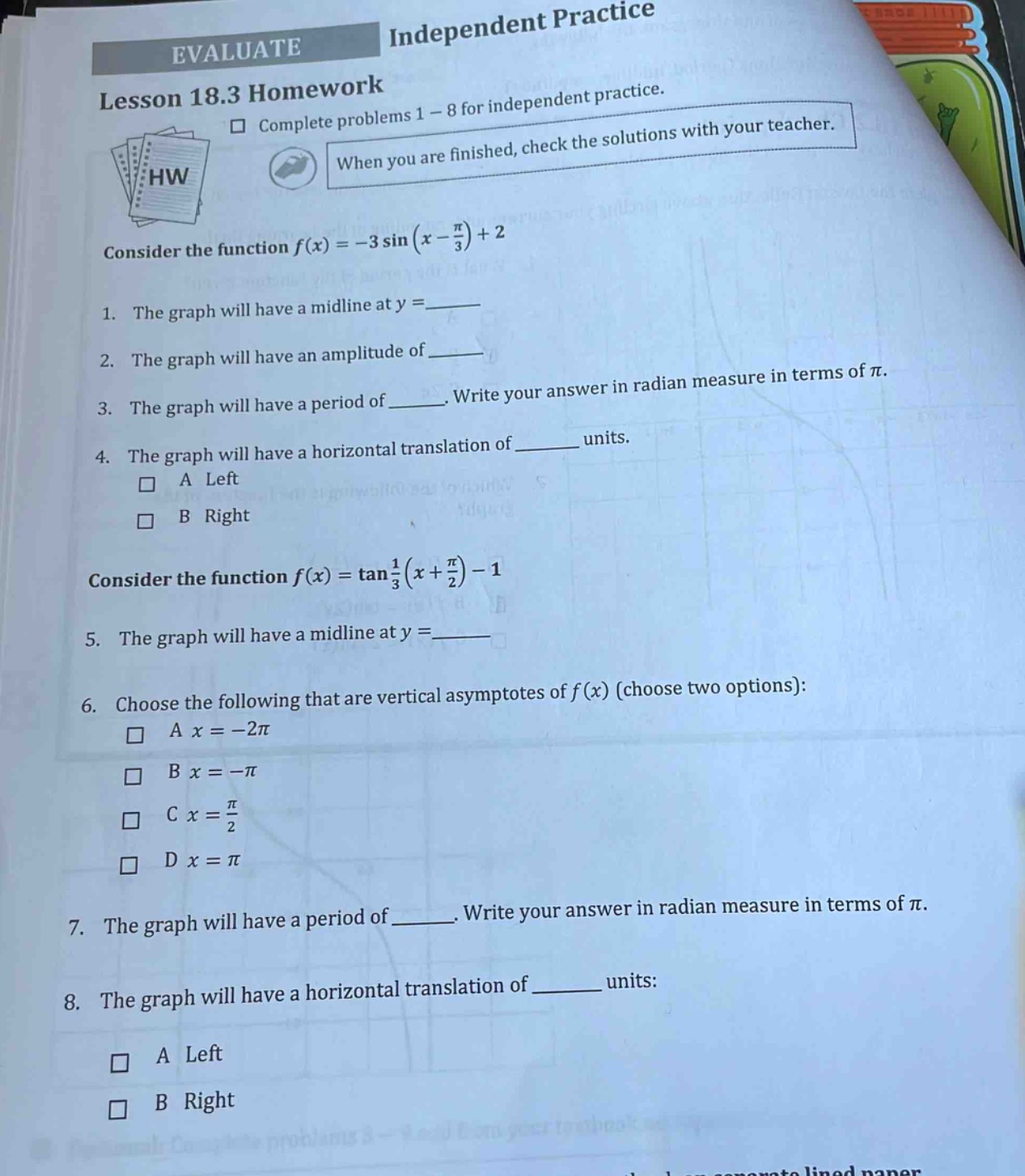
evaluate independent practice lesson 18.3 homework complete problems 1 - 8 for independent practice. when you are finished, check the solutions with your teacher. consider the function f(x)=-3 sin(x - π/3)+2 1. the graph will have a mid - line at y =____ 2. the graph will have an amplitude of____ 3. the graph will have a period of____. write your answer in radian measure in terms of π. 4. the graph will have a horizontal translation of____ units. a left b right consider the function f(x)=tan(1/3)(x + π/2)-1 5. the graph will have a mid - line at y =____ 6. choose the following that are vertical asymptotes of f(x) (choose two options): a x=-2π b x=-π c x = π/2 d x = π 7. the graph will have a period of____. write your answer in radian measure in terms of π. 8. the graph will have a horizontal translation of____ units: a left b right
Answer
Explanation:
Step1: Recall mid - line formula for $y = A\sin(B(x - C))+D$
For a sine function $y = A\sin(B(x - C))+D$, the mid - line is $y = D$. For $f(x)=-3\sin(x-\frac{\pi}{3}) + 2$, $D = 2$.
Step2: Recall amplitude formula for $y = A\sin(B(x - C))+D$
The amplitude of $y = A\sin(B(x - C))+D$ is $|A|$. For $f(x)=-3\sin(x-\frac{\pi}{3}) + 2$, $A=-3$, so amplitude is $| - 3|=3$.
Step3: Recall period formula for $y = A\sin(B(x - C))+D$
The period of $y = A\sin(B(x - C))+D$ is $T=\frac{2\pi}{|B|}$. For $f(x)=-3\sin(x-\frac{\pi}{3}) + 2$, $B = 1$, so $T = 2\pi$.
Step4: Recall horizontal translation formula for $y = A\sin(B(x - C))+D$
For $y = A\sin(B(x - C))+D$, the horizontal translation is $C$ units. For $f(x)=-3\sin(x-\frac{\pi}{3}) + 2$, $C=\frac{\pi}{3}$ and since it is $x-\frac{\pi}{3}$, the translation is $\frac{\pi}{3}$ units to the right.
Step5: Recall mid - line formula for $y = A\tan(B(x - C))+D$
For a tangent function $y = A\tan(B(x - C))+D$, the mid - line is $y = D$. For $f(x)=\tan\frac{1}{3}(x+\frac{\pi}{2})-1$, $D=-1$.
Step6: Recall vertical asymptote formula for $y = A\tan(B(x - C))+D$
The vertical asymptotes of $y=\tan u$ occur at $u=(n+\frac{1}{2})\pi,n\in\mathbb{Z}$. For $y = \tan\frac{1}{3}(x+\frac{\pi}{2})-1$, set $\frac{1}{3}(x+\frac{\pi}{2})=(n+\frac{1}{2})\pi$. Solving for $x$ gives $x = 3n\pi+\pi$. When $n=-1$, $x=-2\pi$; when $n = 0$, $x=\pi$.
Step7: Recall period formula for $y = A\tan(B(x - C))+D$
The period of $y = A\tan(B(x - C))+D$ is $T=\frac{\pi}{|B|}$. For $f(x)=\tan\frac{1}{3}(x+\frac{\pi}{2})-1$, $B=\frac{1}{3}$, so $T = 3\pi$.
Step8: Recall horizontal translation formula for $y = A\tan(B(x - C))+D$
For $y = A\tan(B(x - C))+D$, the horizontal translation is $C$ units. For $f(x)=\tan\frac{1}{3}(x+\frac{\pi}{2})-1$, it is $x+\frac{\pi}{2}$, so the translation is $\frac{\pi}{2}$ units to the left.
Answer:
- $2$
- $3$
- $2\pi$
- $\frac{\pi}{3}$, B Right
- $-1$
- A $x=-2\pi$, D $x = \pi$
- $3\pi$
- $\frac{\pi}{2}$, A Left