(b) evaluate the integral below correct to within an error of 0.001. \n\\(\\int_{0}^{0.5}e^{-4x^{2}}\\)…
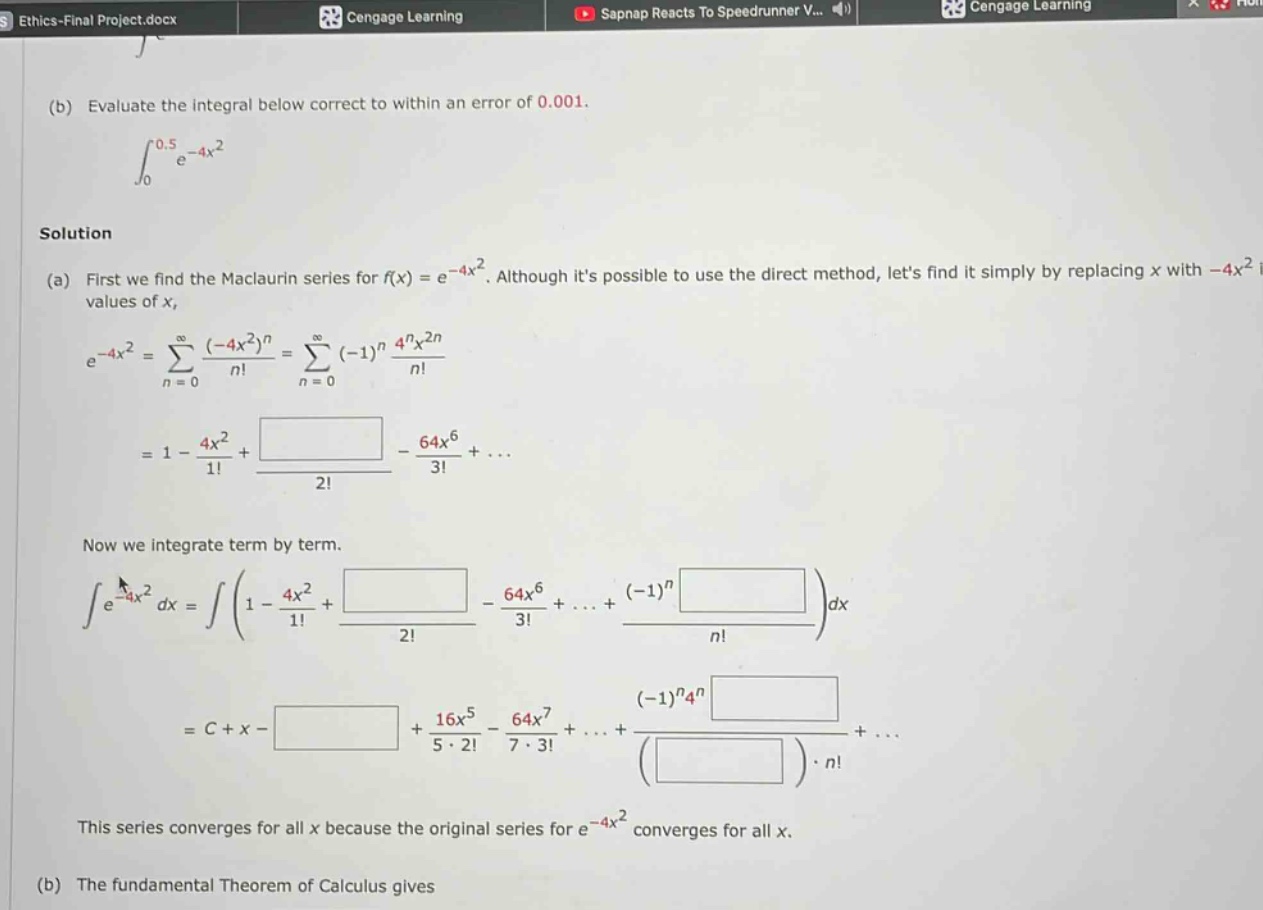
(b) evaluate the integral below correct to within an error of 0.001. \n\\(\\int_{0}^{0.5}e^{-4x^{2}}\\) \nsolution \n(a) first we find the maclaurin series for \\(f(x)=e^{-4x^{2}}\\). although its possible to use the direct method, lets find it simply by replacing \\(x\\) with \\(-4x^{2}\\) \nvalues of \\(x\\), \n\\(e^{-4x^{2}}=\\sum_{n = 0}^{\\infty}\\frac{(-4x^{2})^{n}}{n!}=\\sum_{n = 0}^{\\infty}(-1)^{n}\\frac{4^{n}x^{2n}}{n!}\\) \n\\(=1 - \\frac{4x^{2}}{1!}+\\frac{}{2!}-\\frac{64x^{6}}{3!}+...\\) \nnow we integrate term by term. \n\\(\\int e^{-4x^{2}}dx=\\int(1 - \\frac{4x^{2}}{1!}+\\frac{}{2!}-\\frac{64x^{6}}{3!}+...+\\frac{(-1)^{n}}{n!})dx\\) \n\\(=c + x-+\\frac{16x^{5}}{5\\cdot2!}-\\frac{64x^{7}}{7\\cdot3!}+...+\\frac{(-1)^{n}4^{n}}{( )\\cdot n!}+...\\) \nthis series converges for all \\(x\\) because the original series for \\(e^{-4x^{2}}\\) converges for all \\(x\\). \n(b) the fundamental theorem of calculus gives
Answer
Explanation:
Step1: Recall Maclaurin series of $e^t$
The Maclaurin series of $e^t=\sum_{n = 0}^{\infty}\frac{t^n}{n!}=1 + t+\frac{t^2}{2!}+\frac{t^3}{3!}+\cdots$. Let $t=-4x^{2}$, then $e^{-4x^{2}}=\sum_{n = 0}^{\infty}\frac{(-4x^{2})^n}{n!}=\sum_{n = 0}^{\infty}(-1)^{n}\frac{4^{n}x^{2n}}{n!}=1-\frac{4x^{2}}{1!}+\frac{16x^{4}}{2!}-\frac{64x^{6}}{3!}+\cdots$
Step2: Integrate term - by - term
$\int e^{-4x^{2}}dx=\int\left(1-\frac{4x^{2}}{1!}+\frac{16x^{4}}{2!}-\frac{64x^{6}}{3!}+\cdots+(-1)^{n}\frac{4^{n}x^{2n}}{n!}\right)dx$ $=C + x-\frac{4x^{3}}{3\times1!}+\frac{16x^{5}}{5\times2!}-\frac{64x^{7}}{7\times3!}+\cdots+(-1)^{n}\frac{4^{n}x^{2n + 1}}{(2n+1)\times n!}+\cdots$
Step3: Evaluate the definite integral
We want to find $\int_{0}^{0.5}e^{-4x^{2}}dx=\left[x-\frac{4x^{3}}{3\times1!}+\frac{16x^{5}}{5\times2!}-\frac{64x^{7}}{7\times3!}+\cdots\right]{0}^{0.5}$ $=0.5-\frac{4\times(0.5)^{3}}{3\times1!}+\frac{16\times(0.5)^{5}}{5\times2!}-\frac{64\times(0.5)^{7}}{7\times3!}+\cdots$ We use the Alternating Series Estimation Theorem. For an alternating series $\sum{n = 0}^{\infty}(-1)^{n}a_{n}$ ($a_{n}\gt0$, $a_{n+1}\leq a_{n}$, $\lim_{n\rightarrow\infty}a_{n}=0$), the error $E_N$ in approximating the sum $S$ by the sum of the first $N$ terms $S_N$ is bounded by $|E_N|\leq a_{N + 1}$. Let's calculate the terms: $a_0 = 0.5$ $a_1=\frac{4\times(0.5)^{3}}{3\times1!}=\frac{4\times0.125}{3}=\frac{0.5}{3}\approx0.167$ $a_2=\frac{16\times(0.5)^{5}}{5\times2!}=\frac{16\times0.03125}{10}=0.05$ $a_3=\frac{64\times(0.5)^{7}}{7\times3!}=\frac{64\times0.0078125}{42}\approx0.012$ $a_4=\frac{256\times(0.5)^{9}}{9\times4!}=\frac{256\times0.0009765625}{216}\approx0.0012$ $a_5=\frac{1024\times(0.5)^{11}}{11\times5!}=\frac{1024\times0.0001220703125}{1320}\approx0.0001$
$\int_{0}^{0.5}e^{-4x^{2}}dx\approx0.5-\frac{4\times(0.5)^{3}}{3\times1!}+\frac{16\times(0.5)^{5}}{5\times2!}-\frac{64\times(0.5)^{7}}{7\times3!}+\frac{256\times(0.5)^{9}}{9\times4!}$ $=0.5 - 0.167+0.05 - 0.012 + 0.0012$ $=0.3722$
Answer:
$0.372$