evaluate the integral, where $a$ is determined by the conditions $x^{2}+y^{2}leq81$ and $x + ygeq9$.\n…
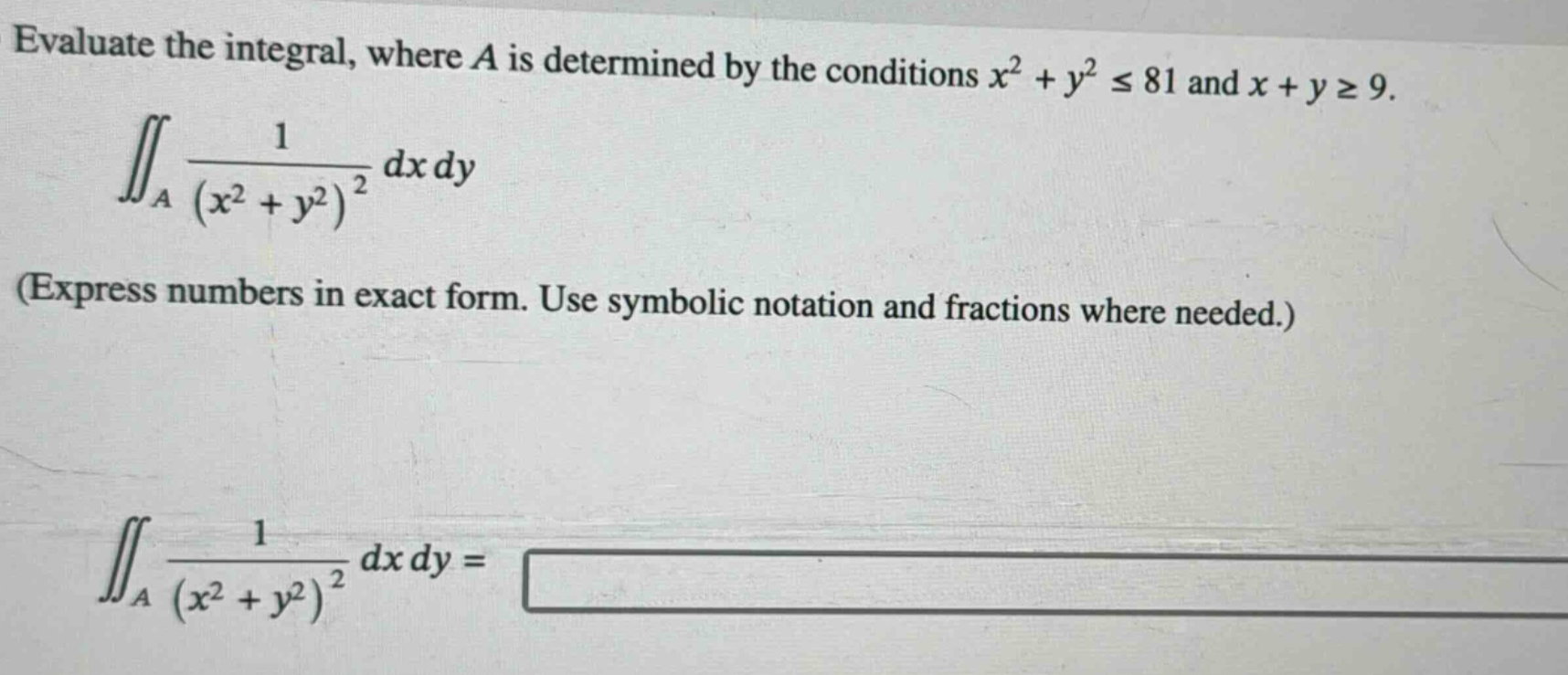
evaluate the integral, where $a$ is determined by the conditions $x^{2}+y^{2}leq81$ and $x + ygeq9$.\n iint_{a}\frac{1}{(x^{2}+y^{2})^{2}}dxdy \n(express numbers in exact form. use symbolic notation and fractions where needed.)\n iint_{a}\frac{1}{(x^{2}+y^{2})^{2}}dxdy=
Answer
Explanation:
Step1: Convert to polar coordinates
In polar coordinates, $x = r\cos\theta$, $y = r\sin\theta$, and $dxdy=r\ drd\theta$, and $x^{2}+y^{2}=r^{2}$. The circle $x^{2}+y^{2}\leq81$ gives $r\leq9$, and the line $x + y\geq9$ becomes $r\cos\theta+r\sin\theta\geq9$, or $r\geq\frac{9}{\cos\theta+\sin\theta}$. Also, $\frac{1}{(x^{2}+y^{2})^{2}}=\frac{1}{r^{4}}$.
Step2: Find the limits of integration for $\theta$
The line $x + y = 9$ and the circle $x^{2}+y^{2}=81$ intersect. Substitute $y = 9 - x$ into $x^{2}+y^{2}=81$, we get $x^{2}+(9 - x)^{2}=81$, $x^{2}+81-18x+x^{2}=81$, $2x^{2}-18x = 0$, $2x(x - 9)=0$. The intersection points are $(0,9)$ and $(9,0)$. In polar - coordinates, these points correspond to $\theta=\frac{\pi}{2}$ and $\theta = 0$. So, the limits for $\theta$ are from $0$ to $\frac{\pi}{2}$.
Step3: Set up the double - integral in polar coordinates
The double - integral $\iint_{A}\frac{1}{(x^{2}+y^{2})^{2}}dxdy$ becomes $\int_{0}^{\frac{\pi}{2}}\int_{\frac{9}{\cos\theta+\sin\theta}}^{9}\frac{1}{r^{4}}\cdot r\ drd\theta=\int_{0}^{\frac{\pi}{2}}\int_{\frac{9}{\cos\theta+\sin\theta}}^{9}\frac{1}{r^{3}}drd\theta$.
Step4: Integrate with respect to $r$ first
$\int_{0}^{\frac{\pi}{2}}\left[-\frac{1}{2r^{2}}\right]{\frac{9}{\cos\theta+\sin\theta}}^{9}d\theta=\int{0}^{\frac{\pi}{2}}\left(-\frac{1}{2\times9^{2}}+\frac{(\cos\theta+\sin\theta)^{2}}{2\times9^{2}}\right)d\theta$.
Step5: Expand and integrate with respect to $\theta$
$\frac{1}{2\times9^{2}}\int_{0}^{\frac{\pi}{2}}(\cos^{2}\theta + 2\sin\theta\cos\theta+\sin^{2}\theta - 1)d\theta$. Since $\cos^{2}\theta+\sin^{2}\theta = 1$, the integral becomes $\frac{1}{162}\int_{0}^{\frac{\pi}{2}}(1 + 2\sin\theta\cos\theta-1)d\theta=\frac{1}{162}\int_{0}^{\frac{\pi}{2}}2\sin\theta\cos\theta d\theta$. Let $u=\sin\theta$, then $du=\cos\theta d\theta$. When $\theta = 0$, $u = 0$; when $\theta=\frac{\pi}{2}$, $u = 1$. So, $\frac{1}{81}\int_{0}^{1}u\ du$.
Step6: Evaluate the final integral
$\frac{1}{81}\left[\frac{u^{2}}{2}\right]_{0}^{1}=\frac{1}{162}$.
Answer:
$\frac{1}{162}$