evaluate the integral. (use c for the constant of integration.) ∫(ln(x)/x²) dx
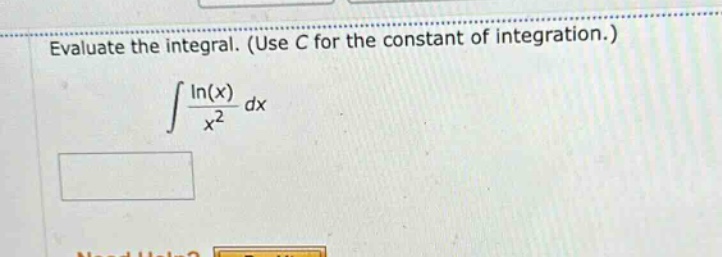
evaluate the integral. (use c for the constant of integration.) ∫(ln(x)/x²) dx
Answer
Explanation:
Step1: Apply integration - by - parts formula
The integration - by - parts formula is $\int u\mathrm{d}v=uv-\int v\mathrm{d}u$. Let $u = \ln(x)$ and $\mathrm{d}v=\frac{1}{x^{2}}\mathrm{d}x$. Then $\mathrm{d}u=\frac{1}{x}\mathrm{d}x$ and $v=-\frac{1}{x}$.
Step2: Substitute into the formula
$\int\frac{\ln(x)}{x^{2}}\mathrm{d}x=-\frac{\ln(x)}{x}-\int(-\frac{1}{x})\cdot\frac{1}{x}\mathrm{d}x$.
Step3: Simplify the second integral
$\int(-\frac{1}{x})\cdot\frac{1}{x}\mathrm{d}x=-\int\frac{1}{x^{2}}\mathrm{d}x$. And $\int\frac{1}{x^{2}}\mathrm{d}x=\int x^{- 2}\mathrm{d}x$. Using the power - rule for integration $\int x^{n}\mathrm{d}x=\frac{x^{n + 1}}{n+1}+C$ ($n\neq - 1$), we have $\int x^{-2}\mathrm{d}x=-\frac{1}{x}+C$.
Step4: Combine the results
$\int\frac{\ln(x)}{x^{2}}\mathrm{d}x=-\frac{\ln(x)}{x}-\left(\frac{1}{x}\right)+C=-\frac{\ln(x)+1}{x}+C$.
Answer:
$-\frac{\ln(x)+1}{x}+C$