evaluate the integral. (use c for the constant of integration.) ∫ln(√x) dx
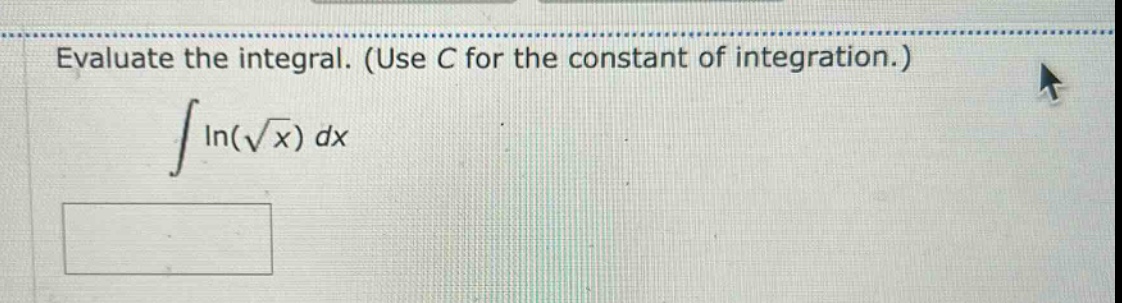
evaluate the integral. (use c for the constant of integration.) ∫ln(√x) dx
Answer
Explanation:
Step1: Simplify the integrand
First, rewrite $\ln(\sqrt{x})$ as $\frac{1}{2}\ln(x)$ since $\sqrt{x}=x^{\frac{1}{2}}$ and $\ln(a^b)=b\ln(a)$. So the integral becomes $\int\frac{1}{2}\ln(x)dx=\frac{1}{2}\int\ln(x)dx$.
Step2: Use integration - by - parts
The integration - by - parts formula is $\int u dv=uv-\int v du$. Let $u = \ln(x)$ and $dv=dx$. Then $du=\frac{1}{x}dx$ and $v = x$. So $\int\ln(x)dx=x\ln(x)-\int x\cdot\frac{1}{x}dx=x\ln(x)-\int 1dx=x\ln(x)-x + C_1$.
Step3: Substitute back
Since our original integral was $\frac{1}{2}\int\ln(x)dx$, substituting the result of $\int\ln(x)dx$ gives $\frac{1}{2}(x\ln(x)-x)+C=\frac{1}{2}x\ln(x)-\frac{1}{2}x + C$.
Answer:
$\frac{1}{2}x\ln(x)-\frac{1}{2}x + C$