7. evaluate the iterated integral 6pts $int_{1}^{2}int_{sqrt{3}x}^{x^{2}}int_{0}^{sqrt{x^{2}+y^{2}}}\frac{y}{…
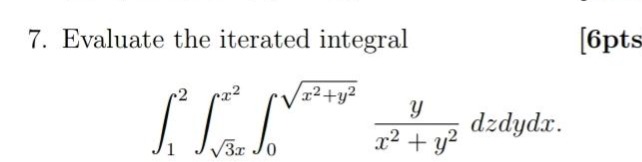
7. evaluate the iterated integral 6pts $int_{1}^{2}int_{sqrt{3}x}^{x^{2}}int_{0}^{sqrt{x^{2}+y^{2}}}\frac{y}{x^{2}+y^{2}}dzdydx$.
Answer
Explanation:
Step1: Integrate with respect to $z$
Integrate $\frac{y}{x^{2}+y^{2}}$ with respect to $z$ from $z = 0$ to $z=\sqrt{x^{2}+y^{2}}$. Since $\frac{y}{x^{2}+y^{2}}$ is treated as a constant with respect to $z$, we have $\int_{0}^{\sqrt{x^{2}+y^{2}}}\frac{y}{x^{2}+y^{2}}dz=\frac{y}{x^{2}+y^{2}}\int_{0}^{\sqrt{x^{2}+y^{2}}}dz=\frac{y}{x^{2}+y^{2}}\cdot z\big|_{0}^{\sqrt{x^{2}+y^{2}}}=\frac{y\sqrt{x^{2}+y^{2}}}{x^{2}+y^{2}}=\frac{y}{\sqrt{x^{2}+y^{2}}}$.
Step2: Convert to polar - coordinates
Let $x = r\cos\theta$ and $y=r\sin\theta$. The region of integration in the $xy$ - plane: The limits for $x$ are from $x = 1$ to $x = 2$, and for $y$ are from $y=\sqrt{3}x$ to $y=x^{2}$. The line $y = \sqrt{3}x$ gives $\tan\theta=\sqrt{3}$, so $\theta=\frac{\pi}{3}$. For the curves in polar - coordinates, $y=x^{2}$ becomes $r\sin\theta=r^{2}\cos^{2}\theta$, or $r=\frac{\sin\theta}{\cos^{2}\theta}$. And $x = 1$ gives $r\cos\theta=1$ or $r=\frac{1}{\cos\theta}$, $x = 2$ gives $r=\frac{2}{\cos\theta}$. Also, $dA=dxdy = r\ drd\theta$ and $\frac{y}{\sqrt{x^{2}+y^{2}}}=\frac{r\sin\theta}{r}=\sin\theta$. The double - integral $\int_{1}^{2}\int_{\sqrt{3}x}^{x^{2}}\frac{y}{\sqrt{x^{2}+y^{2}}}dydx$ becomes $\int_{\frac{\pi}{3}}^{\arctan(4)}\int_{\frac{1}{\cos\theta}}^{\frac{\sin\theta}{\cos^{2}\theta}}r\sin\theta\cdot\frac{1}{r}drd\theta=\int_{\frac{\pi}{3}}^{\arctan(4)}\sin\theta\left(r\big|{\frac{1}{\cos\theta}}^{\frac{\sin\theta}{\cos^{2}\theta}}\right)d\theta=\int{\frac{\pi}{3}}^{\arctan(4)}\sin\theta\left(\frac{\sin\theta}{\cos^{2}\theta}-\frac{1}{\cos\theta}\right)d\theta$.
Step3: Expand and integrate with respect to $\theta$
Expand $\sin\theta\left(\frac{\sin\theta}{\cos^{2}\theta}-\frac{1}{\cos\theta}\right)=\frac{\sin^{2}\theta}{\cos^{2}\theta}-\frac{\sin\theta}{\cos\theta}=\tan^{2}\theta-\tan\theta$. Since $\tan^{2}\theta=\sec^{2}\theta - 1$, we have $\int_{\frac{\pi}{3}}^{\arctan(4)}(\sec^{2}\theta - 1-\tan\theta)d\theta$. Integrating term - by - term: $\int\sec^{2}\theta d\theta=\tan\theta$, $\int 1d\theta=\theta$ and $\int\tan\theta d\theta=-\ln|\cos\theta|$. $\left[\tan\theta-\theta+\ln|\cos\theta|\right]_{\frac{\pi}{3}}^{\arctan(4)}=\left(4-\arctan(4)+\ln\left|\frac{1}{\sqrt{1 + 16}}\right|\right)-\left(\sqrt{3}-\frac{\pi}{3}+\ln\left|\frac{1}{2}\right|\right)$. $=4-\arctan(4)-\frac{1}{2}\ln(17)-\sqrt{3}+\frac{\pi}{3}+\ln(2)$.
Answer:
$4-\arctan(4)-\frac{1}{2}\ln(17)-\sqrt{3}+\frac{\pi}{3}+\ln(2)$