evaluate the limit. if the limit does not exist, enter dne. lim_x→5 (4x^3 + 2x^2 - x + 8)
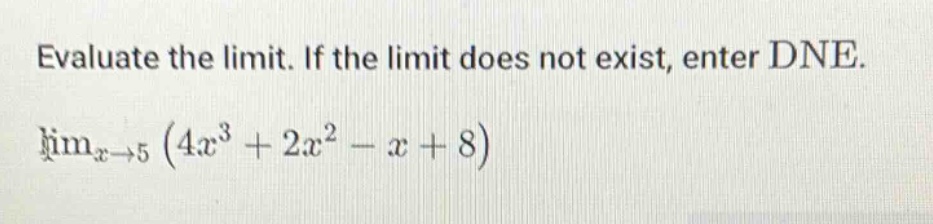
evaluate the limit. if the limit does not exist, enter dne. lim_x→5 (4x^3 + 2x^2 - x + 8)
Answer
Explanation:
Step1: Apply limit - sum rule
The limit of a sum is the sum of the limits. $\lim_{x\rightarrow a}(f(x)+g(x))=\lim_{x\rightarrow a}f(x)+\lim_{x\rightarrow a}g(x)$. So, $\lim_{x\rightarrow 5}(4x^{3}+2x^{2}-x + 8)=\lim_{x\rightarrow 5}(4x^{3})+\lim_{x\rightarrow 5}(2x^{2})-\lim_{x\rightarrow 5}(x)+\lim_{x\rightarrow 5}(8)$.
Step2: Apply constant - multiple rule
The limit of a constant times a function is the constant times the limit of the function. $\lim_{x\rightarrow a}(cf(x))=c\lim_{x\rightarrow a}f(x)$. So we have $4\lim_{x\rightarrow 5}(x^{3})+2\lim_{x\rightarrow 5}(x^{2})-\lim_{x\rightarrow 5}(x)+\lim_{x\rightarrow 5}(8)$.
Step3: Use power rule for limits
The power rule for limits is $\lim_{x\rightarrow a}(x^{n})=a^{n}$. So, $4\times5^{3}+2\times5^{2}-5 + 8$.
Step4: Calculate each term
$4\times5^{3}=4\times125 = 500$, $2\times5^{2}=2\times25 = 50$.
Step5: Perform arithmetic operations
$500+50-5 + 8=550-5 + 8=545+8=553$.
Answer:
$553$