evaluate the limit. if the limit is infinite, enter +∞ or -∞. if the limit does not exist, enter dne. lim…
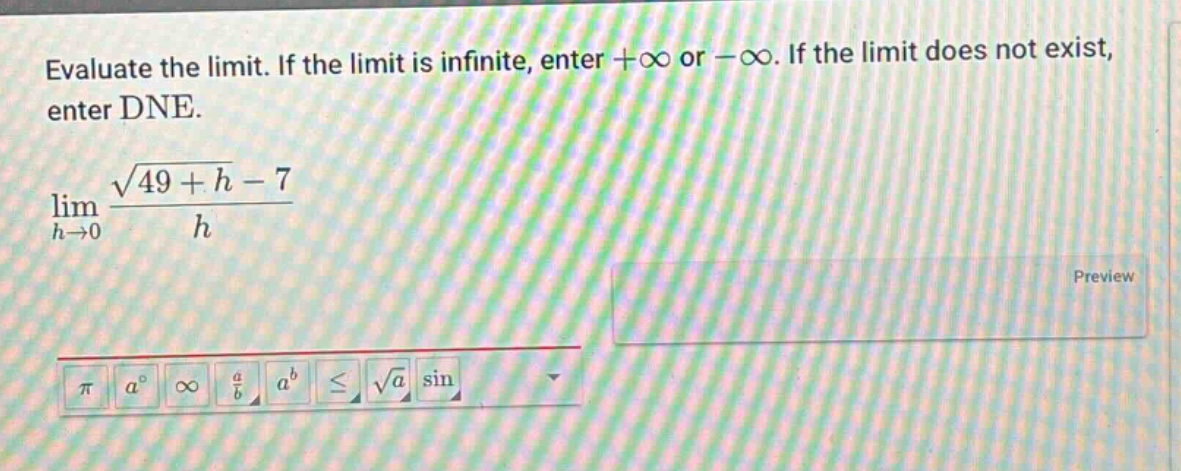
evaluate the limit. if the limit is infinite, enter +∞ or -∞. if the limit does not exist, enter dne. lim h→0 (√(49 + h) - 7)/h
Answer
Explanation:
Step1: Rationalize the numerator
Multiply the fraction by $\frac{\sqrt{49 + h}+7}{\sqrt{49 + h}+7}$. [ \begin{align*} &\lim_{h\rightarrow0}\frac{\sqrt{49 + h}-7}{h}\times\frac{\sqrt{49 + h}+7}{\sqrt{49 + h}+7}\ =&\lim_{h\rightarrow0}\frac{(\sqrt{49 + h}-7)(\sqrt{49 + h}+7)}{h(\sqrt{49 + h}+7)} \end{align*} ]
Step2: Simplify the numerator using difference - of - squares
Since $(a - b)(a + b)=a^{2}-b^{2}$, here $a=\sqrt{49 + h}$ and $b = 7$, so the numerator is $(49 + h)-49=h$. [ \begin{align*} &\lim_{h\rightarrow0}\frac{(49 + h)-49}{h(\sqrt{49 + h}+7)}\ =&\lim_{h\rightarrow0}\frac{h}{h(\sqrt{49 + h}+7)} \end{align*} ]
Step3: Cancel out the common factor
Cancel out the common factor $h$ in the numerator and denominator. [ \begin{align*} &\lim_{h\rightarrow0}\frac{1}{\sqrt{49 + h}+7} \end{align*} ]
Step4: Evaluate the limit
Substitute $h = 0$ into the expression. [ \begin{align*} &\frac{1}{\sqrt{49+0}+7}\ =&\frac{1}{7 + 7}=\frac{1}{14} \end{align*} ]
Answer:
$\frac{1}{14}$