evaluate the limit. if the limit is infinite, enter +∞ or -∞. if the limit does not exist, enter dne…
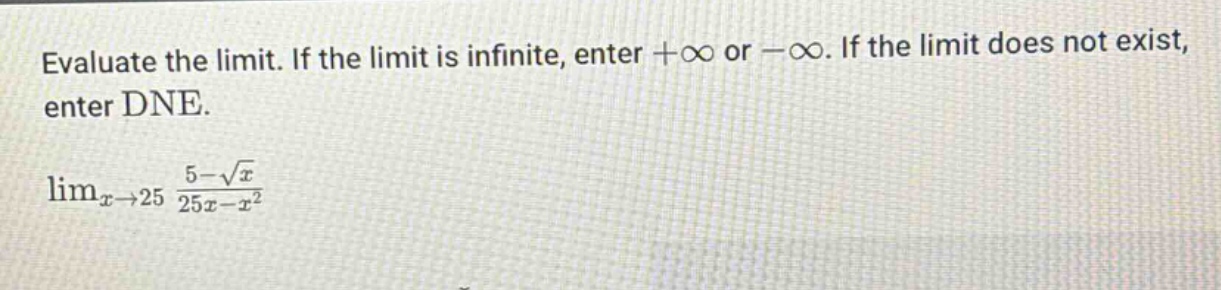
evaluate the limit. if the limit is infinite, enter +∞ or -∞. if the limit does not exist, enter dne. lim_{x→25} (5 - √x)/(25x - x²)
Answer
Explanation:
Step1: Factor the denominator
Factor $25x - x^{2}=x(25 - x)$. So the limit becomes $\lim_{x\rightarrow25}\frac{5-\sqrt{x}}{x(25 - x)}$.
Step2: Rationalize the numerator
Multiply the numerator and denominator by the conjugate of the numerator $5+\sqrt{x}$. We get $\lim_{x\rightarrow25}\frac{(5 - \sqrt{x})(5+\sqrt{x})}{x(25 - x)(5+\sqrt{x})}$. Using the difference - of - squares formula $(a - b)(a + b)=a^{2}-b^{2}$, the numerator is $25 - x$. So the limit is $\lim_{x\rightarrow25}\frac{25 - x}{x(25 - x)(5+\sqrt{x})}$.
Step3: Simplify the expression
Cancel out the common factor $(25 - x)$ (since $x\neq25$ when taking the limit), we have $\lim_{x\rightarrow25}\frac{1}{x(5+\sqrt{x})}$.
Step4: Substitute $x = 25$
Substitute $x = 25$ into $\frac{1}{x(5+\sqrt{x})}$, we get $\frac{1}{25(5+\sqrt{25})}=\frac{1}{25\times(5 + 5)}=\frac{1}{250}$.
Answer:
$\frac{1}{250}$