evaluate the limit. if the limit is infinite, enter +∞ or -∞. if the limit does not exist, enter dne…
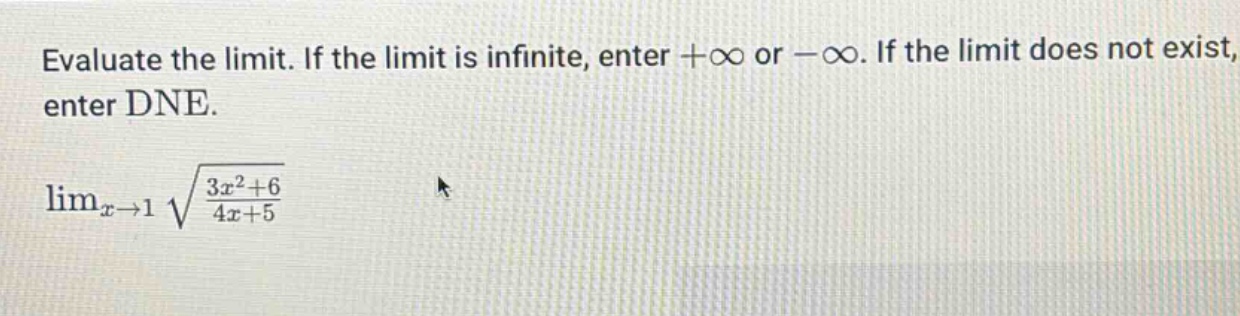
evaluate the limit. if the limit is infinite, enter +∞ or -∞. if the limit does not exist, enter dne. limx→1√(3x² + 6)/(4x + 5)
Answer
Explanation:
Step1: Substitute x = 1
Substitute (x = 1) into the function (\sqrt{\frac{3x^{2}+6}{4x + 5}}). First, find the value of the numerator (3x^{2}+6) when (x = 1): (3\times1^{2}+6=3 + 6=9). Then, find the value of the denominator (4x + 5) when (x = 1): (4\times1+5=4 + 5 = 9). So the fraction (\frac{3x^{2}+6}{4x + 5}) becomes (\frac{9}{9}=1) when (x = 1).
Step2: Take the square - root
Since the value of (\frac{3x^{2}+6}{4x + 5}) at (x = 1) is 1, then (\sqrt{\frac{3x^{2}+6}{4x + 5}}) at (x = 1) is (\sqrt{1}). (\sqrt{1}=1)
Answer:
1