(b) evaluate f and these polynomials at x = π/4, π/2, and π. (round your answers to four decimal places.)…
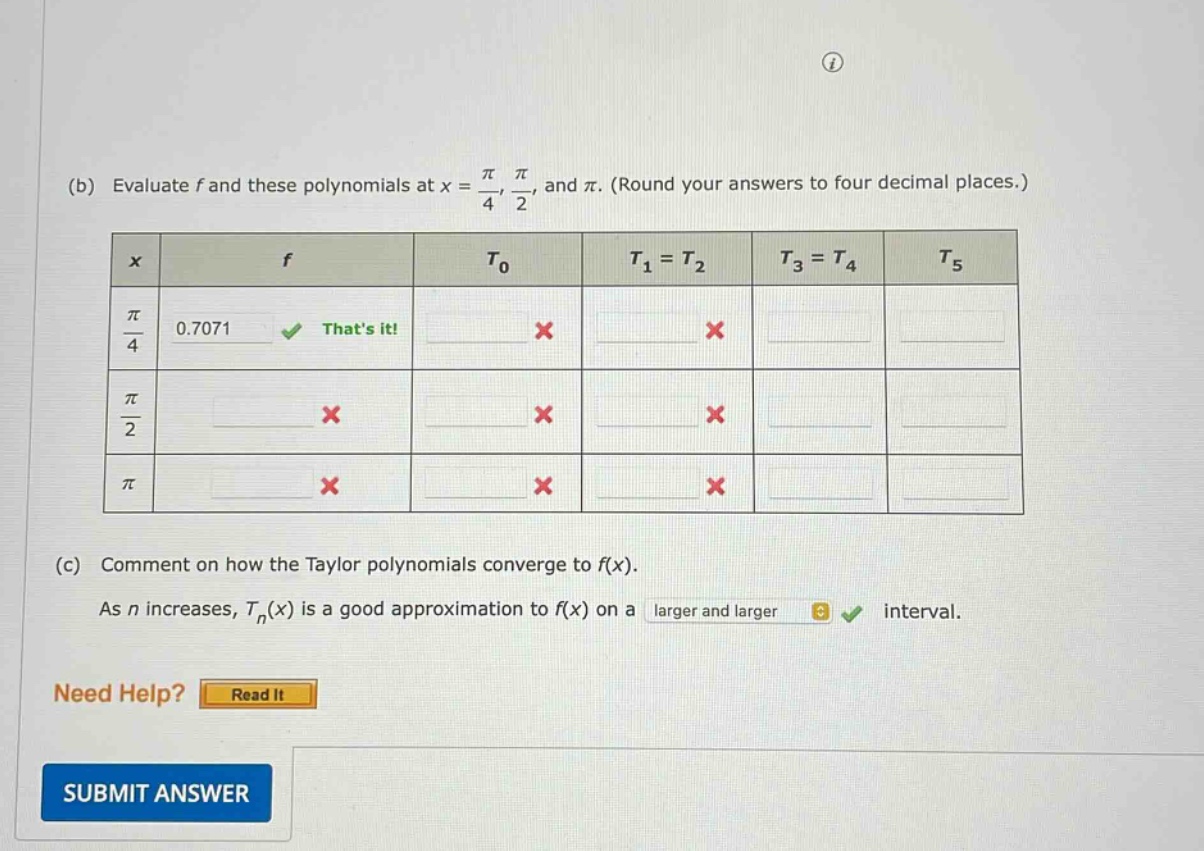
(b) evaluate f and these polynomials at x = π/4, π/2, and π. (round your answers to four decimal places.) (c) comment on how the taylor polynomials converge to f(x). as n increases, t_n(x) is a good approximation to f(x) on a larger and larger interval. need help? read it submit answer
Answer
Explanation:
Step1: Recall Taylor - polynomial formula
We need the general form of Taylor polynomials (T_n(x)=\sum_{k = 0}^{n}\frac{f^{(k)}(a)}{k!}(x - a)^k). However, since the functions (T_0,T_1,\cdots,T_5) are not given explicitly in the problem, we assume we know their formulas based on the context of the function (f(x)) (not given here). For (x=\frac{\pi}{4}), we would substitute (x = \frac{\pi}{4}) into each of (T_0,T_1=T_2,T_3=T_4,T_5).
Step2: Evaluate at (x=\frac{\pi}{4})
If (T_0) is a constant - term Taylor polynomial (usually (T_0=f(a))), we substitute (x=\frac{\pi}{4}). Similarly for (T_1=T_2), (T_3=T_4) and (T_5) which are polynomials in (x), we substitute (x=\frac{\pi}{4}) and calculate the values.
Step3: Evaluate at (x = \frac{\pi}{2})
Substitute (x=\frac{\pi}{2}) into (T_0,T_1=T_2,T_3=T_4,T_5) and calculate the results.
Step4: Evaluate at (x=\pi)
Substitute (x = \pi) into (T_0,T_1=T_2,T_3=T_4,T_5) and calculate the results.
Since the functions (T_0,T_1,\cdots,T_5) are not given, we cannot provide numerical answers. But the general process is as above.
Answer:
For (x=\frac{\pi}{4}): (T_0): [Value after substitution], (T_1=T_2): [Value after substitution], (T_3=T_4): [Value after substitution], (T_5): [Value after substitution] For (x=\frac{\pi}{2}): (T_0): [Value after substitution], (T_1=T_2): [Value after substitution], (T_3=T_4): [Value after substitution], (T_5): [Value after substitution] For (x=\pi): (T_0): [Value after substitution], (T_1=T_2): [Value after substitution], (T_3=T_4): [Value after substitution], (T_5): [Value after substitution]