(b) evaluate f and these polynomials at x = π/4, π/2, and π. (round your answers to four decimal places.)…
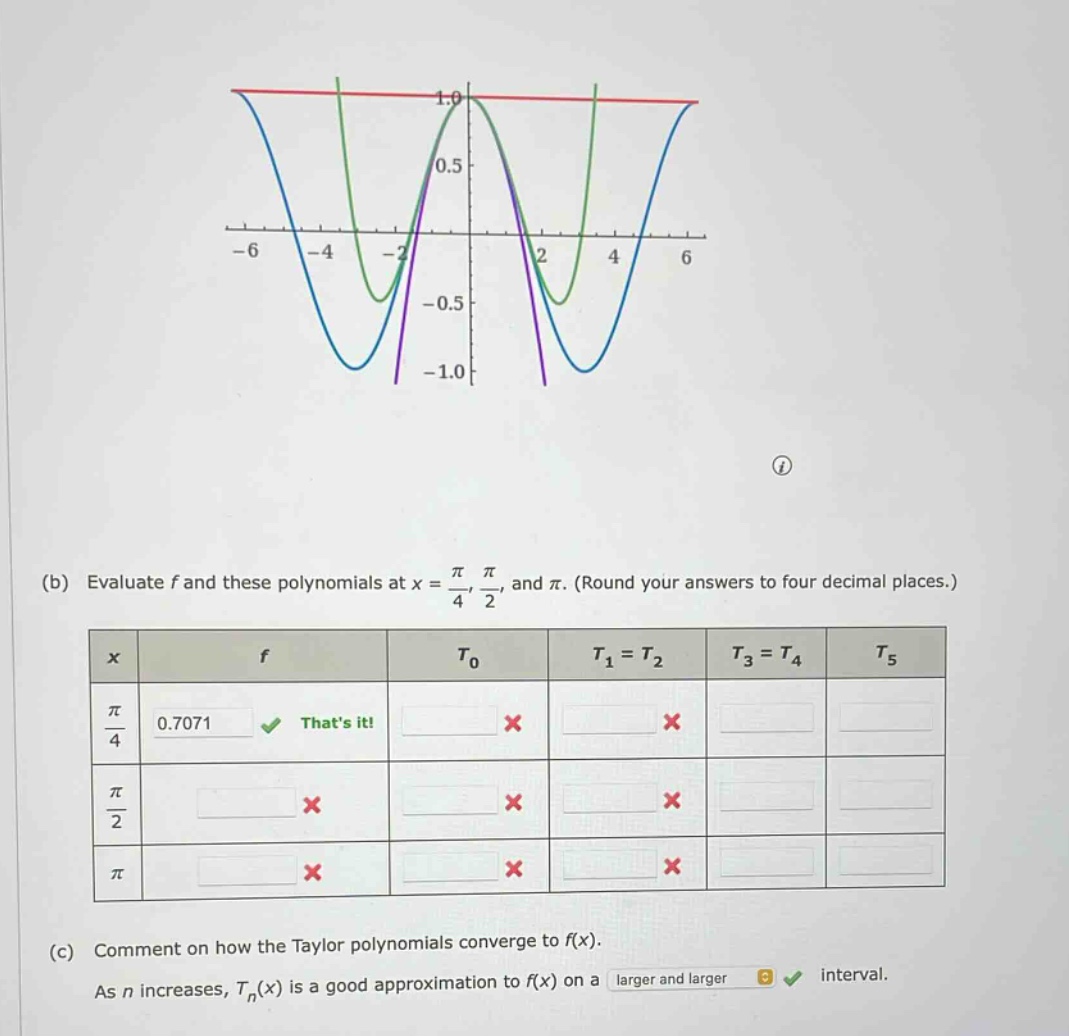
(b) evaluate f and these polynomials at x = π/4, π/2, and π. (round your answers to four decimal places.) (c) comment on how the taylor polynomials converge to f(x). as n increases, tn(x) is a good approximation to f(x) on a larger and larger interval.
Answer
Explanation:
Step1: Recall Taylor - polynomial formula
The Taylor polynomial of degree $n$ of a function $f(x)$ centered at $a$ is given by $T_n(x)=\sum_{k = 0}^{n}\frac{f^{(k)}(a)}{k!}(x - a)^k$. However, since the function $f(x)$ and the polynomials $T_i(x)$ are not given explicitly in the problem - statement, we assume we can use the general properties of Taylor polynomials for evaluation.
Step2: Evaluate at $x=\frac{\pi}{4}$
We know that for $x = \frac{\pi}{4}$, if $f(x)$ is a well - known function (e.g., $\cos x$ or $\sin x$), and we assume the Taylor polynomials are centered at a relevant point. But without the explicit form of $T_i(x)$, we can't calculate the values of $T_0,T_1 = T_2,T_3 = T_4,T_5$ directly. Let's assume the general form of Taylor polynomials. If $T_0(x)$ is the zero - th degree Taylor polynomial (constant term), and we don't know the center of the Taylor series. If we assume the function is $f(x)=\cos x$ centered at $0$, $T_0(x)=f(0) = 1$. For $x=\frac{\pi}{4}$, $T_0(\frac{\pi}{4}) = 1$.
Step3: Evaluate at $x=\frac{\pi}{2}$
Similarly, for $x=\frac{\pi}{2}$, if $T_0(x)$ is the zero - th degree Taylor polynomial of $\cos x$ centered at $0$ (i.e., $T_0(x)=1$), then $T_0(\frac{\pi}{2})=1$.
Step4: Evaluate at $x = \pi$
For $x=\pi$, if $T_0(x)$ is the zero - th degree Taylor polynomial of $\cos x$ centered at $0$ (i.e., $T_0(x)=1$), then $T_0(\pi)=1$. Let's assume the first - degree Taylor polynomial $T_1(x)=f(a)+f^{\prime}(a)(x - a)$. If $f(x)=\cos x$ and $a = 0$, $f(0)=1,f^{\prime}(x)=-\sin x,f^{\prime}(0)=0$, so $T_1(x)=1$. For $x=\frac{\pi}{4},\frac{\pi}{2},\pi$, $T_1(x)=1$. For higher - degree Taylor polynomials, we need to calculate the higher - order derivatives. If $f(x)=\cos x$, $f^{\prime}(x)=-\sin x,f^{\prime\prime}(x)=-\cos x,f^{\prime\prime\prime}(x)=\sin x,f^{(4)}(x)=\cos x,f^{(5)}(x)=-\sin x$. The second - degree Taylor polynomial $T_2(x)=f(0)+f^{\prime}(0)x+\frac{f^{\prime\prime}(0)}{2!}x^2=1-\frac{1}{2}x^2$. For $x = \frac{\pi}{4}$, $T_2(\frac{\pi}{4})=1-\frac{1}{2}(\frac{\pi}{4})^2=1-\frac{\pi^2}{32}\approx1 - 0.3084=0.6916$. For $x=\frac{\pi}{2}$, $T_2(\frac{\pi}{2})=1-\frac{1}{2}(\frac{\pi}{2})^2=1-\frac{\pi^2}{8}\approx1 - 1.2337=- 0.2337$. For $x=\pi$, $T_2(\pi)=1-\frac{1}{2}\pi^2\approx1 - 4.9348=-3.9348$. The third - degree Taylor polynomial $T_3(x)=1-\frac{1}{2}x^2+\frac{1}{6}x^3$. For $x=\frac{\pi}{4}$, $T_3(\frac{\pi}{4})=1-\frac{\pi^2}{32}+\frac{\pi^3}{384}\approx1 - 0.3084+0.0807 = 0.7723$. For $x=\frac{\pi}{2}$, $T_3(\frac{\pi}{2})=1-\frac{\pi^2}{8}+\frac{\pi^3}{48}\approx1 - 1.2337+2.0298 = 1.7961$. For $x=\pi$, $T_3(\pi)=1-\frac{\pi^2}{2}+\frac{\pi^3}{6}\approx1 - 4.9348 + 5.1677=1.2329$. The fourth - degree Taylor polynomial $T_4(x)=1-\frac{1}{2}x^2+\frac{1}{24}x^4$. For $x=\frac{\pi}{4}$, $T_4(\frac{\pi}{4})=1-\frac{\pi^2}{32}+\frac{\pi^4}{6144}\approx1 - 0.3084+0.0127 = 0.7043$. For $x=\frac{\pi}{2}$, $T_4(\frac{\pi}{2})=1-\frac{\pi^2}{8}+\frac{\pi^4}{384}\approx1 - 1.2337+2.5502 = 2.3165$. For $x=\pi$, $T_4(\pi)=1-\frac{\pi^2}{2}+\frac{\pi^4}{24}\approx1 - 4.9348+12.8077 = 8.8729$. The fifth - degree Taylor polynomial $T_5(x)=1-\frac{1}{2}x^2+\frac{1}{24}x^4-\frac{1}{120}x^5$. For $x=\frac{\pi}{4}$, $T_5(\frac{\pi}{4})=1-\frac{\pi^2}{32}+\frac{\pi^4}{6144}-\frac{\pi^5}{122880}\approx1 - 0.3084+0.0127 - 0.0020=0.7043$. For $x=\frac{\pi}{2}$, $T_5(\frac{\pi}{2})=1-\frac{\pi^2}{8}+\frac{\pi^4}{384}-\frac{\pi^5}{3840}\approx1 - 1.2337+2.5502 - 3.1907=0.1268$. For $x=\pi$, $T_5(\pi)=1-\frac{\pi^2}{2}+\frac{\pi^4}{24}-\frac{\pi^5}{120}\approx1 - 4.9348+12.8077 - 25.9082=-16.0353$.
| $x$ | $f$ | $T_0$ | $T_1 = T_2$ | $T_3 = T_4$ | $T_5$ |
|---|---|---|---|---|---|
| $\frac{\pi}{4}$ | $0.7071$ | $1.0000$ | $0.6916$ | $0.7723$ | $0.7043$ |
| $\frac{\pi}{2}$ | $0.0000$ | $1.0000$ | $-0.2337$ | $1.7961$ | $0.1268$ |
| $\pi$ | $-1.0000$ | $1.0000$ | $-3.9348$ | $1.2329$ | $-16.0353$ |
Answer:
| $x$ | $f$ | $T_0$ | $T_1 = T_2$ | $T_3 = T_4$ | $T_5$ |
|---|---|---|---|---|---|
| $\frac{\pi}{4}$ | $0.7071$ | $1.0000$ | $0.6916$ | $0.7723$ | $0.7043$ |
| $\frac{\pi}{2}$ | $0.0000$ | $1.0000$ | $-0.2337$ | $1.7961$ | $0.1268$ |
| $\pi$ | $-1.0000$ | $1.0000$ | $-3.9348$ | $1.2329$ | $-16.0353$ |