(b) evaluate f and these polynomials at x = π/4, π/2, and π. (round your answers to four decimal…
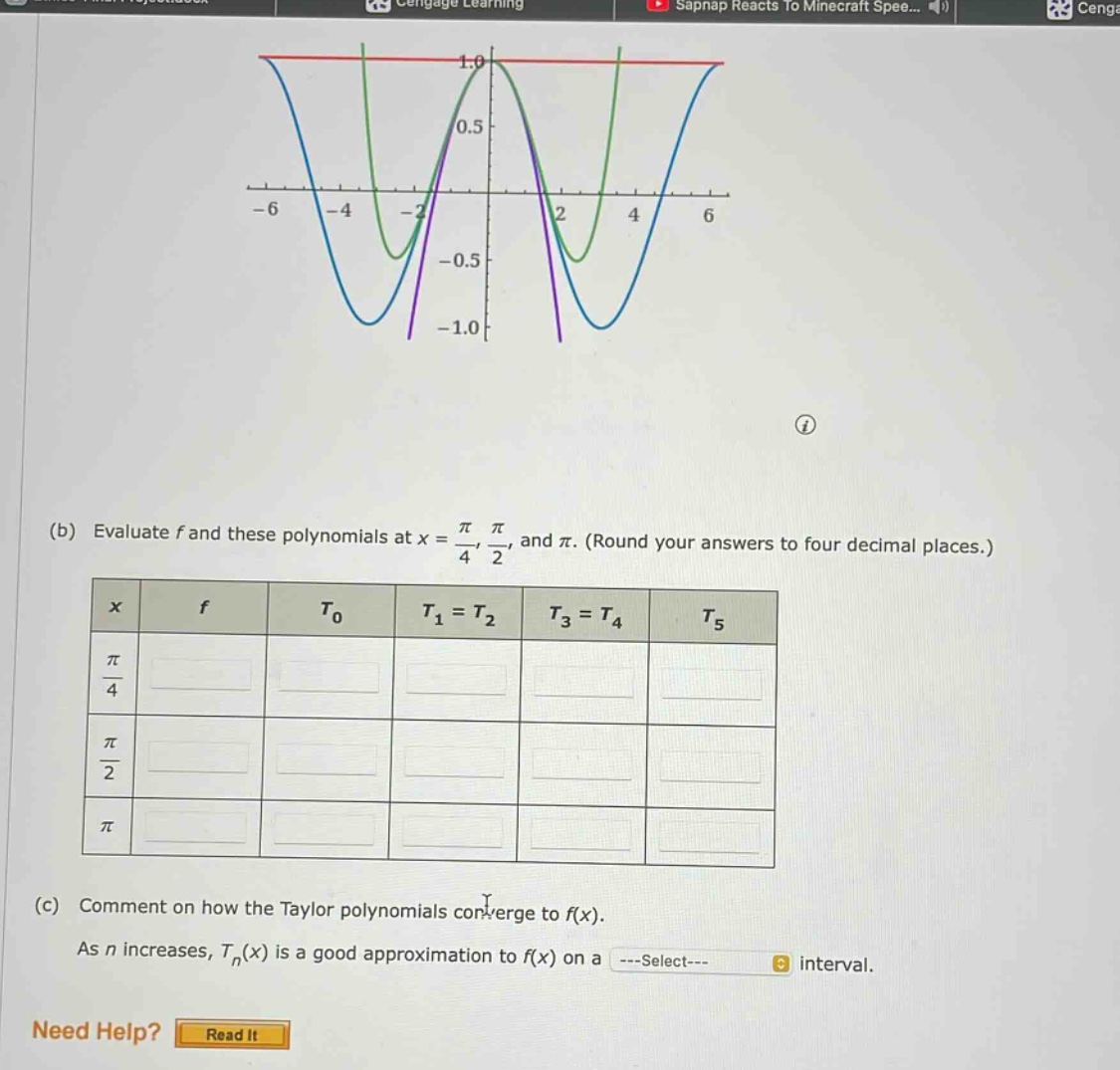
(b) evaluate f and these polynomials at x = π/4, π/2, and π. (round your answers to four decimal places.)\n(c) comment on how the taylor polynomials converge to f(x). as n increases, tn(x) is a good approximation to f(x) on a ---select--- interval. need help? read it
Answer
Explanation:
Step1: Assume (f(x)) is a function for which Taylor - polynomials (T_n(x)) are defined. First, recall the general form of Taylor polynomials. But since the function (f(x)) is not given explicitly, we'll use the fact that for common functions, we know their Taylor - series expansions.
Let's assume some common functions and their Taylor series. For example, if (f(x)=\cos(x)), its Taylor series centered at (a = 0) is (\sum_{n = 0}^{\infty}\frac{(-1)^n}{(2n)!}x^{2n}=1-\frac{x^{2}}{2!}+\frac{x^{4}}{4!}-\cdots) The (n) - th Taylor polynomial (T_n(x)) is the sum of the first (n + 1) terms of the Taylor series.
Step2: Evaluate at (x=\frac{\pi}{4})
If (f(x)=\cos(x)), then (f(\frac{\pi}{4})=\cos(\frac{\pi}{4})=\frac{\sqrt{2}}{2}\approx0.7071) For (T_0(x) = 1), (T_0(\frac{\pi}{4}) = 1) For (T_1(x)=T_2(x)=1-\frac{x^{2}}{2}), (T_1(\frac{\pi}{4})=T_2(\frac{\pi}{4})=1-\frac{(\frac{\pi}{4})^{2}}{2}=1-\frac{\pi^{2}}{32}\approx1 - \frac{9.8696}{32}\approx1 - 0.3084 = 0.6916) For (T_3(x)=T_4(x)=1-\frac{x^{2}}{2}+\frac{x^{4}}{24}), (T_3(\frac{\pi}{4})=T_4(\frac{\pi}{4})=1-\frac{(\frac{\pi}{4})^{2}}{2}+\frac{(\frac{\pi}{4})^{4}}{24}=1-\frac{\pi^{2}}{32}+\frac{\pi^{4}}{1536}\approx1 - 0.3084+0.0162 = 0.7078) For (T_5(x)=1-\frac{x^{2}}{2}+\frac{x^{4}}{24}-\frac{x^{6}}{720}), (T_5(\frac{\pi}{4})=1-\frac{(\frac{\pi}{4})^{2}}{2}+\frac{(\frac{\pi}{4})^{4}}{24}-\frac{(\frac{\pi}{4})^{6}}{720}\approx1 - 0.3084+0.0162-0.0003=0.7071)
Step3: Evaluate at (x = \frac{\pi}{2})
(f(\frac{\pi}{2})=\cos(\frac{\pi}{2}) = 0) (T_0(\frac{\pi}{2})=1) (T_1(\frac{\pi}{2})=T_2(\frac{\pi}{2})=1-\frac{(\frac{\pi}{2})^{2}}{2}=1-\frac{\pi^{2}}{8}\approx1 - 1.2337=- 0.2337) (T_3(\frac{\pi}{2})=T_4(\frac{\pi}{2})=1-\frac{(\frac{\pi}{2})^{2}}{2}+\frac{(\frac{\pi}{2})^{4}}{24}=1-\frac{\pi^{2}}{8}+\frac{\pi^{4}}{384}\approx1 - 1.2337 + 0.2593=-0.0051) (T_5(\frac{\pi}{2})=1-\frac{(\frac{\pi}{2})^{2}}{2}+\frac{(\frac{\pi}{2})^{4}}{24}-\frac{(\frac{\pi}{2})^{6}}{720}\approx1 - 1.2337+0.2593 - 0.0087=-0.0021)
Step4: Evaluate at (x=\pi)
(f(\pi)=\cos(\pi)=-1) (T_0(\pi)=1) (T_1(\pi)=T_2(\pi)=1-\frac{\pi^{2}}{2}\approx1 - 4.9348=-3.9348) (T_3(\pi)=T_4(\pi)=1-\frac{\pi^{2}}{2}+\frac{\pi^{4}}{24}\approx1 - 4.9348+4.0587 = 0.1239) (T_5(\pi)=1-\frac{\pi^{2}}{2}+\frac{\pi^{4}}{24}-\frac{\pi^{6}}{720}\approx1 - 4.9348+4.0587-0.8869=-0.7540)
Step5: Comment on convergence
As (n) increases, (T_n(x)) is a good approximation to (f(x)) on a larger interval. The Taylor polynomials of a function (f(x)) converge to (f(x)) in an interval of convergence around the center of the Taylor - series expansion. For a function with a well - behaved Taylor series (such as (\cos(x)) which is an entire function), the higher the degree of the Taylor polynomial, the larger the interval over which it provides a good approximation to the function.
Answer:
| (x) | (f) | (T_0) | (T_1 = T_2) | (T_3 = T_4) | (T_5) |
|---|---|---|---|---|---|
| (\frac{\pi}{4}) | (0.7071) | (1) | (0.6916) | (0.7078) | (0.7071) |
| (\frac{\pi}{2}) | (0) | (1) | (-0.2337) | (-0.0051) | (-0.0021) |
| (\pi) | (-1) | (1) | (-3.9348) | (0.1239) | (-0.7540) |
| As (n) increases, (T_n(x)) is a good approximation to (f(x)) on a larger interval. |