(b) evaluate f and these polynomials at x = π/4, π/2, and π. (round your answers to four decimal places.)…
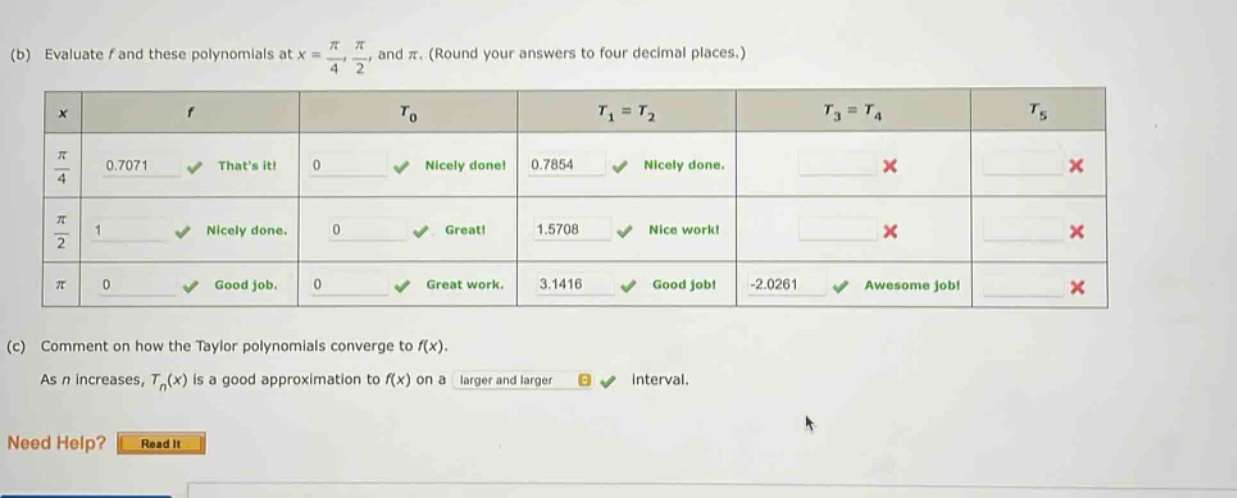
(b) evaluate f and these polynomials at x = π/4, π/2, and π. (round your answers to four decimal places.) (c) comment on how the taylor polynomials converge to f(x). as n increases, t_n(x) is a good approximation to f(x) on a larger and larger interval. need help? read it
Answer
Explanation:
Step1: Recall Taylor - polynomial concept
Taylor polynomials $T_n(x)$ of a function $f(x)$ are used to approximate the function. The general form of the $n$ - th Taylor polynomial of $f(x)$ centered at $a$ is $T_n(x)=\sum_{k = 0}^{n}\frac{f^{(k)}(a)}{k!}(x - a)^k$.
Step2: Analyze convergence
As $n$ increases, the Taylor polynomial $T_n(x)$ includes more and more terms of the Taylor series of $f(x)$. This allows it to better capture the behavior of the function $f(x)$. Mathematically, for a function $f(x)$ that is infinitely - differentiable at a point $a$, the Taylor series $\sum_{n=0}^{\infty}\frac{f^{(n)}(a)}{n!}(x - a)^n$ converges to $f(x)$ on an interval of convergence. The Taylor polynomial $T_n(x)$ is a partial sum of this series. As $n$ gets larger, $T_n(x)$ approximates $f(x)$ more accurately on a larger and larger interval around the center of the Taylor expansion.
Answer:
As $n$ increases, the Taylor polynomial $T_n(x)$ provides a better approximation of $f(x)$ on a larger interval because it includes more terms of the Taylor series which capture more of the function's behavior.