example 3 evaluate each definite integral. a. ∫₀³ (x³ - 6x)dx b. ∫₀² (2x³ - 6x + 3/(x² + 1))dx c. ∫₁⁹ (2t² +…
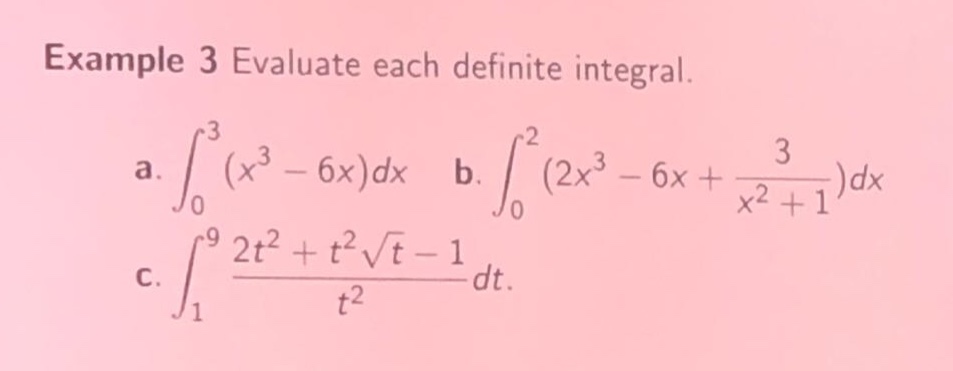
example 3 evaluate each definite integral. a. ∫₀³ (x³ - 6x)dx b. ∫₀² (2x³ - 6x + 3/(x² + 1))dx c. ∫₁⁹ (2t² + t²√t - 1)/t² dt.
Answer
Explanation:
Step1: Recall power - rule for integration
The power - rule for integration is $\int x^n dx=\frac{x^{n + 1}}{n+1}+C$ for $n\neq - 1$, and $\int\frac{1}{x^{2}+1}dx=\arctan(x)+C$. Also, $\int_{a}^{b}f(x)dx=F(b)-F(a)$ where $F(x)$ is an antiderivative of $f(x)$.
Step2: Solve part a
For $\int_{0}^{3}(x^{3}-6x)dx$, first find the antiderivative: The antiderivative of $x^{3}-6x$ is $\frac{x^{4}}{4}-3x^{2}$. Then, by the fundamental theorem of calculus: [ \begin{align*} \int_{0}^{3}(x^{3}-6x)dx&=\left[\frac{x^{4}}{4}-3x^{2}\right]_{0}^{3}\ &=\frac{3^{4}}{4}-3\times3^{2}-\left(\frac{0^{4}}{4}-3\times0^{2}\right)\ &=\frac{81}{4}-27\ &=\frac{81 - 108}{4}\ &=-\frac{27}{4} \end{align*} ]
Step3: Solve part b
For $\int_{0}^{2}(2x^{3}-6x+\frac{3}{x^{2}+1})dx$, find the antiderivative: The antiderivative of $2x^{3}-6x+\frac{3}{x^{2}+1}$ is $\frac{2x^{4}}{4}-3x^{2}+3\arctan(x)=\frac{1}{2}x^{4}-3x^{2}+3\arctan(x)$. Then, by the fundamental theorem of calculus: [ \begin{align*} \int_{0}^{2}(2x^{3}-6x+\frac{3}{x^{2}+1})dx&=\left[\frac{1}{2}x^{4}-3x^{2}+3\arctan(x)\right]_{0}^{2}\ &=\frac{1}{2}\times2^{4}-3\times2^{2}+3\arctan(2)-\left(\frac{1}{2}\times0^{4}-3\times0^{2}+3\arctan(0)\right)\ &=8 - 12+3\arctan(2)-0\ &=3\arctan(2)-4 \end{align*} ]
Step4: Solve part c
First, simplify the integrand $\frac{2t^{2}+t^{2}\sqrt{t}-1}{t^{2}}$. [ \begin{align*} \frac{2t^{2}+t^{2}\sqrt{t}-1}{t^{2}}&=2 + t^{\frac{1}{2}}-t^{-2} \end{align*} ] The antiderivative of $2 + t^{\frac{1}{2}}-t^{-2}$ is $2t+\frac{2}{3}t^{\frac{3}{2}}+\frac{1}{t}$. Then, by the fundamental theorem of calculus: [ \begin{align*} \int_{1}^{9}(2 + t^{\frac{1}{2}}-t^{-2})dt&=\left[2t+\frac{2}{3}t^{\frac{3}{2}}+\frac{1}{t}\right]_{1}^{9}\ &=(2\times9+\frac{2}{3}\times9^{\frac{3}{2}}+\frac{1}{9})-(2\times1+\frac{2}{3}\times1^{\frac{3}{2}}+\frac{1}{1})\ &=(18 + 18+\frac{1}{9})-(2+\frac{2}{3}+1)\ &=36+\frac{1}{9}-3-\frac{2}{3}\ &=33+\frac{1 - 6}{9}\ &=33-\frac{5}{9}\ &=\frac{297 - 5}{9}\ &=\frac{292}{9} \end{align*} ]
Answer:
a. $-\frac{27}{4}$ b. $3\arctan(2)-4$ c. $\frac{292}{9}$