example 2: find the volume of the solid whose base is bounded by the graphs of y = x + 1 and y = x² - 1…
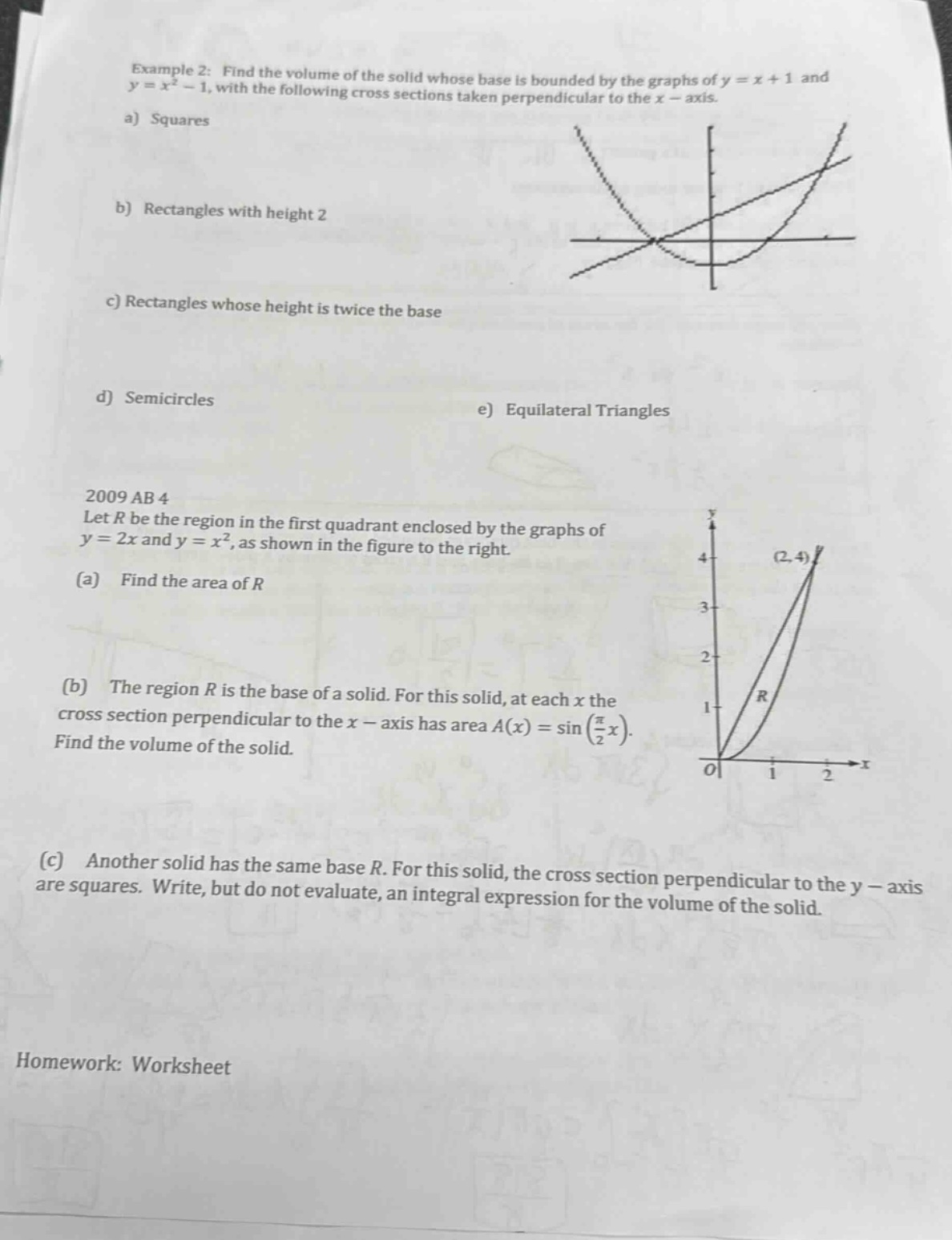
example 2: find the volume of the solid whose base is bounded by the graphs of y = x + 1 and y = x² - 1, with the following cross sections taken perpendicular to the x - axis. a) squares b) rectangles with height 2 c) rectangles whose height is twice the base d) semicircles e) equilateral triangles 2009 ab 4 let r be the region in the first quadrant enclosed by the graphs of y = 2x and y = x², as shown in the figure to the right. (a) find the area of r (b) the region r is the base of a solid. for this solid, at each x the cross section perpendicular to the x - axis has area a(x) = sin(π/2 x). find the volume of the solid. (c) another solid has the same base r. for this solid, the cross section perpendicular to the y - axis are squares. write, but do not evaluate, an integral expression for the volume of the solid. homework: worksheet
Answer
Explanation:
Step1: Find intersection points
Set $x + 1=x^{2}-1$, then $x^{2}-x - 2 = 0$. Factoring gives $(x - 2)(x+1)=0$, so $x=-1,2$.
Step2: Volume with square cross - sections
The side length of the square $s=(x + 1)-(x^{2}-1)=-x^{2}+x + 2$. The volume $V=\int_{-1}^{2}s^{2}dx=\int_{-1}^{2}(-x^{2}+x + 2)^{2}dx=\int_{-1}^{2}(x^{4}-2x^{3}-3x^{2}+4x + 4)dx$. [ \begin{align*} \int_{-1}^{2}(x^{4}-2x^{3}-3x^{2}+4x + 4)dx&=\left[\frac{1}{5}x^{5}-\frac{1}{2}x^{4}-x^{3}+2x^{2}+4x\right]_{-1}^{2}\ &=\left(\frac{1}{5}(2)^{5}-\frac{1}{2}(2)^{4}-(2)^{3}+2(2)^{2}+4(2)\right)-\left(\frac{1}{5}(-1)^{5}-\frac{1}{2}(-1)^{4}-(-1)^{3}+2(-1)^{2}+4(-1)\right)\ &=\left(\frac{32}{5}-8 - 8+8 + 8\right)-\left(-\frac{1}{5}-\frac{1}{2}+1 + 2-4\right)\ &=\frac{32}{5}-\left(-\frac{2 + 5}{10}-1\right)\ &=\frac{32}{5}-\left(-\frac{7}{10}-1\right)\ &=\frac{32}{5}-\left(-\frac{17}{10}\right)\ &=\frac{64 + 17}{10}=\frac{81}{10} \end{align*} ]
Step3: Volume with rectangles of height 2
The base of the rectangle $b=(x + 1)-(x^{2}-1)=-x^{2}+x + 2$. The volume $V = 2\int_{-1}^{2}(-x^{2}+x + 2)dx$. [ \begin{align*} 2\int_{-1}^{2}(-x^{2}+x + 2)dx&=2\left[-\frac{1}{3}x^{3}+\frac{1}{2}x^{2}+2x\right]_{-1}^{2}\ &=2\left[\left(-\frac{8}{3}+2 + 4\right)-\left(\frac{1}{3}+\frac{1}{2}-2\right)\right]\ &=2\left[\left(-\frac{8}{3}+6\right)-\left(\frac{2 + 3}{6}-2\right)\right]\ &=2\left[\frac{- 8+18}{3}-\left(\frac{5}{6}-2\right)\right]\ &=2\left[\frac{10}{3}-\left(\frac{5 - 12}{6}\right)\right]\ &=2\left[\frac{10}{3}+\frac{7}{6}\right]\ &=2\times\frac{20 + 7}{6}=9 \end{align*} ]
Step4: Volume with rectangles where height is twice the base
The base $b=(x + 1)-(x^{2}-1)=-x^{2}+x + 2$, height $h = 2b=2(-x^{2}+x + 2)$. The volume $V=\int_{-1}^{2}h\times bdx=\int_{-1}^{2}2(-x^{2}+x + 2)^{2}dx$. Since we know $\int_{-1}^{2}(-x^{2}+x + 2)^{2}dx=\frac{81}{10}$, then $V = 2\times\frac{81}{10}=\frac{81}{5}$.
Step5: Volume with semi - circles
The diameter of the semi - circle $d=(x + 1)-(x^{2}-1)=-x^{2}+x + 2$, radius $r=\frac{-x^{2}+x + 2}{2}$. The area of the semi - circle $A=\frac{1}{2}\pi r^{2}=\frac{\pi}{8}(-x^{2}+x + 2)^{2}$. The volume $V=\frac{\pi}{8}\int_{-1}^{2}(-x^{2}+x + 2)^{2}dx=\frac{81\pi}{80}$.
Step6: Volume with equilateral triangles
The base of the equilateral triangle $b=(x + 1)-(x^{2}-1)=-x^{2}+x + 2$. The area of an equilateral triangle $A=\frac{\sqrt{3}}{4}b^{2}=\frac{\sqrt{3}}{4}(-x^{2}+x + 2)^{2}$. The volume $V=\frac{\sqrt{3}}{4}\int_{-1}^{2}(-x^{2}+x + 2)^{2}dx=\frac{81\sqrt{3}}{40}$.
For 2009 AB 4:
Step1: Find intersection points of $y = 2x$ and $y=x^{2}$
Set $2x=x^{2}$, then $x^{2}-2x=0$, factoring gives $x(x - 2)=0$, so $x = 0,2$.
Step2: Area of region $R$
The area $A=\int_{0}^{2}(2x - x^{2})dx=\left[x^{2}-\frac{1}{3}x^{3}\right]_{0}^{2}=4-\frac{8}{3}=\frac{4}{3}$.
Step3: Volume of solid with $A(x)=\sin(\frac{\pi}{2}x)$
The volume $V=\int_{0}^{2}\sin(\frac{\pi}{2}x)dx$. Let $u=\frac{\pi}{2}x$, then $du=\frac{\pi}{2}dx$. When $x = 0$, $u = 0$; when $x = 2$, $u=\pi$. So $V=\frac{2}{\pi}\int_{0}^{\pi}\sin(u)du=\frac{2}{\pi}[-\cos(u)]_{0}^{\pi}=\frac{2}{\pi}(1 + 1)=\frac{4}{\pi}$.
Step4: Integral for volume with square cross - sections perpendicular to $y$ - axis
Solve $y = 2x$ for $x=\frac{y}{2}$ and $y=x^{2}$ for $x=\sqrt{y}$. The side length of the square $s=\frac{y}{2}-\sqrt{y}$. The volume $V=\int_{0}^{4}(\frac{y}{2}-\sqrt{y})^{2}dy$.
Answer:
For Example 2: a) $\frac{81}{10}$ b) $9$ c) $\frac{81}{5}$ d) $\frac{81\pi}{80}$ e) $\frac{81\sqrt{3}}{40}$ For 2009 AB 4: a) $\frac{4}{3}$ b) $\frac{4}{\pi}$ c) $\int_{0}^{4}(\frac{y}{2}-\sqrt{y})^{2}dy$