example video example express 1/(1 - x)^2 as a power series by differentiating the equation below. what is…
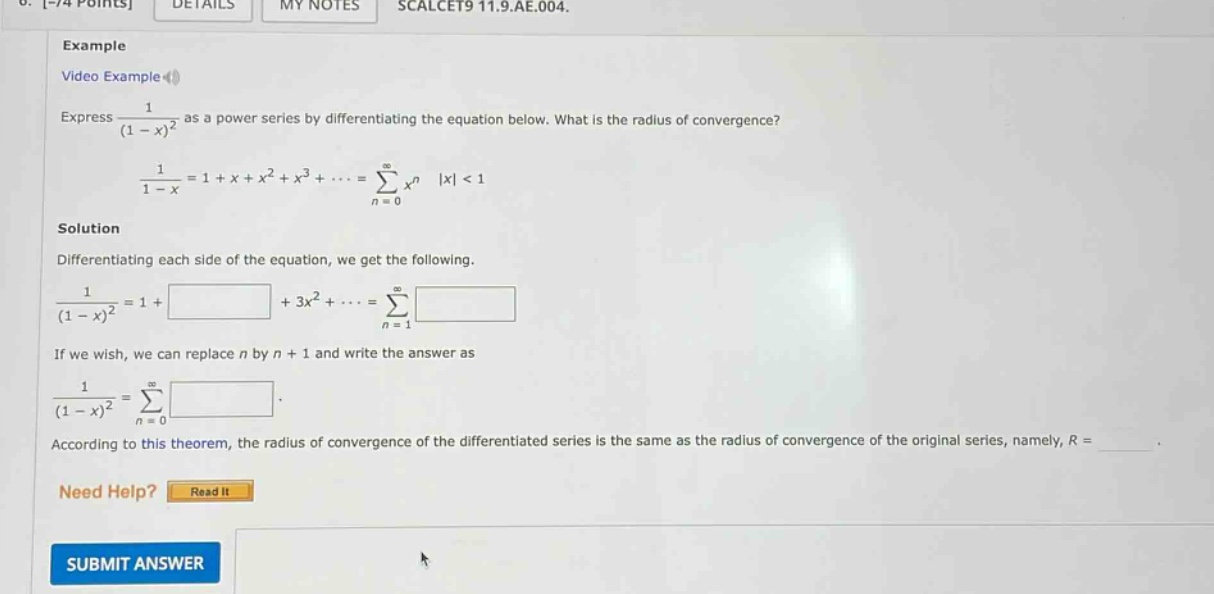
example video example express 1/(1 - x)^2 as a power series by differentiating the equation below. what is the radius of convergence? 1/(1 - x)=1 + x + x^2 + x^3+...=∑(n = 0 to ∞)x^n |x| < 1 solution differentiating each side of the equation, we get the following. 1/(1 - x)^2=1+ +3x^2+...=∑(n = 1 to ∞) if we wish, we can replace n by n + 1 and write the answer as 1/(1 - x)^2=∑(n = 0 to ∞) . according to this theorem, the radius of convergence of the differentiated series is the same as the radius of convergence of the original series, namely, r =
Answer
Explanation:
Step1: Differentiate the power - series
The power - series of $\frac{1}{1 - x}=\sum_{n = 0}^{\infty}x^{n}$, for $|x|\lt1$. Differentiating term - by - term using the power rule $\frac{d}{dx}(x^{n})=nx^{n - 1}$, we have $\frac{d}{dx}(\frac{1}{1 - x})=\frac{1}{(1 - x)^{2}}$ and $\frac{d}{dx}(\sum_{n = 0}^{\infty}x^{n})=\sum_{n = 1}^{\infty}nx^{n - 1}=1 + 2x+3x^{2}+\cdots$.
Step2: Rewrite the series
If we replace $n$ by $n + 1$ in $\sum_{n = 1}^{\infty}nx^{n - 1}$, let $m=n - 1$, then $n=m + 1$. The series becomes $\sum_{m=0}^{\infty}(m + 1)x^{m}$.
Step3: Determine the radius of convergence
The radius of convergence of a power - series and its derivative are the same. Since the radius of convergence of $\frac{1}{1 - x}=\sum_{n = 0}^{\infty}x^{n}$ is $R = 1$, the radius of convergence of $\frac{1}{(1 - x)^{2}}=\sum_{n = 0}^{\infty}(n + 1)x^{n}$ is also $R = 1$.
Answer:
The power - series of $\frac{1}{(1 - x)^{2}}$ is $\sum_{n = 0}^{\infty}(n + 1)x^{n}$ and the radius of convergence $R = 1$.