example video example express 1/(1 - x)^2 as a power series by differentiating the equation below. what is…
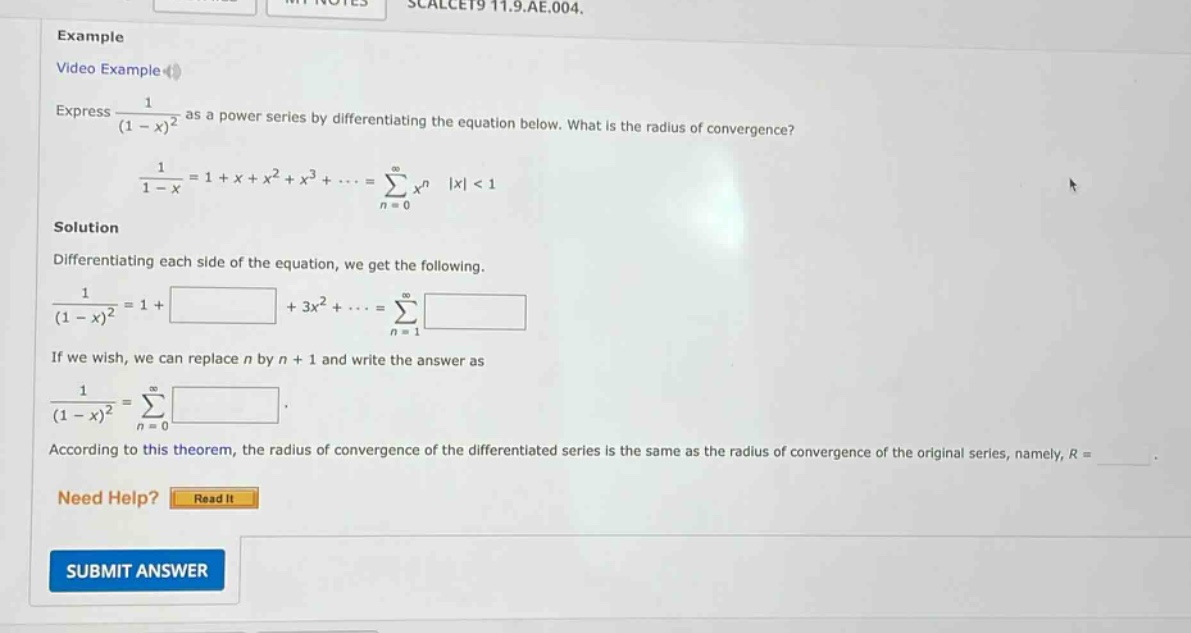
example video example express 1/(1 - x)^2 as a power series by differentiating the equation below. what is the radius of convergence? 1/(1 - x)=1 + x + x^2 + x^3+...=∑(n = 0 to ∞)x^n |x| < 1 solution differentiating each side of the equation, we get the following. 1/(1 - x)^2=1 + +3x^2+...=∑(n = 1 to ∞) if we wish, we can replace n by n + 1 and write the answer as 1/(1 - x)^2=∑(n = 0 to ∞) . according to this theorem, the radius of convergence of the differentiated series is the same as the radius of convergence of the original series, namely, r = _. need help? read it submit answer
Answer
Explanation:
Step1: Differentiate the geometric - series
The geometric - series is $\frac{1}{1 - x}=\sum_{n = 0}^{\infty}x^{n}=1 + x+x^{2}+x^{3}+\cdots$, for $|x|\lt1$. Differentiating term - by - term using the power rule $\frac{d}{dx}(x^{n})=nx^{n - 1}$, we have $\frac{d}{dx}(\frac{1}{1 - x})=\frac{1}{(1 - x)^{2}}$ and $\frac{d}{dx}(\sum_{n = 0}^{\infty}x^{n})=\sum_{n = 1}^{\infty}nx^{n - 1}=1 + 2x+3x^{2}+\cdots$.
Step2: Rewrite the series with a different index
Let $m=n - 1$, then $n=m + 1$. When $n = 1$, $m = 0$. So $\sum_{n = 1}^{\infty}nx^{n - 1}=\sum_{m = 0}^{\infty}(m + 1)x^{m}$.
Step3: Determine the radius of convergence
According to the theorem, the radius of convergence of the differentiated power series is the same as the radius of convergence of the original power series. Since the radius of convergence of $\frac{1}{1 - x}=\sum_{n = 0}^{\infty}x^{n}$ is $R = 1$, the radius of convergence of $\frac{1}{(1 - x)^{2}}=\sum_{n = 0}^{\infty}(n + 1)x^{n}$ is also $R = 1$.
Answer:
The power - series of $\frac{1}{(1 - x)^{2}}$ is $\sum_{n = 0}^{\infty}(n + 1)x^{n}$, and the radius of convergence $R = 1$.