exercise 1: determining volumes\nfind the volume of the solid whose base is the region bounded by the…
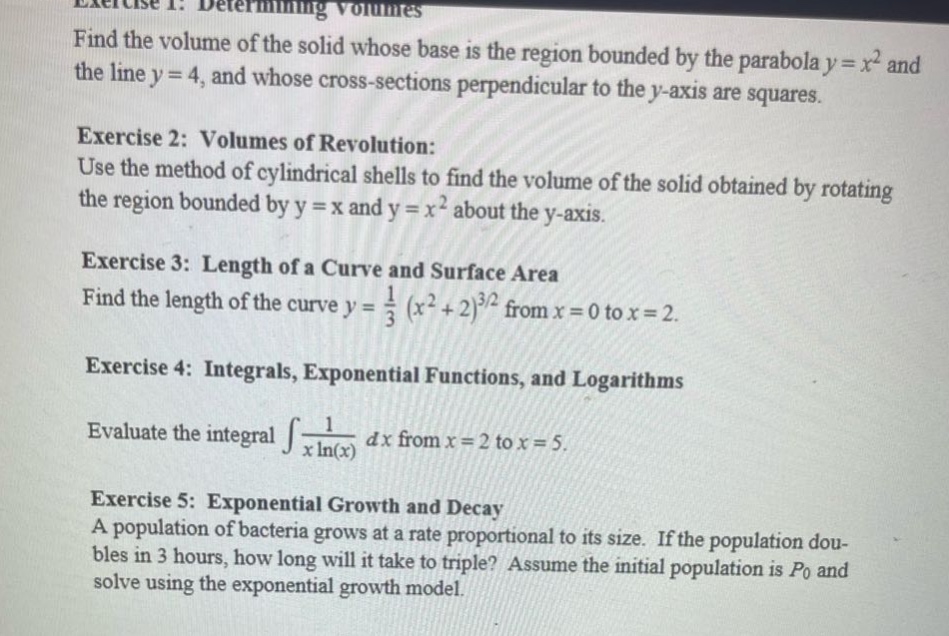
exercise 1: determining volumes\nfind the volume of the solid whose base is the region bounded by the parabola y = x² and the line y = 4, and whose cross - sections perpendicular to the y - axis are squares.\nexercise 2: volumes of revolution:\nuse the method of cylindrical shells to find the volume of the solid obtained by rotating the region bounded by y = x and y = x² about the y - axis.\nexercise 3: length of a curve and surface area\nfind the length of the curve y = 1/3 (x² + 2)^(3/2) from x = 0 to x = 2.\nexercise 4: integrals, exponential functions, and logarithms\nevaluate the integral ∫1/(xln(x)) dx from x = 2 to x = 5.\nexercise 5: exponential growth and decay\na population of bacteria grows at a rate proportional to its size. if the population doubles in 3 hours, how long will it take to triple? assume the initial population is p0 and solve using the exponential growth model.
Answer
Exercise 1
Explanation:
Step1: Find the limits of integration in terms of y
The parabola $y = x^{2}$ and $y = 4$. Solving $y=x^{2}$ for $x$, we get $x=\pm\sqrt{y}$. The cross - sections perpendicular to the $y$-axis are squares. The side length of each square $s$ is $2\sqrt{y}$ (since the distance from $x =-\sqrt{y}$ to $x=\sqrt{y}$). The limits of integration for $y$ are from $y = 0$ to $y = 4$.
Step2: Set up the integral for the volume
The area of a square cross - section $A(y)=s^{2}=(2\sqrt{y})^{2}=4y$. The volume $V$ of the solid using the cross - sectional area formula $V=\int_{a}^{b}A(y)dy$ is $V=\int_{0}^{4}4y;dy$.
Step3: Evaluate the integral
Using the power rule $\int y^{n}dy=\frac{y^{n + 1}}{n+1}+C(n\neq - 1)$, we have $\int_{0}^{4}4y;dy=4\times\frac{y^{2}}{2}\big|{0}^{4}=2y^{2}\big|{0}^{4}=2(4^{2}-0^{2}) = 32$.
Answer:
$32$
Exercise 2
Explanation:
Step1: Find the intersection points of $y = x$ and $y=x^{2}$
Set $x=x^{2}$, then $x^{2}-x = 0$, factoring gives $x(x - 1)=0$. So the intersection points are $x = 0$ and $x = 1$.
Step2: Set up the integral using the cylindrical - shells formula
The formula for the volume $V$ using cylindrical shells when rotating about the $y$-axis is $V = 2\pi\int_{a}^{b}x\left(f(x)-g(x)\right)dx$, where $f(x)=x$ and $g(x)=x^{2}$, and $a = 0$, $b = 1$. So $V=2\pi\int_{0}^{1}x(x - x^{2})dx=2\pi\int_{0}^{1}(x^{2}-x^{3})dx$.
Step3: Evaluate the integral
Using the power rule $\int x^{n}dx=\frac{x^{n+1}}{n + 1}+C(n\neq-1)$, we have $2\pi\int_{0}^{1}(x^{2}-x^{3})dx=2\pi\left(\frac{x^{3}}{3}-\frac{x^{4}}{4}\right)\big|_{0}^{1}=2\pi\left(\frac{1}{3}-\frac{1}{4}\right)=2\pi\times\frac{1}{12}=\frac{\pi}{6}$.
Answer:
$\frac{\pi}{6}$
Exercise 3
Explanation:
Step1: Find the derivative of $y=\frac{1}{3}(x^{2}+2)^{\frac{3}{2}}$
Using the chain - rule, if $u=x^{2}+2$, then $y=\frac{1}{3}u^{\frac{3}{2}}$. $\frac{dy}{du}=\frac{1}{3}\times\frac{3}{2}u^{\frac{1}{2}}=\frac{1}{2}(x^{2}+2)^{\frac{1}{2}}$ and $\frac{du}{dx}=2x$. So $\frac{dy}{dx}=x\sqrt{x^{2}+2}$.
Step2: Set up the arc - length formula
The arc - length formula for a curve $y = f(x)$ from $x=a$ to $x = b$ is $L=\int_{a}^{b}\sqrt{1+\left(\frac{dy}{dx}\right)^{2}}dx$. Here, $1+\left(\frac{dy}{dx}\right)^{2}=1+(x\sqrt{x^{2}+2})^{2}=1 + x^{2}(x^{2}+2)=x^{4}+2x^{2}+1=(x^{2}+1)^{2}$. So $L=\int_{0}^{2}\sqrt{(x^{2}+1)^{2}}dx=\int_{0}^{2}(x^{2}+1)dx$.
Step3: Evaluate the integral
Using the power rule $\int x^{n}dx=\frac{x^{n + 1}}{n+1}+C(n\neq - 1)$, we have $\int_{0}^{2}(x^{2}+1)dx=\left(\frac{x^{3}}{3}+x\right)\big|_{0}^{2}=\frac{8}{3}+2=\frac{8 + 6}{3}=\frac{14}{3}$.
Answer:
$\frac{14}{3}$
Exercise 4
Explanation:
Step1: Use substitution
Let $u=\ln(x)$, then $du=\frac{1}{x}dx$. When $x = 2$, $u=\ln(2)$; when $x = 5$, $u=\ln(5)$. The integral $\int_{2}^{5}\frac{1}{x\ln(x)}dx=\int_{\ln(2)}^{\ln(5)}\frac{1}{u}du$.
Step2: Evaluate the integral
The antiderivative of $\frac{1}{u}$ is $\ln|u|+C$. So $\int_{\ln(2)}^{\ln(5)}\frac{1}{u}du=\ln|u|\big|_{\ln(2)}^{\ln(5)}=\ln(\ln(5))-\ln(\ln(2))=\ln\left(\frac{\ln(5)}{\ln(2)}\right)$.
Answer:
$\ln\left(\frac{\ln(5)}{\ln(2)}\right)$
Exercise 5
Explanation:
Step1: Write the exponential growth model
The exponential growth model is $\frac{dP}{dt}=kP$, where $P$ is the population at time $t$, and $k$ is the growth constant. The solution of the differential equation is $P(t)=P_{0}e^{kt}$.
Step2: Find the value of $k$
Since the population doubles in 3 hours, when $t = 3$, $P(3)=2P_{0}$. Substituting into $P(t)=P_{0}e^{kt}$, we get $2P_{0}=P_{0}e^{3k}$. Canceling out $P_{0}$ (since $P_{0}\neq0$), we have $e^{3k}=2$, then $k=\frac{\ln(2)}{3}$.
Step3: Find the time $t$ when the population triples
We want to find $t$ when $P(t)=3P_{0}$. Substitute into $P(t)=P_{0}e^{kt}$: $3P_{0}=P_{0}e^{\frac{\ln(2)}{3}t}$. Canceling out $P_{0}$, we get $e^{\frac{\ln(2)}{3}t}=3$. Take the natural logarithm of both sides: $\frac{\ln(2)}{3}t=\ln(3)$. Solving for $t$, we have $t=\frac{3\ln(3)}{\ln(2)}$.
Answer:
$\frac{3\ln(3)}{\ln(2)}$