in exercises 10 - 13, graph the function. identify the x - intercepts and the po where the local maximums…
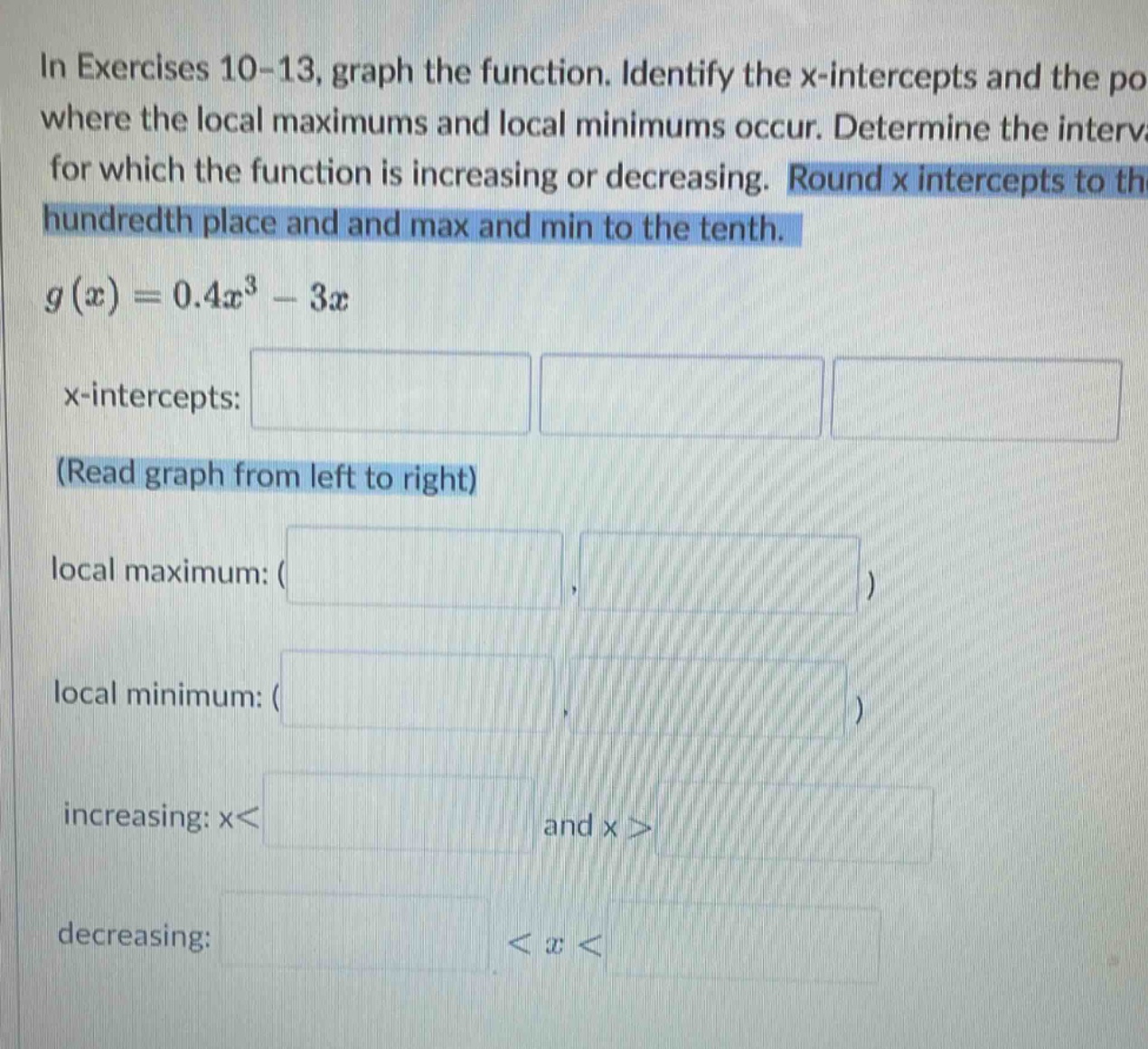
in exercises 10 - 13, graph the function. identify the x - intercepts and the po where the local maximums and local minimums occur. determine the interv for which the function is increasing or decreasing. round x intercepts to the hundredth place and and max and min to the tenth. g(x)=0.4x³ - 3x x - intercepts: (read graph from left to right) local maximum: ( ) local minimum: ( ) increasing: x< and x> decreasing: <x<
Answer
Explanation:
Step1: Find x - intercepts
Set $g(x)=0$, so $0.4x^{3}-3x = 0$. Factor out $x$: $x(0.4x^{2}-3)=0$. Then $x = 0$ or $0.4x^{2}-3=0$. Solving $0.4x^{2}-3=0$ gives $x^{2}=\frac{3}{0.4}=7.5$, so $x=\pm\sqrt{7.5}\approx\pm2.74$.
Step2: Find the derivative
$g^\prime(x)=1.2x^{2}-3$.
Step3: Find critical points
Set $g^\prime(x) = 0$. So $1.2x^{2}-3 = 0$. Then $x^{2}=\frac{3}{1.2}=2.5$, and $x=\pm\sqrt{2.5}\approx\pm1.58$.
Step4: Determine local max and min
Substitute $x = - 1.58$ into $g(x)$: $g(-1.58)=0.4(-1.58)^{3}-3(-1.58)\approx2.4$. Substitute $x = 1.58$ into $g(x)$: $g(1.58)=0.4(1.58)^{3}-3(1.58)\approx - 2.4$.
Step5: Determine intervals of increase and decrease
Test intervals: For $x<-1.58$, let $x=-2$, $g^\prime(-2)=1.2\times(-2)^{2}-3 = 1.8>0$, so increasing. For $-1.58<x<1.58$, let $x = 0$, $g^\prime(0)=-3<0$, so decreasing. For $x>1.58$, let $x = 2$, $g^\prime(2)=1.2\times2^{2}-3 = 1.8>0$, so increasing.
Answer:
x - intercepts: $-2.74$, $0$, $2.74$ local maximum: $(-1.6,2.4)$ local minimum: $(1.6,-2.4)$ increasing: $x < - 1.6$ and $x>1.6$ decreasing: $-1.6 < x < 1.6$