in exercises 10-13, graph the function. identify the x - intercepts and the points where the local maximums…
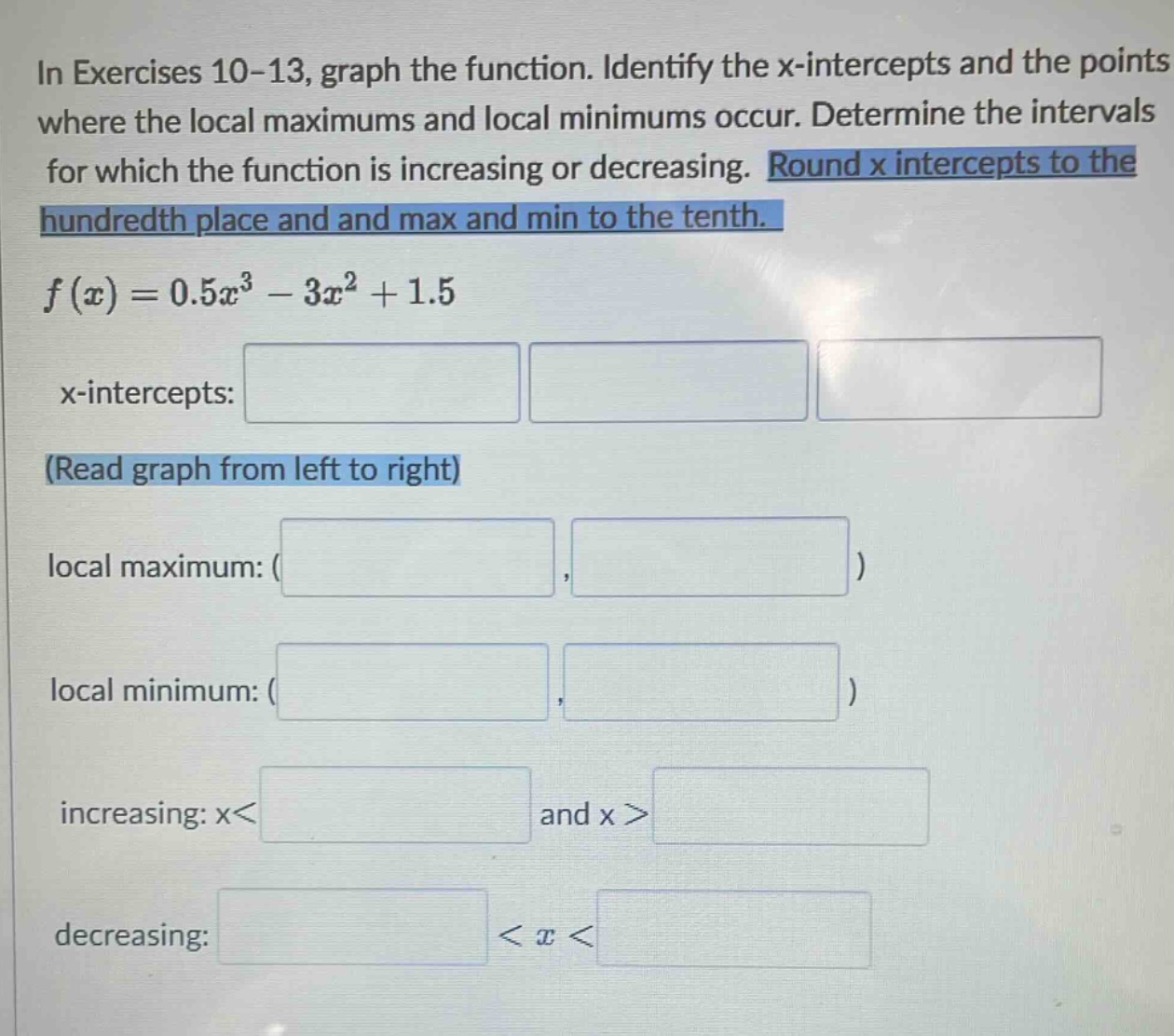
in exercises 10-13, graph the function. identify the x - intercepts and the points where the local maximums and local minimums occur. determine the intervals for which the function is increasing or decreasing. round x intercepts to the hundredth place and and max and min to the tenth. f(x)=0.5x³ - 3x² + 1.5 x - intercepts: (read graph from left to right) local maximum: ( , ) local minimum: ( , ) increasing: x< and x > decreasing: < x <
Answer
Explanation:
Step1: Find the derivative
The derivative of $f(x)=0.5x^{3}-3x^{2}+1.5$ using the power - rule $(x^n)' = nx^{n - 1}$ is $f'(x)=1.5x^{2}-6x=1.5x(x - 4)$.
Step2: Find the x - intercepts
Set $f(x)=0$, so $0.5x^{3}-3x^{2}+1.5 = 0$. Multiply through by 2 to get $x^{3}-6x^{2}+3 = 0$. Using a numerical method (such as Newton - Raphson method or a graphing utility), the x - intercepts are approximately $x\approx - 0.67,0.73,5.94$.
Step3: Find critical points
Set $f'(x)=0$. Since $f'(x)=1.5x(x - 4)=0$, the critical points are $x = 0$ and $x = 4$.
Step4: Determine local maxima and minima
Find the second - derivative $f''(x)=3x-6$. When $x = 0$, $f''(0)=-6<0$, so $f(x)$ has a local maximum at $x = 0$. And $f(0)=1.5$. When $x = 4$, $f''(4)=12 - 6=6>0$, so $f(x)$ has a local minimum at $x = 4$. And $f(4)=0.5\times4^{3}-3\times4^{2}+1.5=0.5\times64 - 3\times16+1.5=32-48 + 1.5=-14.5$.
Step5: Determine intervals of increase and decrease
Test intervals: For $x<0$, let $x=-1$, then $f'(-1)=1.5\times(-1)\times(-1 - 4)=7.5>0$, so $f(x)$ is increasing on $x<0$. For $0<x<4$, let $x = 1$, then $f'(1)=1.5\times1\times(1 - 4)=-4.5<0$, so $f(x)$ is decreasing on $0<x<4$. For $x>4$, let $x = 5$, then $f'(5)=1.5\times5\times(5 - 4)=7.5>0$, so $f(x)$ is increasing on $x>4$.
Answer:
x - intercepts: $-0.67$, $0.73$, $5.94$ local maximum: $(0,1.5)$ local minimum: $(4,-14.5)$ increasing: $x<0$ and $x>4$ decreasing: $0<x<4$