in exercises 7 - 12, test for symmetry with respect to a. the polar axis. b. the line θ = π/2. c. the pole…
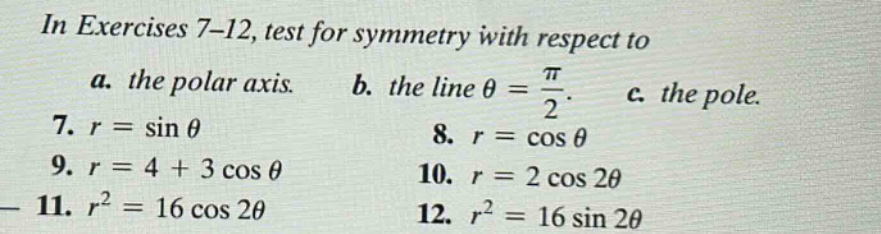
in exercises 7 - 12, test for symmetry with respect to a. the polar axis. b. the line θ = π/2. c. the pole. 7. r = sin θ 8. r = cos θ 9. r = 4 + 3 cos θ 10. r = 2 cos 2θ 11. r² = 16 cos 2θ 12. r² = 16 sin 2θ
Answer
- Testing for symmetry with respect to the polar - axis ((\theta = 0)):
- Replace (\theta) with (-\theta) in the polar equation. Recall that (\sin(-\theta)=-\sin\theta) and (\cos(-\theta)=\cos\theta).
- For (r = \sin\theta):
- Substitute (\theta) with (-\theta), we get (r=\sin(-\theta)=-\sin\theta). The original equation (r = \sin\theta) and (r=-\sin\theta) are not equivalent, so the graph of (r = \sin\theta) is not symmetric about the polar - axis.
- For (r=\cos\theta):
- Substitute (\theta) with (-\theta), we get (r = \cos(-\theta)=\cos\theta). Since the new equation is the same as the original one, the graph of (r=\cos\theta) is symmetric about the polar - axis.
- For (r = 4 + 3\cos\theta):
- Substitute (\theta) with (-\theta), we get (r = 4+3\cos(-\theta)=4 + 3\cos\theta). Since the new equation is the same as the original one, the graph of (r = 4 + 3\cos\theta) is symmetric about the polar - axis.
- For (r = 2\cos2\theta):
- Substitute (\theta) with (-\theta), we know that (\cos2(-\theta)=\cos(- 2\theta)=\cos2\theta). So (r = 2\cos2(-\theta)=2\cos2\theta). Since the new equation is the same as the original one, the graph of (r = 2\cos2\theta) is symmetric about the polar - axis.
- For (r^{2}=16\cos2\theta):
- Substitute (\theta) with (-\theta), we have (r^{2}=16\cos2(-\theta)=16\cos2\theta). Since the new equation is the same as the original one, the graph of (r^{2}=16\cos2\theta) is symmetric about the polar - axis.
- For (r^{2}=16\sin2\theta):
- Substitute (\theta) with (-\theta), we get (r^{2}=16\sin2(-\theta)=-16\sin2\theta). The original equation (r^{2}=16\sin2\theta) and (r^{2}=-16\sin2\theta) are not equivalent, so the graph of (r^{2}=16\sin2\theta) is not symmetric about the polar - axis.
- For (r = \sin\theta):
- Replace (\theta) with (-\theta) in the polar equation. Recall that (\sin(-\theta)=-\sin\theta) and (\cos(-\theta)=\cos\theta).
- Testing for symmetry with respect to the line (\theta=\frac{\pi}{2}):
- Replace ((r,\theta)) with ((r,\pi - \theta)) or ((-r,-\theta)). Recall that (\sin(\pi-\theta)=\sin\theta) and (\cos(\pi - \theta)=-\cos\theta).
- For (r = \sin\theta):
- Substitute (\theta) with (\pi-\theta), we get (r=\sin(\pi - \theta)=\sin\theta). Since the new equation is the same as the original one, the graph of (r = \sin\theta) is symmetric about the line (\theta=\frac{\pi}{2}).
- For (r=\cos\theta):
- Substitute (\theta) with (\pi - \theta), we get (r=\cos(\pi - \theta)=-\cos\theta). The original equation (r=\cos\theta) and (r = -\cos\theta) are not equivalent, so the graph of (r=\cos\theta) is not symmetric about the line (\theta=\frac{\pi}{2}).
- For (r = 4 + 3\cos\theta):
- Substitute (\theta) with (\pi - \theta), we get (r = 4+3\cos(\pi - \theta)=4-3\cos\theta). The original equation (r = 4 + 3\cos\theta) and (r = 4-3\cos\theta) are not equivalent, so the graph of (r = 4 + 3\cos\theta) is not symmetric about the line (\theta=\frac{\pi}{2}).
- For (r = 2\cos2\theta):
- Recall that (\cos2(\pi - \theta)=\cos(2\pi - 2\theta)=\cos2\theta). Substitute (\theta) with (\pi - \theta), we get (r = 2\cos2(\pi - \theta)=2\cos2\theta). Since the new equation is the same as the original one, the graph of (r = 2\cos2\theta) is symmetric about the line (\theta=\frac{\pi}{2}).
- For (r^{2}=16\cos2\theta):
- Substitute (\theta) with (\pi - \theta), we have (r^{2}=16\cos2(\pi - \theta)=16\cos2\theta). Since the new equation is the same as the original one, the graph of (r^{2}=16\cos2\theta) is symmetric about the line (\theta=\frac{\pi}{2}).
- For (r^{2}=16\sin2\theta):
- Substitute (\theta) with (\pi - \theta), we get (r^{2}=16\sin2(\pi - \theta)=16\sin(2\pi - 2\theta)=-16\sin2\theta). The original equation (r^{2}=16\sin2\theta) and (r^{2}=-16\sin2\theta) are not equivalent, so the graph of (r^{2}=16\sin2\theta) is not symmetric about the line (\theta=\frac{\pi}{2}).
- For (r = \sin\theta):
- Replace ((r,\theta)) with ((r,\pi - \theta)) or ((-r,-\theta)). Recall that (\sin(\pi-\theta)=\sin\theta) and (\cos(\pi - \theta)=-\cos\theta).
- Testing for symmetry with respect to the pole ((r = 0)):
- Replace (r) with (-r) in the polar equation.
- For (r = \sin\theta):
- Replace (r) with (-r), we get (-r=\sin\theta) or (r=-\sin\theta). The original equation (r = \sin\theta) and (r=-\sin\theta) are not equivalent, so the graph of (r = \sin\theta) is not symmetric about the pole.
- For (r=\cos\theta):
- Replace (r) with (-r), we get (-r=\cos\theta) or (r = -\cos\theta). The original equation (r=\cos\theta) and (r = -\cos\theta) are not equivalent, so the graph of (r=\cos\theta) is not symmetric about the pole.
- For (r = 4 + 3\cos\theta):
- Replace (r) with (-r), we get (-r = 4+3\cos\theta) or (r=-4 - 3\cos\theta). The original equation (r = 4 + 3\cos\theta) and (r=-4 - 3\cos\theta) are not equivalent, so the graph of (r = 4 + 3\cos\theta) is not symmetric about the pole.
- For (r = 2\cos2\theta):
- Replace (r) with (-r), we get (-r = 2\cos2\theta) or (r=-2\cos2\theta). The original equation (r = 2\cos2\theta) and (r=-2\cos2\theta) are not equivalent, so the graph of (r = 2\cos2\theta) is not symmetric about the pole.
- For (r^{2}=16\cos2\theta):
- Replace (r) with (-r), we have ((-r)^{2}=r^{2}=16\cos2\theta). Since the new equation is the same as the original one, the graph of (r^{2}=16\cos2\theta) is symmetric about the pole.
- For (r^{2}=16\sin2\theta):
- Replace (r) with (-r), we get ((-r)^{2}=r^{2}=16\sin2\theta). Since the new equation is the same as the original one, the graph of (r^{2}=16\sin2\theta) is symmetric about the pole.
- For (r = \sin\theta):
- Replace (r) with (-r) in the polar equation.
Summary:
- For (r = \sin\theta):
- Symmetric about the line (\theta=\frac{\pi}{2}), not symmetric about the polar - axis and the pole.
- For (r=\cos\theta):
- Symmetric about the polar - axis, not symmetric about the line (\theta=\frac{\pi}{2}) and the pole.
- For (r = 4 + 3\cos\theta):
- Symmetric about the polar - axis, not symmetric about the line (\theta=\frac{\pi}{2}) and the pole.
- For (r = 2\cos2\theta):
- Symmetric about the polar - axis and the line (\theta=\frac{\pi}{2}), not symmetric about the pole.
- For (r^{2}=16\cos2\theta):
- Symmetric about the polar - axis, the line (\theta=\frac{\pi}{2}), and the pole.
- For (r^{2}=16\sin2\theta):
- Symmetric about the pole, not symmetric about the polar - axis and the line (\theta=\frac{\pi}{2}).
Explanation:
Step1: Test for polar - axis symmetry
Replace (\theta) with (-\theta) in each equation. Use trigonometric identities (\sin(-\theta)=-\sin\theta) and (\cos(-\theta)=\cos\theta) to check if the new equation is the same as the original.
Step2: Test for symmetry about (\theta=\frac{\pi}{2})
Replace (\theta) with (\pi - \theta) in each equation. Use trigonometric identities (\sin(\pi-\theta)=\sin\theta) and (\cos(\pi - \theta)=-\cos\theta) to check for equivalence.
Step3: Test for pole symmetry
Replace (r) with (-r) in each equation. Check if the new equation is the same as the original.
Answer:
- (r = \sin\theta): Symmetric about (\theta=\frac{\pi}{2}), not symmetric about polar - axis and pole.
- (r=\cos\theta): Symmetric about polar - axis, not symmetric about (\theta=\frac{\pi}{2}) and pole.
- (r = 4 + 3\cos\theta): Symmetric about polar - axis, not symmetric about (\theta=\frac{\pi}{2}) and pole.
- (r = 2\cos2\theta): Symmetric about polar - axis and (\theta=\frac{\pi}{2}), not symmetric about pole.
- (r^{2}=16\cos2\theta): Symmetric about polar - axis, (\theta=\frac{\pi}{2}), and pole.
- (r^{2}=16\sin2\theta): Symmetric about pole, not symmetric about polar - axis and (\theta=\frac{\pi}{2}).