in exercises 29 and 30, answer the questions for the piecewise - defined function.\n29. $f(x)=\\begin{cases}1…
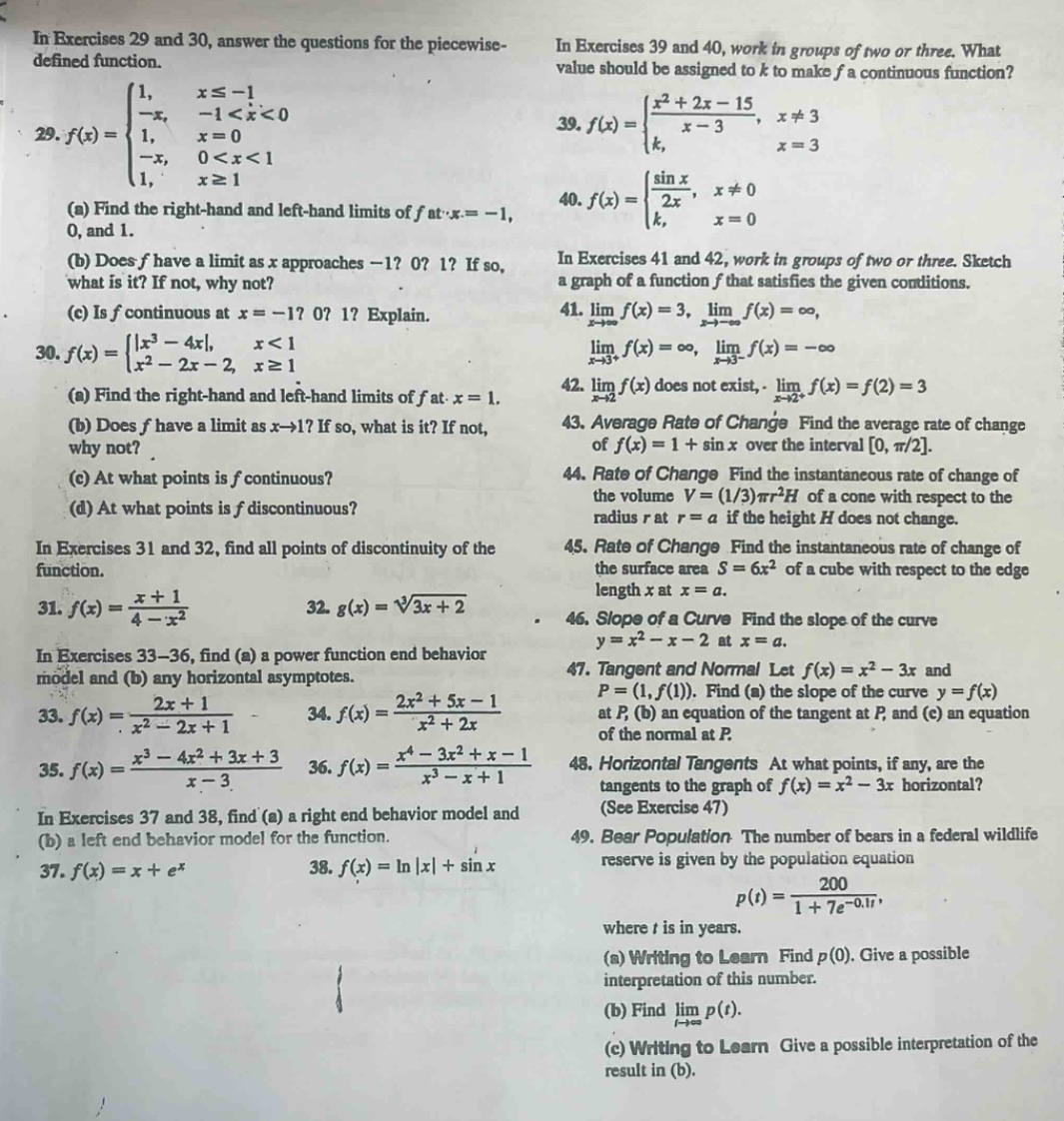
in exercises 29 and 30, answer the questions for the piecewise - defined function.\n29. $f(x)=\\begin{cases}1, & x\\leq - 1 \\ -x, & -1 < x < 0 \\ 1, & x = 0 \\ -x, & 0 < x < 1 \\ 1, & x\\geq1\\end{cases}$\n(a) find the right - hand and left - hand limits of $f$ at $x=-1$, 0, and 1.\n(b) does $f$ have a limit as $x$ approaches $-1$? 0? 1? if so, what is it? if not, why not?\n(c) is $f$ continuous at $x=-1$? 0? 1? explain.\n30. $f(x)=\\begin{cases}|x^{3}-4x|, & x < 1 \\ x^{2}-2x - 2, & x\\geq1\\end{cases}$\n(a) find the right - hand and left - hand limits of $f$ at $x = 1$.\n(b) does $f$ have a limit as $x\\to1$? if so, what is it? if not, why not?\n(c) at what points is $f$ continuous?\n(d) at what points is $f$ discontinuous?\nin exercises 31 and 32, find all points of discontinuity of the function.\n31. $f(x)=\\frac{x + 1}{4 - x^{2}}$ 32. $g(x)=\\sqrt3{3x + 2}$\nin exercises 33 - 36, find (a) a power function end behavior model and (b) any horizontal asymptotes.\n33. $f(x)=\\frac{2x + 1}{x^{2}-2x + 1}$ 34. $f(x)=\\frac{2x^{2}+5x - 1}{x^{2}+2x}$\n35. $f(x)=\\frac{x^{3}-4x^{2}+3x + 3}{x - 3}$ 36. $f(x)=\\frac{x^{4}-3x^{2}+x - 1}{x^{3}-x + 1}$\nin exercises 37 and 38, find (a) a right end behavior model and (b) a left end behavior model for the function.\n37. $f(x)=x + e^{x}$ 38. $f(x)=ln|x|+sin x$\nin exercises 39 and 40, work in groups of two or three. what value should be assigned to $k$ to make $f$ a continuous function?\n39. $f(x)=\\begin{cases}\\frac{x^{2}+2x - 15}{x - 3}, & x\\neq3 \\ k, & x = 3\\end{cases}$\n40. $f(x)=\\begin{cases}\\frac{\\sin x}{2x}, & x\\neq0 \\ k, & x = 0\\end{cases}$\nin exercises 41 and 42, work in groups of two or three. sketch a graph of a function $f$ that satisfies the given conditions.\n41. $\\lim_{x\\to\\infty}f(x)=3$, $\\lim_{x\\to - \\infty}f(x)=\\infty$, $\\lim_{x\\to3^{+}}f(x)=\\infty$, $\\lim_{x\\to3^{-}}f(x)=-\\infty$\n42. $\\lim_{x\\to2^{-}}f(x)$ does not exist, $\\lim_{x\\to2^{+}}f(x)=f(2)=3$\n43. average rate of change find the average rate of change of $f(x)=1+sin x$ over the interval $0,\\pi/2$.\n44. rate of change find the instantaneous rate of change of the volume $v=(1/3)\\pi r^{2}h$ of a cone with respect to the radius $r$ at $r = a$ if the height $h$ does not change.\n45. rate of change find the instantaneous rate of change of the surface area $s = 6x^{2}$ of a cube with respect to the edge length $x$ at $x = a$.\n46. slope of a curve find the slope of the curve $y=x^{2}-x - 2$ at $x = a$.\n47. tangent and normal let $f(x)=x^{2}-3x$ and $p=(1,f(1))$. find (a) the slope of the curve $y = f(x)$ at $p$, (b) an equation of the tangent at $p$, and (c) an equation of the normal at $p$.\n48. horizontal tangents at what points, if any, are the tangents to the graph of $f(x)=x^{2}-3x$ horizontal? (see exercise 47)\n49. bear population the number of bears in a federal wildlife reserve is given by the population equation $p(t)=\\frac{200}{1 + 7e^{-0.1t}}$, where $t$ is in years.\n(a) writing to learn find $p(0)$. give a possible interpretation of this number.\n(b) find $\\lim_{t\\to\\infty}p(t)$.\n(c) writing to learn give a possible interpretation of the result in (b).
Answer
Explanation:
Step1: Analyze problem type
This is a problem about limits and continuity of functions, which is a key - concept in Calculus.
Step2: For Exercise 29(a)
For (x=-1): Right - hand limit (\lim_{x\rightarrow - 1^{+}}f(x)=\lim_{x\rightarrow - 1^{+}}(-x)=1) (since for (-1 < x<0), (f(x)=-x)). Left - hand limit (\lim_{x\rightarrow - 1^{-}}f(x)=1) (since for (x\leq - 1), (f(x) = 1)). For (x = 0): Right - hand limit (\lim_{x\rightarrow0^{+}}f(x)=\lim_{x\rightarrow0^{+}}(-x)=0) (since for (0 < x<1), (f(x)=-x)). Left - hand limit (\lim_{x\rightarrow0^{-}}f(x)=\lim_{x\rightarrow0^{-}}(-x)=0) (since for (-1 < x<0), (f(x)=-x)), but (f(0)=1). For (x = 1): Right - hand limit (\lim_{x\rightarrow1^{+}}f(x)=1) (since for (x\geq1), (f(x)=1)). Left - hand limit (\lim_{x\rightarrow1^{-}}f(x)=\lim_{x\rightarrow1^{-}}(-x)=-1) (since for (0 < x<1), (f(x)=-x)).
Step3: For Exercise 29(b)
At (x=-1), (\lim_{x\rightarrow - 1^{-}}f(x)=\lim_{x\rightarrow - 1^{+}}f(x)=1), so (\lim_{x\rightarrow - 1}f(x)=1). At (x = 0), (\lim_{x\rightarrow0^{-}}f(x)=0) and (f(0)=1), so the limit does not exist as the left - hand limit and the function value at (x = 0) are not equal. At (x = 1), (\lim_{x\rightarrow1^{-}}f(x)=-1) and (\lim_{x\rightarrow1^{+}}f(x)=1), so the limit does not exist.
Step4: For Exercise 29(c)
At (x=-1), (\lim_{x\rightarrow - 1}f(x)=1) and (f(-1)=1), so (f(x)) is continuous at (x=-1). At (x = 0), (\lim_{x\rightarrow0}f(x)) does not exist, so (f(x)) is not continuous at (x = 0). At (x = 1), (\lim_{x\rightarrow1}f(x)) does not exist, so (f(x)) is not continuous at (x = 1).
Answer:
For Exercise 29(a): At (x=-1), right - hand limit is 1, left - hand limit is 1. At (x = 0), right - hand limit is 0, left - hand limit is 0. At (x = 1), right - hand limit is 1, left - hand limit is - 1. For Exercise 29(b): Limit exists at (x=-1) and is 1. Limit does not exist at (x = 0) and (x = 1). For Exercise 29(c): Continuous at (x=-1), not continuous at (x = 0) and (x = 1).