**3. if it exists, determine the equation of the line tangent to the following function at the…
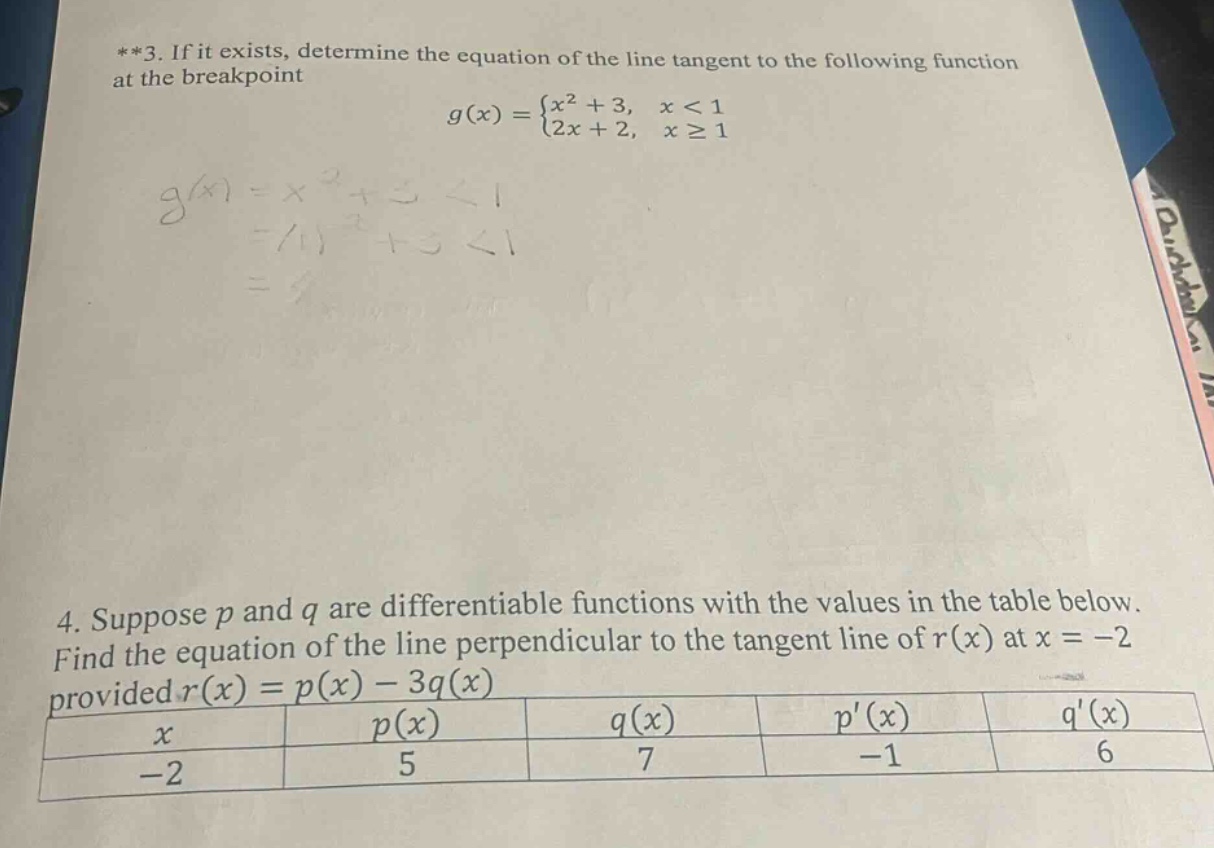
**3. if it exists, determine the equation of the line tangent to the following function at the breakpoint\ng(x)=\begin{cases}x^{2}+3, & x < 1\\2x + 2, & xgeq1end{cases}\n4. suppose (p) and (q) are differentiable functions with the values in the table below. find the equation of the line perpendicular to the tangent line of (r(x)) at (x=-2) provided (r(x)=p(x)-3q(x))\n| (x) | (p(x)) | (q(x)) | (p(x)) | (q(x)) |\n| ---- | ---- | ---- | ---- | ---- |\n| (-2) | (5) | (7) | (-1) | (6) |
Answer
Explanation:
Step1: Check continuity at breakpoint $x = 1$ for $g(x)$
Left - hand limit: $\lim_{x\rightarrow1^{-}}g(x)=\lim_{x\rightarrow1^{-}}(x^{2}+3)=1^{2}+3 = 4$ Right - hand limit: $\lim_{x\rightarrow1^{+}}g(x)=\lim_{x\rightarrow1^{+}}(2x + 2)=2\times1+2=4$ $g(1)=2\times1 + 2=4$. Since $\lim_{x\rightarrow1^{-}}g(x)=\lim_{x\rightarrow1^{+}}g(x)=g(1)$, the function is continuous at $x = 1$.
Step2: Find the left - hand derivative at $x = 1$
For $g(x)=x^{2}+3,x\lt1$, $g'(x)=2x$. So $g'(1^{-})=2\times1 = 2$.
Step3: Find the right - hand derivative at $x = 1$
For $g(x)=2x + 2,x\geq1$, $g'(x)=2$. So $g'(1^{+})=2$. Since $g'(1^{-})=g'(1^{+}) = 2$, the derivative exists at $x = 1$.
Step4: Use point - slope form for tangent line
The point on the function at $x = 1$ is $(1,4)$ and slope $m = 2$. The point - slope form is $y - y_{1}=m(x - x_{1})$. So $y-4=2(x - 1)$. Expanding gives $y-4=2x-2$, or $y=2x + 2$.
Step5: For $r(x)=p(x)-3q(x)$ at $x=-2$
First, find $r'(x)$ using the difference rule: $r'(x)=p'(x)-3q'(x)$. Then $r'(-2)=p'(-2)-3q'(-2)$. Substitute $p'(-2)=-1$ and $q'(-2)=6$: $r'(-2)=-1-3\times6=-1 - 18=-19$. The slope of the line perpendicular to the tangent line of $r(x)$ at $x=-2$ is $\frac{1}{19}$ (since the product of slopes of perpendicular lines is $- 1$). $r(-2)=p(-2)-3q(-2)=5-3\times7=5 - 21=-16$. Using point - slope form $y - y_{1}=m(x - x_{1})$ with point $(-2,-16)$ and slope $\frac{1}{19}$, we have $y+16=\frac{1}{19}(x + 2)$. Expanding gives $y=\frac{1}{19}x+\frac{2}{19}-16=\frac{1}{19}x+\frac{2-304}{19}=\frac{1}{19}x-\frac{302}{19}$.
Answer:
The equation of the tangent line to $g(x)$ at $x = 1$ is $y = 2x+2$. The equation of the line perpendicular to the tangent line of $r(x)$ at $x=-2$ is $y=\frac{1}{19}x-\frac{302}{19}$