explain how the graph of y = -2sin(x) - 1 differs from the parent function. make sure to compare key points…
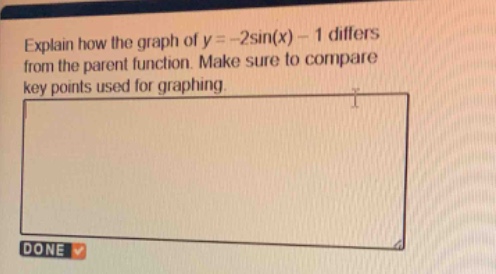
explain how the graph of y = -2sin(x) - 1 differs from the parent function. make sure to compare key points used for graphing.
Answer
Answer:
The graph of (y = - 2\sin(x)-1) differs from the parent - function (y=\sin(x)) in the following ways:
- Amplitude: The amplitude of the parent function (y = \sin(x)) is (A = 1). For the function (y=-2\sin(x)-1), the amplitude is (|A| = 2). This means that the maximum and minimum values of (y=\sin(x)) are (y = 1) and (y=-1) respectively, while for (y=-2\sin(x)-1), the maximum value is (y=-1 + 2=1) and the minimum value is (y=-1-2=-3).
- Reflection: The negative sign in front of the (2) in (y=-2\sin(x)-1) reflects the graph of (y = 2\sin(x)) about the (x) - axis. For (y=\sin(x)), when (x = \frac{\pi}{2}), (y = 1); for (y=-2\sin(x)-1), when (x=\frac{\pi}{2}), (y=-2\times1 - 1=-3).
- Vertical Shift: The (-1) in (y=-2\sin(x)-1) shifts the graph of (y=-2\sin(x)) down by (1) unit. For the parent function (y = \sin(x)), the mid - line is (y = 0). For (y=-2\sin(x)-1), the mid - line is (y=-1).
Some key points for (y=\sin(x)) are:
| (x) | (y=\sin(x)) |
|---|---|
| (0) | (0) |
| (\frac{\pi}{2}) | (1) |
| (\pi) | (0) |
| (\frac{3\pi}{2}) | (-1) |
| (2\pi) | (0) |
For (y=-2\sin(x)-1):
| (x) | (y=-2\sin(x)-1) |
|---|---|
| (0) | (-1) |
| (\frac{\pi}{2}) | (-3) |
| (\pi) | (-1) |
| (\frac{3\pi}{2}) | (1) |
| (2\pi) | (-1) |
Brief Explanations:
We consider the general form of a sinusoidal function (y = A\sin(Bx - C)+D). Here (A) affects amplitude, the sign of (A) causes reflection, and (D) is for vertical shift. We compare key - points of the parent function (y=\sin(x)) and the transformed function (y=-2\sin(x)-1) to show the differences.