explain how the graph of the function f(x) = 7/x can be obtained from the graph of y = 1/x. then graph f and…
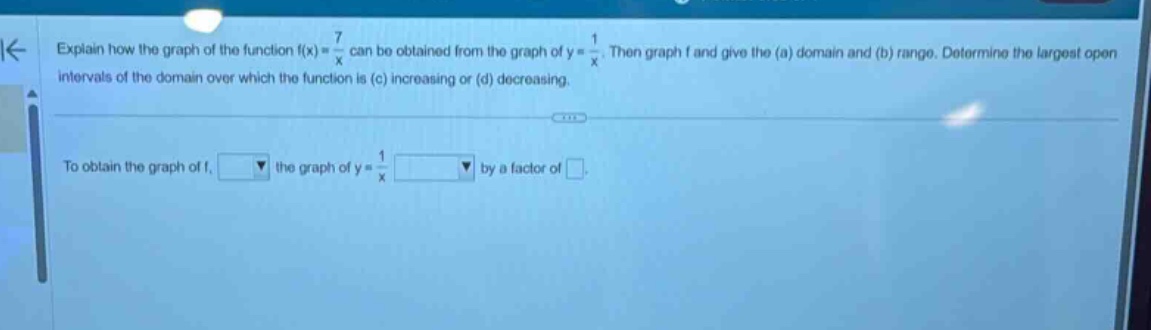
explain how the graph of the function f(x) = 7/x can be obtained from the graph of y = 1/x. then graph f and give the (a) domain and (b) range. determine the largest open intervals of the domain over which the function is (c) increasing or (d) decreasing. to obtain the graph of f, blank the graph of y = 1/x blank by a factor of blank.
Answer
Explanation:
Step1: Recall function - transformation rules
For a function (y = f(x)) and (y=af(x)), if (a>0), it is a vertical - stretch or compression. Here, (f(x)=\frac{7}{x}=7\times\frac{1}{x}), and (a = 7).
Step2: Determine the transformation
To obtain the graph of (y=\frac{7}{x}) from the graph of (y = \frac{1}{x}), we vertically stretch the graph of (y=\frac{1}{x}) by a factor of 7.
For the domain and range: The function (y=\frac{7}{x}) is a rational function. The denominator cannot be zero.
Step3: Find the domain
The domain of (y = \frac{7}{x}) is all real numbers except (x = 0), which can be written in interval notation as ((-\infty,0)\cup(0,\infty)).
Step4: Find the range
The range of (y=\frac{7}{x}) is all real numbers except (y = 0), which can be written in interval notation as ((-\infty,0)\cup(0,\infty)).
To find where the function is increasing or decreasing: We can take the derivative of (y=\frac{7}{x}=7x^{-1}). Using the power - rule ((x^n)^\prime=nx^{n - 1}), we have (y^\prime=-7x^{-2}=-\frac{7}{x^{2}}). Since (y^\prime=-\frac{7}{x^{2}}<0) for all (x\neq0).
Step5: Determine increasing and decreasing intervals
The function (y = \frac{7}{x}) is decreasing on the intervals ((-\infty,0)) and ((0,\infty)) and has no intervals where it is increasing.
Answer:
To obtain the graph of (f), vertically stretch the graph of (y=\frac{1}{x}) by a factor of 7. (a) Domain: ((-\infty,0)\cup(0,\infty)) (b) Range: ((-\infty,0)\cup(0,\infty)) (c) Increasing intervals: None (d) Decreasing intervals: ((-\infty,0)) and ((0,\infty))